Published: 27 July 2026
Choosing the right red team provider means selecting a partner that can realistically simulate sophisticated cyberattacks, uncover attack paths that traditional penetration testing may miss, and provide actionable recommendations that improve your organisation’s cyber resilience. The best providers combine experienced offensive security operators, proven adversary emulation methodologies, high-quality reporting, and industry expertise, not simply vulnerability scanning or checklist-based assessments.
As enterprise organisations face increasingly sophisticated threats from ransomware groups, nation-state actors, and financially motivated attackers, red teaming has become an essential way to validate security controls, detection capabilities, and incident response readiness. However, not all providers deliver the same level of expertise. Differences in operator experience, attack realism, reporting quality, global delivery capability, and post-engagement support can significantly affect the value of an engagement.
This buyer’s guide explains how to choose the right red team provider, the questions every security leader should ask during vendor selection, typical costs and deliverables, and the key characteristics that distinguish experienced enterprise red team providers from traditional penetration testing vendors.
Quick Verdict: Choosing a Red Team Provider
- Best For: Organisations with mature security programmes that want to validate their ability to detect, respond to, and recover from realistic cyberattacks.
- Who Should Consider It? Enterprises, regulated organisations, financial institutions, critical infrastructure providers, SaaS companies, and organisations preparing for compliance or board-level cyber resilience assessments.
- What to Look For: Proven real-world offensive security experience, realistic adversary emulation, custom attack scenarios, executive and technical reporting, global delivery capability, and clear remediation guidance.
- Typical Cost: Enterprise red team engagements typically start from $10,000 and can exceed $40,000+, depending on the objectives, duration, geographic scope, and complexity of the engagement. Learn more about red teaming cost.
- Typical Duration: Most engagements take 2–8 weeks, including planning, adversary simulation, reporting, and executive debriefing.
- Expected Deliverables: Executive summary, technical report, attack-path documentation, MITRE ATT&CK mapping (where applicable), detection and response observations, evidence of exploitation, and prioritised remediation recommendations.
- Key Question to Ask: Can this provider demonstrate real-world offensive security experience and explain how their red team methodology differs from a standard penetration test?
What Is a Red Team Provider?
A Red Team provider is a cybersecurity company that performs offensive security engagements designed to simulate realistic cyberattacks against an organization.
Unlike traditional penetration testing providers, Red Team providers evaluate how attackers can combine weaknesses across people, processes, and technology to achieve business objectives while avoiding detection.
Enterprise Red Team engagements commonly simulate:
- External attackers targeting internet-facing assets
- Credential theft and phishing campaigns
- Cloud identity compromise
- Active Directory and Microsoft Entra ID attacks
- Lateral movement across enterprise environments
- Privilege escalation
- Business email compromise (BEC)
- Sensitive data access and simulated exfiltration
- Security Operations Center (SOC) detection and response validation
Rather than focusing solely on technical vulnerabilities, Red Team providers assess an organization’s overall cyber resilience.
If you’re new to offensive security, our guide to Enterprise Red Team Services explains how Red Team engagements differ from traditional penetration testing.
Why Choosing the Right Provider Matters
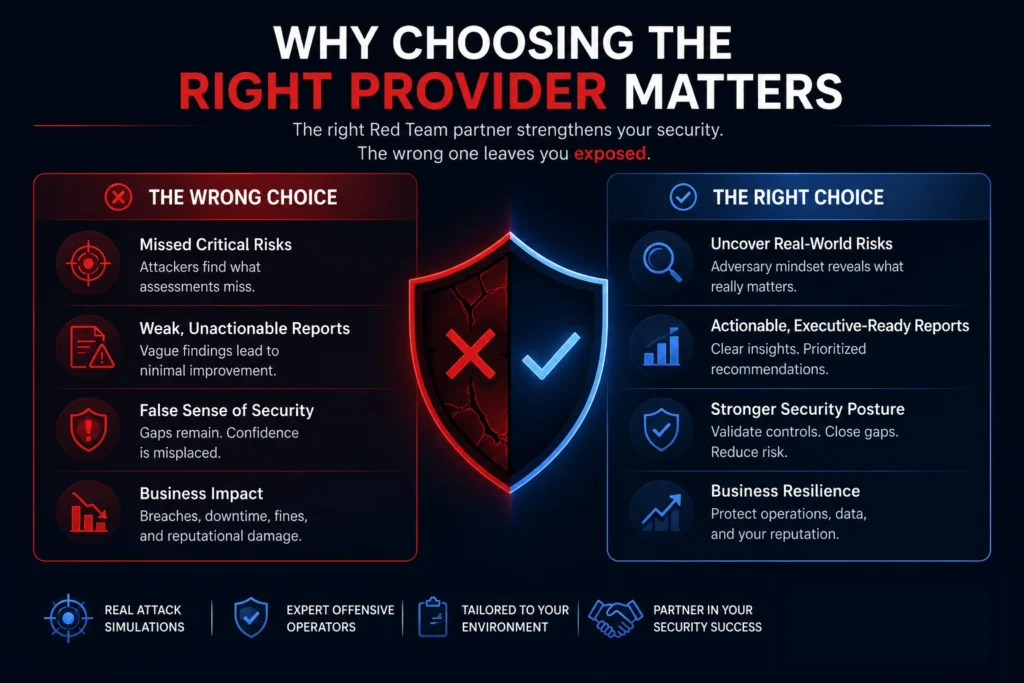
Not every Red Team engagement delivers the same value.
Some providers rely heavily on automated tooling and predefined playbooks, while others use experienced operators who adapt tactics based on the target environment, closely mirroring how real adversaries behave.
The right provider should help you answer questions such as:
- Can attackers compromise our cloud environment?
- Would our SOC detect lateral movement?
- Can our identity controls stop privilege escalation?
- Could attackers reach sensitive business systems?
- How effective is our incident response capability?
A high-quality engagement provides actionable answers—not just a list of vulnerabilities.
Organizations often combine Continuous Red Teaming Services with periodic Red Team engagements to validate security controls throughout the year.
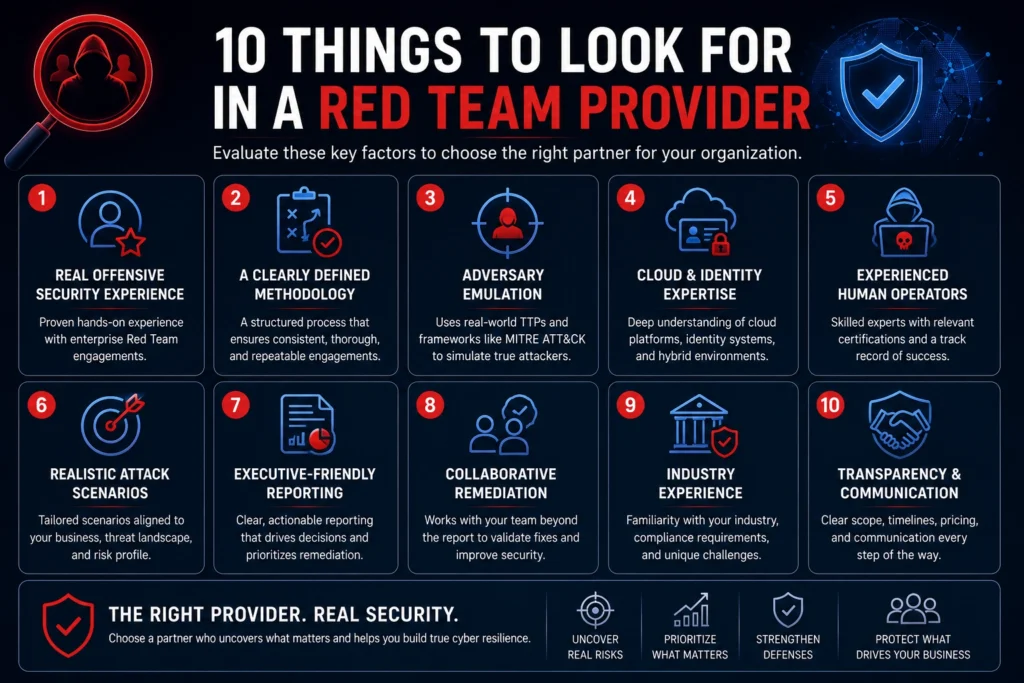
10 Things to Look for in a Red Team Provider
1. Real Offensive Security Experience
Look for consultants with extensive hands-on experience conducting enterprise Red Team engagements across cloud, identity, applications, and hybrid environments.
Experienced operators understand how attackers chain multiple weaknesses together to achieve meaningful objectives rather than focusing on isolated exploits.
2. A Clearly Defined Methodology
Ask potential providers how they plan and execute Red Team engagements.
A mature methodology should include:
- Planning and scoping
- Threat modeling
- Reconnaissance
- Initial access
- Privilege escalation
- Lateral movement
- Objective execution
- Reporting and remediation
A structured process produces consistent and measurable results.
3. Adversary Emulation
The best Red Team providers emulate real-world threat actors using tactics, techniques, and procedures (TTPs) aligned with frameworks such as MITRE ATT&CK.
Rather than performing generic testing, they replicate the behavior of ransomware groups, advanced persistent threats (APTs), and financially motivated attackers.
4. Cloud and Identity Expertise
Modern enterprise attacks frequently target identity platforms and cloud environments.
Ensure your provider has demonstrated experience assessing:
- Microsoft Entra ID
- Active Directory
- AWS
- Microsoft Azure
- Google Cloud Platform
- Microsoft 365
- SaaS applications
Cloud-native expertise is essential for accurately simulating today’s attack paths.
Many organizations also perform Digital Red Teaming Services to evaluate cloud environments, SaaS applications, identity platforms, and internet-facing infrastructure.
5. Experienced Human Operators
Automated tools play an important role in offensive security, but they cannot replace experienced Red Team consultants.
Look for providers whose operators hold respected industry certifications such as:
- OSCP
- OSCE
- CRTO
- CRTP
- CREST certifications
Equally important is proven experience performing enterprise engagements.
6. Realistic Attack Scenarios
Every organization faces different threats.
A strong provider should tailor attack scenarios to your business rather than relying on generic testing templates.
Examples include:
- Ransomware simulation
- Insider threat
- Business email compromise
- Cloud compromise
- AI application attacks
- Supply chain compromise
- Credential theft
- Privileged identity abuse
Some organizations complement human-led Red Team exercises with Breach and Attack Simulation (BAS) Services for continuous security validation.
7. Executive-Friendly Reporting
An effective Red Team report should be useful for both technical teams and executive leadership.
Deliverables should typically include:
- Executive summary
- Attack narrative
- Technical findings
- MITRE ATT&CK mapping
- Business impact
- Risk prioritization
- Remediation roadmap
Clear reporting helps security teams focus on the issues that matter most.
8. Collaborative Remediation
The engagement shouldn’t end when the report is delivered.
Leading providers work closely with security teams to explain findings, validate fixes, answer technical questions, and support remediation planning.
9. Industry Experience
Organizations in healthcare, financial services, manufacturing, government, and critical infrastructure often face unique regulatory and operational challenges.
Choosing a provider familiar with your industry can improve the relevance and effectiveness of the engagement.
Organizations deploying generative AI applications should also consider specialized AI Red Teaming Services to assess prompt injection, AI agent abuse, and LLM-specific attack vectors.
10. Transparency
A trustworthy Red Team provider should clearly explain:
- Scope
- Objectives
- Rules of engagement
- Communication procedures
- Deliverables
- Timeline
- Pricing model
Transparency helps build confidence before the engagement begins.
Working through procurement or an RFP? Use our Red Team Vendor Evaluation Checklist to score each vendor against these criteria.
Questions to Ask Before Hiring a Red Team Provider
Before selecting a provider, consider asking:
- How many enterprise Red Team engagements have you completed?
- Which industries do you specialize in?
- What certifications do your consultants hold?
- How do you tailor engagements to different environments?
- Which frameworks guide your methodology?
- What reporting will we receive?
- How do you validate remediation?
- Can you assess cloud-native and hybrid environments?
- How do you ensure testing remains safe and controlled?
- Can you provide anonymized examples of previous engagements?
These questions help differentiate experienced providers from those offering generic offensive security services.
Red Flags to Watch Out For
When evaluating providers, be cautious if they:
- Promise unrealistic outcomes or guaranteed breaches
- Offer one-size-fits-all engagements
- Depend entirely on automated tools
- Cannot clearly explain their methodology
- Provide vague reporting examples
- Lack experience in enterprise environments
- Focus only on technical vulnerabilities without evaluating detection and response
A Red Team engagement should provide meaningful insights—not simply demonstrate that vulnerabilities exist.
If you’re unsure whether your organization actually needs a Red Team engagement, our Red Team Audit guide explains when these assessments provide the greatest value.
Why Enterprise Organizations Choose Bluefire Redteam
Bluefire Redteam specializes in enterprise offensive security assessments designed to emulate realistic adversaries across cloud, identity, applications, and hybrid environments.
Our engagements focus on measuring real-world cyber resilience by validating how effectively organizations can detect, respond to, and recover from sophisticated attacks.
Clients choose Bluefire Redteam because we provide:
- Experienced offensive security consultants
- Tailored adversary simulations
- Cloud and identity security expertise
- Executive and technical reporting
- Actionable remediation guidance
- Collaborative post-engagement support
Our objective is not simply to identify weaknesses, but to help organizations strengthen their overall security posture.
Our Case Study:
Read more: Red Team Case Study: How One Web Flaw Exposed a Global Travel Company’s Entire Cloud Estate
Frequently Asked Questions - Red Team Provider
- What should I look for in a Red Team provider?Look for proven offensive security experience, a structured methodology, realistic adversary emulation, cloud and identity expertise, clear reporting, and collaborative remediation support.
- How do I compare Red Team providers?Evaluate providers based on experience, technical capabilities, certifications, methodology, reporting quality, customer references, and their ability to tailor engagements to your organization.
- Are certifications important?Yes, but certifications should complement—not replace—real-world experience. Providers with recognized offensive security certifications and a history of enterprise engagements are generally better positioned to deliver meaningful assessments.
- Should my Red Team provider understand cloud security?Absolutely. Modern attacks frequently target cloud infrastructure, identity platforms, and SaaS environments. Cloud expertise is essential for realistic Red Team engagements.
- How often should organizations evaluate their Red Team provider?Organizations should review providers periodically and whenever major business, infrastructure, or regulatory changes occur to ensure engagements remain aligned with current risks.
Before selecting a provider, you may also find these resources helpful:
Choose a Red Team Provider That Delivers More Than a Report
A Red Team engagement is an investment in your organization’s cyber resilience. Choosing the right provider ensures you receive realistic attack simulations, actionable findings, and strategic guidance that helps strengthen your defenses—not just another list of vulnerabilities.
Whether you’re planning your first Red Team engagement or reassessing your current provider, selecting a partner with proven enterprise experience can make a measurable difference in your security outcomes.
Ready to evaluate your organization’s resilience? Contact Bluefire Redteam to discuss your next Red Team engagement.