During a real-world enterprise red team engagement, Bluefire Redteam exploited a publicly accessible web vulnerability to compromise cloud infrastructure, business applications, and corporate email—all within a single attack chain. This case study explains how the attack succeeded and the security improvements that prevented it from happening again.
Engagement Snapshot
- Industry: Global travel & hospitality technology / digital marketing
- Engagement type: Black-box external red team — full kill-chain (web → cloud → SaaS → human)
- Scope: Corporate group and multiple subsidiaries (wildcard)
- Headline result: One web flaw → full cloud, SaaS, and identity compromise, undetected
- Findings: 17 (6 critical)
The one-line version: the client didn’t have a “hacker” problem — they had an exposure problem. One input-validation bug, long-lived secrets behind it, over-privileged access, and no monitoring. Individually ordinary. Chained together, catastrophic.
The challenge
Our client — a global travel-technology company operating several consumer and B2B brands — engaged Bluefire for an intelligence-led red team engagement. The mandate was simple to state and hard to answer:
“If a motivated attacker targeted us today, could they reach what matters most, and would we even know?”
Like many fast-scaling technology groups, the client’s attack surface had grown faster than its inventory of it. Multiple subsidiaries, a heavy cloud footprint, and a sprawling SaaS estate meant the real perimeter was far larger and less understood than any single asset list suggested. They wanted the truth, delivered the way a real adversary would find it: no credentials, no insider knowledge, no assumptions.
Our approach
Bluefire ran the engagement black-box and external, starting from zero access — exactly where an internet-based attacker starts. Our senior-only operators worked two tracks in parallel:
- Technical exploitation of the in-scope web, cloud, and SaaS surface.
- Social engineering, to test the human layer under realistic conditions.
Every action was mapped to the MITRE ATT&CK framework and structured along the cyber kill chain. Where an action would have disrupted production or harmed individuals, our operators stopped at the safe limit and documented the proven capability instead of executing it — the discipline that separates a professional adversary simulation from a reckless one.
What we found
One web flaw became the master key
The engagement began with a single Local File Inclusion (LFI) vulnerability on an internet-facing application. It required no login. By exploiting it, our operators read the application’s own source code — and inside that source were hardcoded credentials: long-lived keys and passwords for the company’s most important systems.
That one flaw turned a read-only bug into a full credential compromise.
From one bug to the entire estate
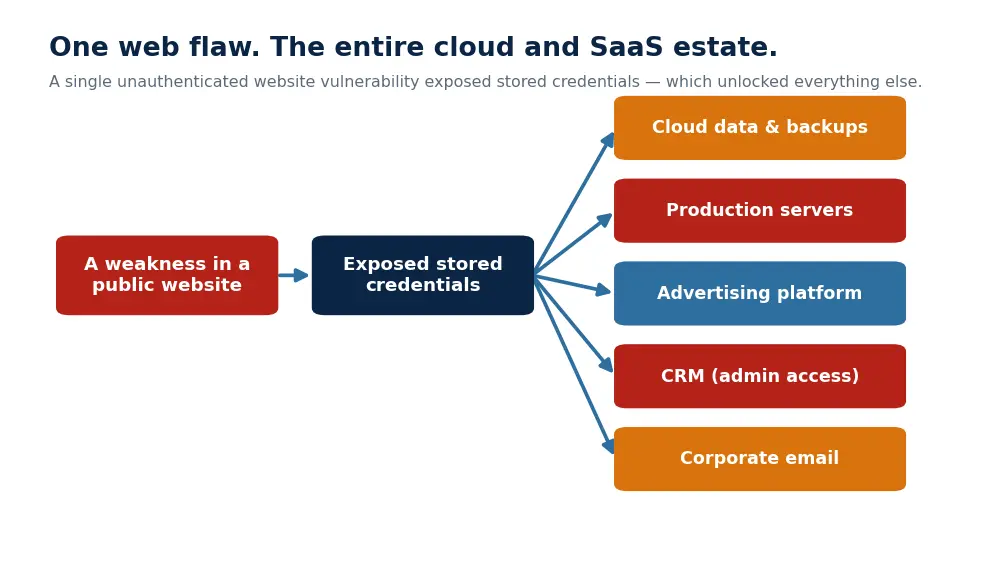
Using only the secrets recovered from that single application, our operators reached:
- The cloud data warehouse — over 100 datasets of advertising, tracking, and audience data, plus downloadable production database backups.
- A production server — with the ability to take interactive control (demonstrated, not executed).
- The advertising manager account — visibility into client campaigns and spend.
- The CRM, as a System Administrator — the full sales pipeline, and more secrets stored inside it.
- Corporate email — the ability to send and read mail as a legitimate employee.
- Partner data — sensitive commercial information belonging to a third party.
The human layer fell just as fast
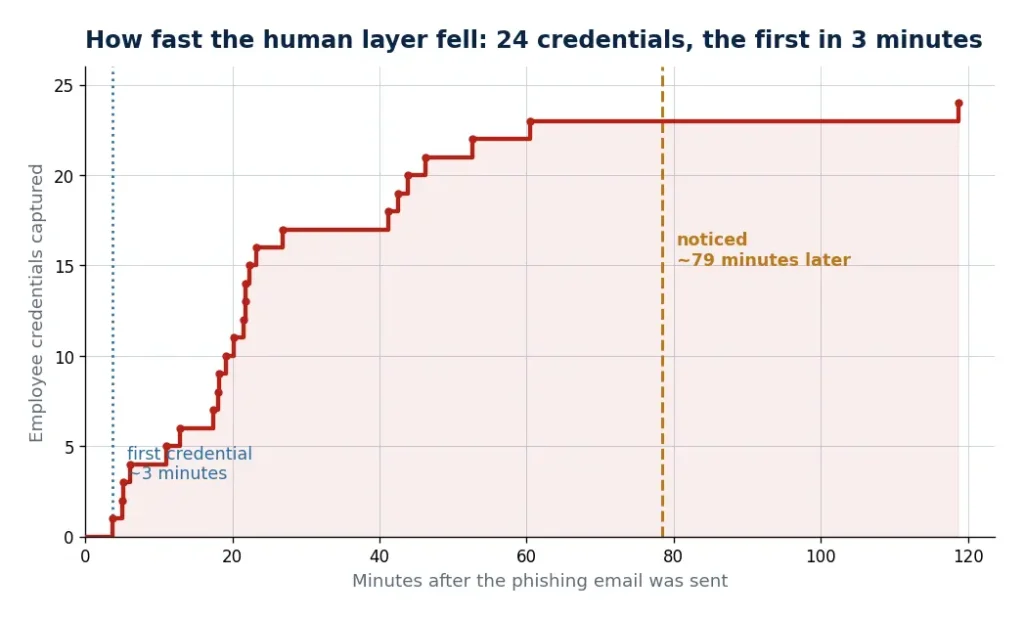
Separately, our team ran an authorized phishing campaign built around a plausible “account migration” theme. Crucially, it was sent from a mailbox the operators had already compromised — so it looked completely internal. The result:
- 24 employee credentials captured — the first within three minutes of the email being sent.
- The activity wasn’t noticed by the security team for over an hour — long after the damage was done.
Nobody was watching
The most important finding wasn’t any single vulnerability. It was that the technical attack chain generated no alerts at all. Across roughly four hours spanning web exploitation, credential theft, cloud enumeration, and bulk data access, the client’s monitoring caught none of it.
The business impact
Translated out of security jargon, the access we achieved would let a real attacker:
- Trigger a data breach of customer, partner, and employee information — with the regulatory and contractual fallout that follows.
- Disrupt production systems, the profile of a ransomware or extortion event.
- Commit invoice fraud and executive impersonation from trusted, legitimate email addresses.
- Operate undetected for an extended period, with all the time needed to exfiltrate data and establish persistence.
The outcome
The value of a red team engagement isn’t the break-in — it’s what changes afterward. Bluefire delivered:
- A prioritized remediation plan (P1–P4) with engineer-grade, step-by-step fixes and a clear owner for every item.
- A plain-language attack-path explanation for leadership, and a credential-rotation guide for the technical team.
- A detection roadmap mapping each attacker action to the alert that should have fired.
Because the root causes were well-understood controls — strong authentication, secrets management, least-privilege access, and monitoring — the highest-impact fixes were achievable in days, and the structural work in weeks. The client left with a plan they could fund and execute, not a list of problems.
Why this matters for every scaling tech company
This engagement is a textbook example of a pattern we see constantly: modern breaches rarely require a sophisticated exploit. They require the patient chaining of ordinary weaknesses — an exposed service, a secret in source code, an over-privileged identity, and a blind spot in monitoring.
If your organization has grown quickly, runs across multiple cloud and SaaS platforms, or has acquired subsidiaries with their own security postures, the same conditions almost certainly exist somewhere in your estate. The only way to know is to look — the way an attacker would.
About Bluefire Redteam
Bluefire Redteam is a senior-only, AI-augmented offensive security firm. We deliver red teaming, adversary simulation, cloud and application penetration testing, and social-engineering assessments for BFSI, enterprise, and government clients worldwide. Every engagement is run by experienced operators and human-adjudicated — no junior hands, no black-box tooling passed off as expertise.
See what an attacker sees — before they do
Most organizations discover this class of exposure the hard way. You don’t have to.
Book a red team scoping call with Bluefire and we’ll map how a real adversary would target your business — and exactly what to fix first.
Frequently asked questions - Red Team Engagement
- What is a red team engagement?
A red team engagement is a full-scope, objective-based simulation of a real attacker. Rather than listing vulnerabilities, it tests whether a motivated adversary can reach your most critical assets — across technology, cloud, and people — and whether your team detects and responds in time.
- How is red teaming different from penetration testing?A penetration test finds and reports vulnerabilities in a defined scope. A red team engagement is goal-driven: it chains weaknesses together to reach a real-world objective (like your crown-jewel data) and measures your detection and response along the way. Red teaming answers "could we be breached, and would we know?" rather than "what bugs exist here?"
- How can a single vulnerability lead to full compromise?When a low-level flaw exposes stored credentials, and those credentials are long-lived and over-privileged, one bug becomes many. As this case shows, an exposed web weakness plus secrets in source code plus broad access plus no monitoring is enough to reach an entire cloud and SaaS estate.
- How long does a red team engagement take?Timelines vary with scope, but most external red team engagements run a few weeks end to end, including reconnaissance, exploitation, reporting, and a remediation debrief. In this case, initial access was achieved in under an hour of active testing.
- What's the ROI of a red team engagement?The investment is a scoped, one-time cost your teams can largely act on in-house. The cost of not doing it — breach response, regulatory penalties, downtime, and lost trust — is open-ended and recurring. Red teaming is one of the highest-leverage risk-reduction investments a security program can make.