Published: 27 July 2026
What Is a Red Team Audit?
A Red Team Audit evaluates how well your organization can withstand these real-world attack scenarios by simulating sophisticated adversaries in a controlled environment.
Unlike traditional security assessments that focus on identifying vulnerabilities, a Red Team Audit measures your organization’s ability to prevent, detect, respond to, and recover from realistic cyberattacks.
The objective isn’t simply to discover weaknesses, it’s to answer a far more important question:
Could an attacker successfully compromise our business, and would we detect them before they achieved their objectives?
For organizations operating in cloud, hybrid, or highly regulated environments, Red Team Audits have become an essential component of modern cybersecurity programs.
Why Organizations Conduct Red Team Audits
Many organizations invest heavily in cybersecurity technologies, including firewalls, endpoint detection and response (EDR), identity protection, SIEM platforms, and cloud security tools.
However, deploying security controls doesn’t automatically mean they’re effective.
Questions security leaders commonly ask include:
- Can our SOC detect lateral movement?
- Would our EDR identify credential theft?
- Can attackers bypass our email security?
- Are our cloud identities adequately protected?
- Would privileged accounts be abused without detection?
- Could sensitive data be exfiltrated before our incident response team reacts?
A Red Team Audit answers these questions by validating security controls under realistic attack conditions.
Rather than relying on theoretical assumptions, organizations gain measurable evidence of how their security program performs against modern adversary techniques.
While ‘Red Team Audit’ is not a formal industry standard, many organizations use the term to describe an independent Red Team engagement that evaluates how effectively people, processes, and technology withstand realistic cyberattacks.
What Is a Red Team Audit?
A Red Team Audit is an independent offensive security assessment that simulates real-world attackers attempting to compromise an organization’s people, processes, and technology.
Unlike vulnerability assessments or penetration tests that evaluate individual systems, Red Team Audits focus on complete attack paths.
Typical objectives include:
- Obtaining privileged access
- Compromising Active Directory or Microsoft Entra ID
- Accessing sensitive business data
- Bypassing endpoint detection
- Testing phishing resilience
- Evaluating cloud security
- Measuring Security Operations Center (SOC) performance
- Assessing incident response capabilities
Throughout the engagement, experienced Red Team operators emulate the tactics, techniques, and procedures (TTPs) used by ransomware groups, advanced persistent threats (APTs), and financially motivated cybercriminals.
The goal is not simply to exploit vulnerabilities—but to understand whether your organization can detect and stop a determined attacker.
Understand the factors that influence Red Team engagement pricing.
What Does a Red Team Audit Evaluate?
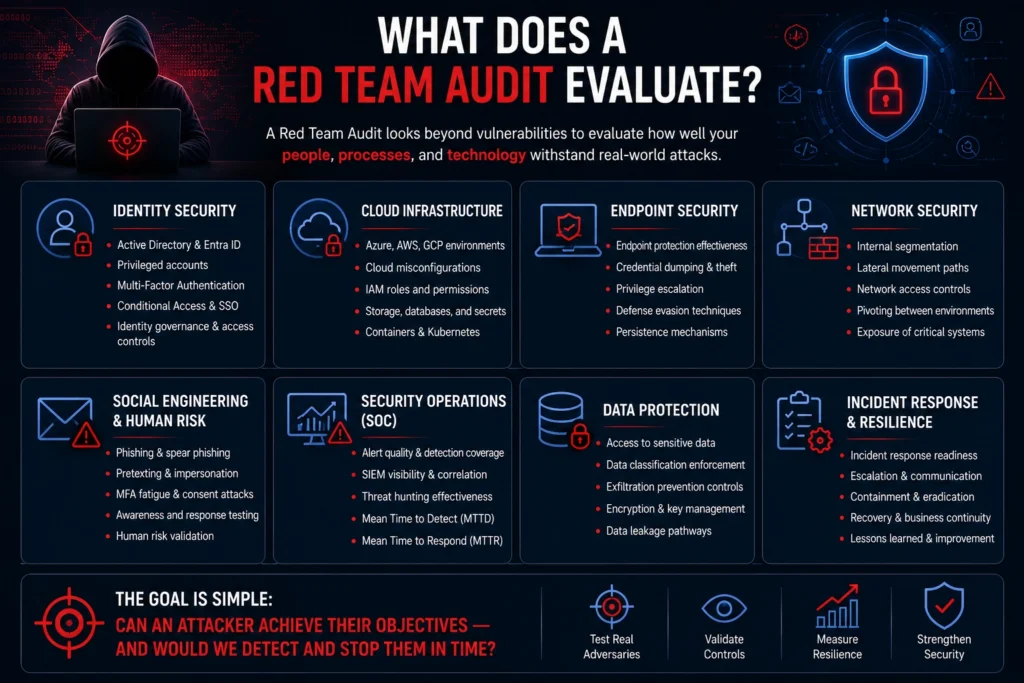
Unlike traditional security assessments, Red Team Audits evaluate cybersecurity as a complete ecosystem.
Common assessment areas include:
Identity Security
Identity remains one of the most targeted attack vectors.
Audits often evaluate:
- Microsoft Entra ID
- Active Directory
- Multi-Factor Authentication (MFA)
- Conditional Access
- Privileged accounts
- Identity governance
- Single Sign-On (SSO)
Cloud Infrastructure
Modern organizations rely heavily on cloud platforms.
Red Team Audits frequently assess:
- Microsoft Azure
- Amazon Web Services (AWS)
- Google Cloud Platform (GCP)
- Microsoft 365
- Kubernetes
- SaaS applications
- Cloud Identity and Access Management (IAM)
Endpoint Security
Endpoint controls are validated against realistic attacker behavior, including:
- Credential dumping
- Privilege escalation
- Defense evasion
- Persistence techniques
- Living-off-the-land attacks
The objective is determining whether endpoint protection platforms detect sophisticated attacker activity.
Network Security
Organizations frequently assume internal networks are adequately segmented.
Red Team Audits validate whether attackers can:
- Move laterally
- Escalate privileges
- Pivot between environments
- Reach critical systems
- Access sensitive resources
Security Operations
Perhaps the most valuable aspect of a Red Team Audit is evaluating defensive operations.
Assessments commonly measure:
- Alert quality
- SIEM visibility
- Threat hunting
- Detection engineering
- Incident response
- Mean Time to Detect (MTTD)
- Mean Time to Respond (MTTR)
These insights help organizations improve both technology and operational processes.
How a Red Team Audit Works
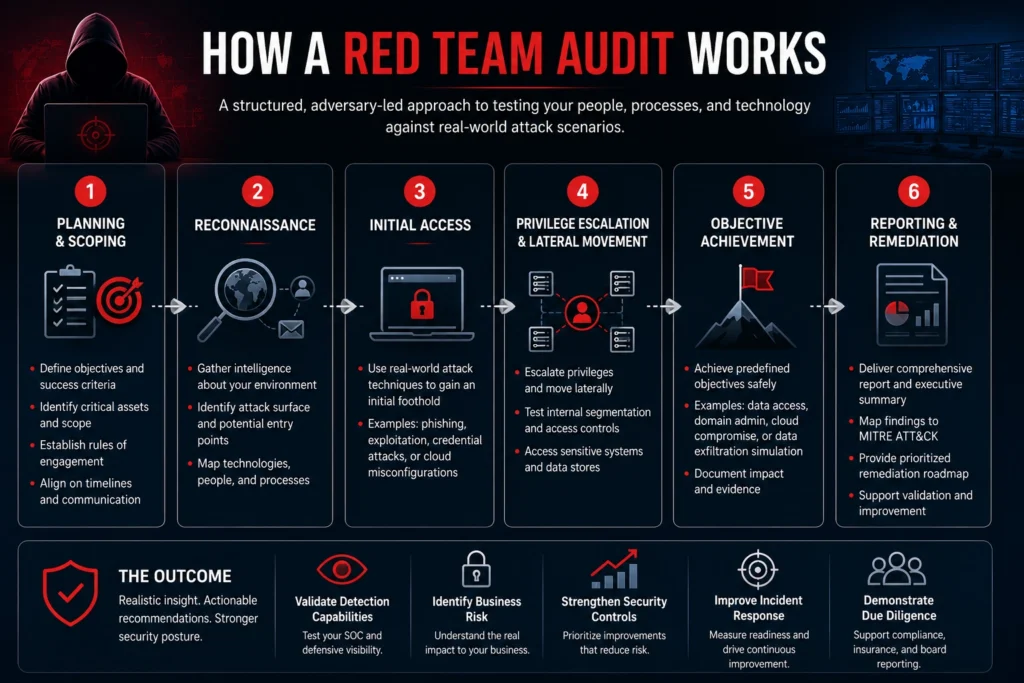
Although every engagement is tailored to the organization, most follow a structured methodology.
Phase 1: Planning & Scoping
The engagement begins by defining clear objectives.
This includes identifying:
- Critical assets
- Business priorities
- Rules of engagement
- Testing boundaries
- Success criteria
- Threat scenarios
Well-defined scope ensures the assessment delivers meaningful results while minimizing operational risk.
Phase 2: Reconnaissance
Red Team operators collect intelligence about the target environment using techniques similar to those employed by real attackers.
This may involve:
- Open-source intelligence (OSINT)
- Attack surface discovery
- Cloud reconnaissance
- Identity enumeration
- Technology fingerprinting
Reconnaissance enables realistic attack planning before any exploitation begins.
Phase 3: Initial Access
The Red Team attempts to gain an initial foothold using approved attack scenarios.
Examples include:
- External compromise
- Credential attacks
- Phishing simulations
- Web application exploitation
- Cloud misconfiguration abuse
The specific techniques used depend on the agreed engagement objectives.
Phase 4: Privilege Escalation & Lateral Movement
Once access is established, operators simulate the behavior of advanced threat actors by attempting to:
- Escalate privileges
- Access additional systems
- Move laterally across the environment
- Identify sensitive assets
- Reach business-critical resources
These activities evaluate the effectiveness of internal segmentation, identity controls, and detection capabilities.
Phase 5: Objective Achievement
Rather than causing disruption, the engagement concludes when predefined objectives are safely demonstrated.
Examples include:
- Access to sensitive information
- Simulated data exfiltration
- Domain administrator privileges
- Cloud tenant compromise
- Business application access
This demonstrates the potential business impact without exposing the organization to unnecessary risk.
Phase 6: Reporting & Remediation
Every Red Team Audit concludes with comprehensive reporting.
Typical deliverables include:
- Executive summary
- Attack narrative
- Timeline of attacker activity
- MITRE ATT&CK mapping
- Security control evaluation
- Technical findings
- Business risk assessment
- Prioritized remediation roadmap
The report provides actionable guidance for executives, security teams, and technical stakeholders.
Why Red Team Audits Matter More Than Ever
Today’s attack surface is significantly larger than it was just a few years ago.
Organizations now manage:
- Hybrid workforces
- Cloud-native infrastructure
- SaaS ecosystems
- AI-powered applications
- Third-party integrations
- Complex identity environments
Every new technology introduces additional opportunities for attackers.
A Red Team Audit helps organizations validate that their security investments continue to perform as the environment evolves, providing confidence that defensive controls, people, and processes work together under realistic attack conditions.
Learn how BAS complements human-led Red Team engagements through continuous security validation.
Red Team Audit vs. Penetration Testing
Although the terms are sometimes used interchangeably, a Red Team Audit and a penetration test serve different purposes.
A penetration test focuses on identifying and exploiting technical vulnerabilities within a defined scope, such as a web application, network, cloud environment, or API. The goal is to discover weaknesses before attackers do.
A Red Team Audit takes a broader, adversarial approach. Instead of simply finding vulnerabilities, it evaluates whether an attacker could achieve meaningful business objectives while remaining undetected.
| Red Team Audit | Penetration Testing |
|---|---|
| Simulates realistic attackers | Identifies technical vulnerabilities |
| Tests people, processes, and technology | Focuses on specific systems or applications |
| Measures detection and response capabilities | Measures exploitability |
| Goal-oriented engagements | Vulnerability-oriented engagements |
| Often lasts several weeks | Typically completed within days or weeks |
| Executive and operational insights | Primarily technical findings |
Many mature organizations perform both. Penetration testing helps identify vulnerabilities, while Red Team Audits validate whether those vulnerabilities could actually lead to a successful compromise.
If you’re ready to simulate real-world cyberattacks, explore our Enterprise Red Team Services.
Red Team Audit vs. Vulnerability Assessment
A vulnerability assessment is designed to identify known security weaknesses using automated tools and manual validation.
A Red Team Audit goes much further.
Rather than asking:
“What vulnerabilities exist?”
It asks:
“Can those vulnerabilities be chained together to compromise critical business assets?”
For example, a vulnerability assessment may identify:
- Weak password policies
- Missing patches
- Misconfigured cloud resources
- Outdated software
A Red Team Audit evaluates whether those weaknesses can be combined to:
- Obtain privileged access
- Compromise Microsoft Entra ID or Active Directory
- Access sensitive business data
- Evade detection
- Achieve ransomware objectives
This provides a much more realistic understanding of organizational cyber resilience.
Who Should Conduct a Red Team Audit?
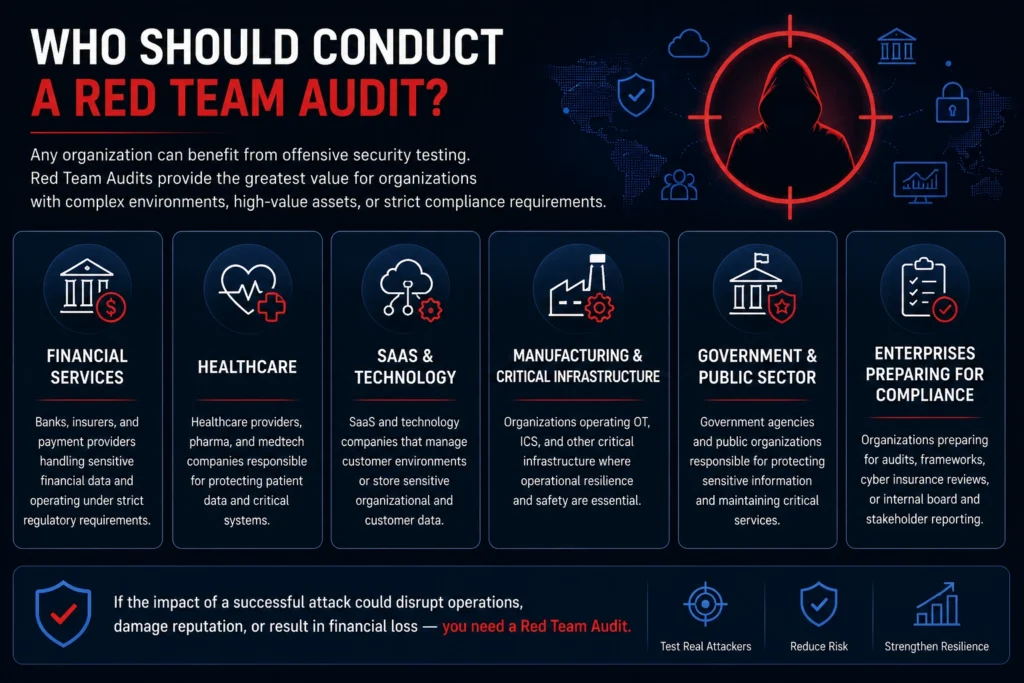
While every organization benefits from offensive security testing, Red Team Audits provide the greatest value for organizations with mature security programs or high-value digital assets.
Organizations that commonly perform Red Team Audits include:
Financial Services
Banks, insurance providers, and payment processors handling sensitive financial information and operating under strict regulatory requirements.
Healthcare
Hospitals, healthcare providers, pharmaceutical companies, and medical technology organizations responsible for protecting patient data and critical systems.
SaaS & Technology Companies
Organizations delivering cloud-native applications or managing sensitive customer environments.
Manufacturing & Critical Infrastructure
Companies operating operational technology (OT), industrial control systems (ICS), and other critical infrastructure where operational resilience is essential.
Government & Public Sector
Government agencies and public organizations responsible for protecting sensitive information and maintaining critical services.
Enterprises Preparing for Compliance
Organizations preparing for:
- PCI DSS assessments
- SOC 2 audits
- ISO 27001 certification
- NIS2 readiness
- Internal board reporting
- Cyber insurance assessments
A Red Team Audit provides independent validation that security controls perform effectively under realistic attack scenarios.
Organizations seeking ongoing validation should consider Continuous Red Teaming.
How to Choose the Right Red Team Provider
Not all Red Team providers deliver the same level of expertise.
Choosing the right partner requires more than comparing pricing.
Consider the following factors:
Proven Offensive Security Experience
Look for providers with demonstrated experience conducting enterprise Red Team engagements across cloud, identity, applications, and hybrid environments.
Realistic Adversary Simulation
The engagement should emulate modern threat actors using current tactics, techniques, and procedures (TTPs), rather than relying solely on automated tools.
Clear Methodology
Ask how engagements are planned, executed, documented, and reported.
A structured methodology helps ensure consistency and measurable outcomes.
Actionable Reporting
High-quality reports should provide:
- Executive summaries
- Technical findings
- MITRE ATT&CK mapping
- Business impact
- Prioritized remediation guidance
Reports should be valuable to executives, security teams, and technical stakeholders alike.
See the reports and executive summaries included in a typical Red Team engagement.
Collaborative Remediation
A strong Red Team provider doesn’t simply identify weaknesses—they help your organization understand, prioritize, and address them.
Common Mistakes Organizations Make
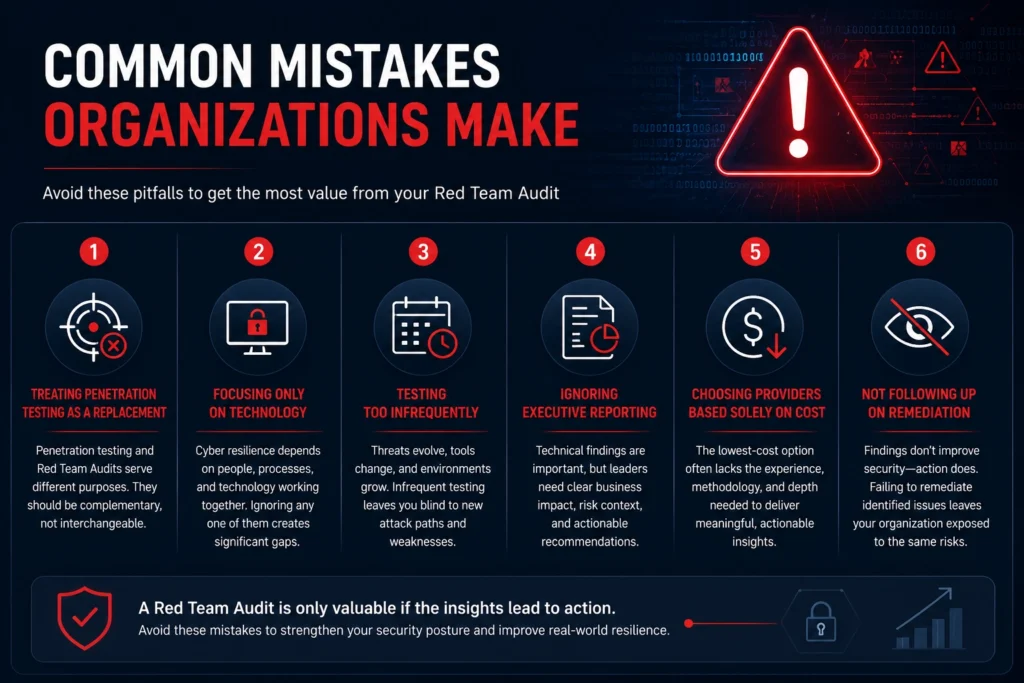
Many organizations invest significantly in cybersecurity but still struggle to accurately assess their resilience.
Common mistakes include:
Treating Penetration Testing as a Replacement
Penetration testing and Red Team Audits answer different questions and should be viewed as complementary assessments.
Focusing Only on Technology
Effective cybersecurity depends on people, processes, and technology working together.
Red Team Audits evaluate all three.
Testing Too Infrequently
Infrastructure, cloud environments, identities, and business applications evolve continuously.
Periodic validation helps ensure security controls remain effective over time.
Ignoring Executive Reporting
Technical findings are important, but leadership also needs to understand business risk, potential impact, and strategic priorities.
Choosing Providers Based Solely on Cost
The lowest-cost engagement may not provide the depth, expertise, or actionable insights required to improve organizational resilience.
Frequently Asked Questions - Red Team Audit
- What is the purpose of a Red Team Audit?A Red Team Audit validates an organization's ability to detect, respond to, and withstand realistic cyberattacks by simulating sophisticated adversaries.
- How often should a Red Team Audit be performed?Most enterprise organizations perform Red Team Audits annually or after significant changes to infrastructure, cloud environments, identity systems, or business-critical applications.
- Does a Red Team Audit replace penetration testing?No. Penetration testing identifies vulnerabilities, while a Red Team Audit evaluates whether attackers could successfully exploit those vulnerabilities to achieve meaningful business objectives.
- How long does a Red Team Audit take?The duration depends on the scope and objectives. Enterprise engagements typically range from several weeks to multiple months for larger environments.
- What frameworks are commonly used?Many Red Team engagements align with the MITRE ATT&CK framework to emulate real-world adversary behavior and provide consistent reporting.
- What deliverables should I expect?Typical deliverables include an executive summary, attack narrative, technical findings, MITRE ATT&CK mapping, evidence, business risk assessment, and prioritized remediation recommendations.
Final Thoughts
Cybersecurity isn’t just about finding vulnerabilities—it’s about understanding whether your organization can withstand a determined attacker.
A Red Team Audit provides that perspective by validating your people, processes, and technology against realistic attack scenarios. Rather than relying on assumptions, organizations gain measurable insight into how their security controls perform under pressure and where improvements will have the greatest impact.
For organizations seeking to strengthen cyber resilience, improve detection capabilities, and validate security investments, a Red Team Audit is one of the most effective ways to assess real-world readiness.
Ready to Validate Your Security Against Real Attackers?
Bluefire Redteam delivers enterprise Red Team engagements that simulate sophisticated cyber threats across cloud, identity, applications, and hybrid environments.
Whether you’re preparing for compliance, strengthening your Security Operations Center (SOC), or evaluating your organization’s cyber resilience, our experienced Red Team consultants can help identify weaknesses before attackers do.