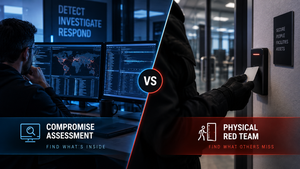

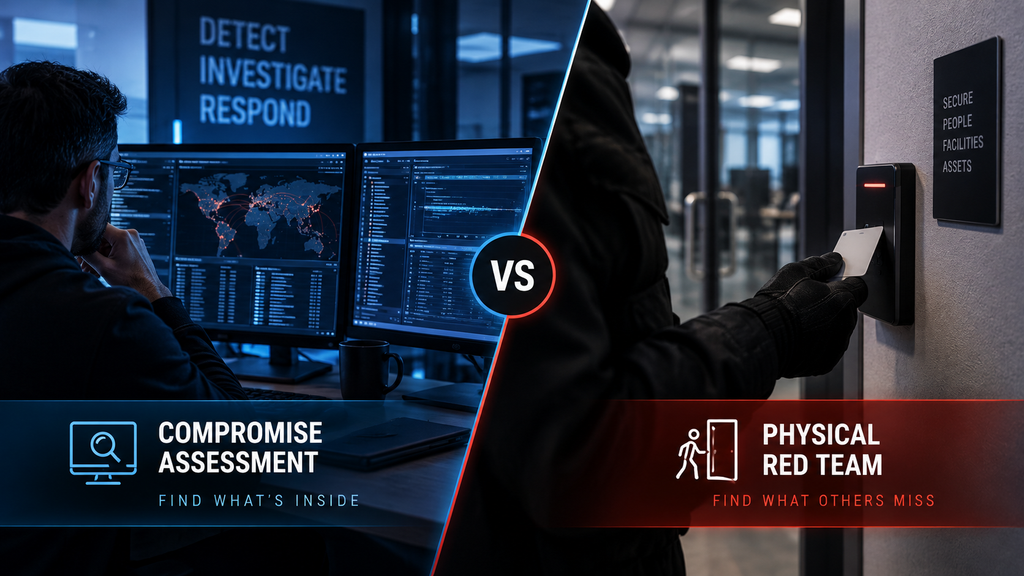
Compromise assessment vs physical red team is a comparison we get asked about constantly, and the short answer is this: a compromise assessment finds out if you’ve already been breached, while a physical red team finds out if you could be breached through your facilities. They’re not competing services – they answer fundamentally different questions, and understanding which one you actually need can save you from commissioning the wrong engagement entirely. At BFRT, we run both, and the first conversation with a new client is often just sorting out which one solves their actual problem.

Why This Comparison Confuses Even Experienced CISOs
The confusion around compromise assessment vs physical red team usually comes from both services sounding similarly “investigative” on the surface – both involve a security team examining an organization’s environment for signs of weakness. But a compromise assessment is retrospective and forensic, looking for evidence an attacker is already inside, while a physical red team engagement is prospective and adversarial, actively attempting to gain unauthorized facility access the way a real intruder would.
If you’ve read our breakdown of the physical red team kill chain, you already understand how a red team engagement progresses through staged intrusion. A compromise assessment doesn’t follow that same offensive progression at all – it’s a defensive audit, not an attack simulation.
Difference 1: What Question Each Engagement Answers
A compromise assessment answers: “Is there evidence an attacker has already compromised our environment?” A physical red team engagement answers: “Could an attacker realistically breach our facilities and what would they access if they did?” This distinction matters because organizations sometimes commission a physical red team engagement when what they actually need is a forensic sweep for existing compromise indicators – or the reverse.
We ask new clients directly: are you worried about something that may have already happened, or are you trying to validate whether something could happen? The answer determines which engagement actually fits.
Difference 2: Assumed State – Detection vs. Prevention
CA assumes a breach may have already occurred and searches for indicators of compromise (IOCs), unusual access patterns, or persistence mechanisms already present in the environment. A physical red team engagement assumes no prior breach and tests whether preventive physical controls – badge systems, visitor management, reception protocols – actually hold up against a real intrusion attempt.
This is why compromise assessment vs physical red team isn’t really a choice between “better” or “worse” – one looks backward for evidence, the other looks forward for gaps.
Difference 3: Scope and Methodology
Compromise assessments typically involve digital forensics: reviewing logs, endpoint telemetry, network traffic patterns, and system artifacts across a defined time window. Physical red team engagements involve on-site operators physically attempting infiltration, badge cloning, tailgating, and social engineering – grounded in the same rules of engagement structure we outlined in our RoE guide.
The methodologies barely overlap, which is why a provider skilled at one doesn’t automatically have the operational experience to deliver the other well.
Difference 4: Timeline and Deliverables
Compromise assessments generally run faster – often one to three weeks – since they’re analyzing existing data and system states rather than executing live physical operations across multiple site visits. Physical red team engagements take longer to scope and execute, following the same considerations we detailed in our engagement cost breakdown, since they require reconnaissance, on-site execution windows, and often multiple attempts across different times of day.
The deliverables also differ in nature: a compromise assessment report documents findings about what’s already present in your environment, while a physical red team report documents what was achieved through active testing, complete with photographic evidence of the intrusion attempt.
Difference 5: When Each One Actually Applies
A compromise assessment fits best after a suspected incident, following a merger or acquisition (to check the acquired environment’s cleanliness), or as a periodic health check for high-risk industries. A physical red team engagement fits best when evaluating facility security posture before a compliance audit, after opening a new location, or as part of a broader red team program validating both digital and physical defenses together.
Can You Need Both? (Usually, Yes)
Many enterprise clients – particularly in BFSI, healthcare, and data center operations – eventually commission both services, but for different reasons and often on different timelines. A compromise assessment might run annually as a hygiene check, while a physical red team engagement might run whenever a new facility opens or before a major compliance renewal. Neither replaces the other; they cover different risk categories entirely.
How BFRT Decides Which Engagement Fits Your Situation
We start every new client conversation by asking what triggered their interest – a specific concern about existing compromise, a compliance deadline, a new facility, or general risk validation. That single question usually resolves the compromise assessment vs physical red team decision within minutes, because the two services solve such clearly different problems once the actual trigger is identified.
Understanding compromise assessment vs physical red team isn’t just academic – commissioning the wrong engagement wastes budget and leaves the actual risk you were worried about unaddressed. If you’re not sure which service fits your current situation, BFRT can walk through your specific concern and recommend the right engagement rather than defaulting to whichever service happens to be top of mind.
Book a Call with BFRT’s Redteam
Or connect with Jay Sinh, Head of Redteam Ops, on LinkedIn to discuss which assessment fits your situation.