

A physical red team report is the document that translates an intrusion test into decisions your organization can actually act on – and most CISOs never learn how to properly evaluate one until they’re holding a weak report with nothing usable inside it. At BFRT, we’ve seen prospective clients switch providers specifically because a previous report gave them findings with no evidence, no risk context, and no path to remediation. Knowing what a strong report should contain isn’t just useful after the engagement – it should shape which vendor you pick before you sign anything.
Quick Glance: Physical Red Team Report
A physical red team report is the document that translates a covert physical intrusion test into evidence-backed findings, business-risk ratings, and a prioritized remediation plan an organization can act on. A strong report contains six sections: an executive summary, a scope and rules-of-engagement recap, a timeline of the engagement, findings with evidence (timestamped photos, badge logs, or video), risk ratings tied to business impact and compliance, and a remediation roadmap. If a report lacks evidence, risk context, or a path to fixing what was found, it fails the client no matter how well the engagement itself went.

What a Strong Physical Red Team Report Includes
A physical red team engagement can go flawlessly in execution and still fail the client if the resulting report doesn’t communicate findings in a way that drives action. We’ve reviewed reports from other providers that read like incident logs – a list of doors opened and cameras avoided – with no connection to actual business risk or compliance impact.
If you’ve already read our guide on the physical red team kill chain, you know an engagement moves through six distinct stages. A proper report should mirror that structure, showing exactly how each stage played out rather than just listing a final outcome.
Section 1: Executive Summary
The executive summary is the first – and sometimes only – section board members and non-technical executives will read, so a strong one puts the business impact here, not technical jargon. This section should answer three questions in plain language: what we tried to do, how far we got, and what it means for the organization’s risk posture.
We write this section assuming the reader has thirty seconds of attention, because in practice, that’s often exactly what a board member gives it before moving to the next agenda item.
Section 2: Scope and Rules of Engagement Recap
Every report should restate the agreed scope and boundaries from the original rules of engagement document, confirming what was authorized and what wasn’t touched. This section matters because it protects both parties – it’s the record showing the test stayed within legal and ethical limits.
We covered exactly what this authorization document should contain in our rules of engagement guide, and a report that skips this recap is missing a critical accountability checkpoint.
Section 3: Timeline of the Engagement
A chronological timeline showing when reconnaissance began, when infiltration succeeded, and when the engagement concluded gives readers a concrete sense of how quickly (or slowly) a real adversary could replicate the same breach. Timelines matter because “we got in” means something very different if it took four hours of persistent effort versus four minutes of walking through an unlocked door.
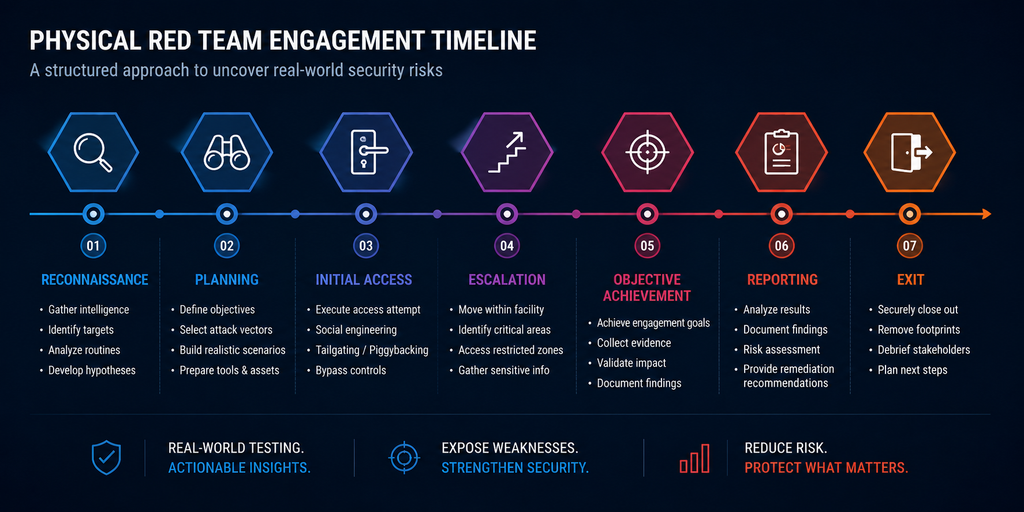
We include timestamps down to specific actions in this section, since a report without timing context makes it impossible for a client to judge urgency accurately.
Section 4: Findings With Evidence
This is the core of any credible PRT report – each finding needs supporting evidence, typically timestamped photographs, badge access logs, or video where authorized, tied to a specific location and moment in the engagement. Findings without evidence are just claims, and claims don’t hold up when a facilities director pushes back on a finding they find hard to believe.
We photograph everything permissible under the rules of engagement specifically so that when a client’s security team asks “how do we know this actually happened,” the answer is documented, not anecdotal.
Section 5: Risk Ratings and Business Impact
Every finding in a PRT report needs a risk rating – critical, high, medium, or low – tied to a clear explanation of business impact, not just a technical severity label. A cloned badge that only grants lobby access rates differently than a cloned badge that reaches the server room, and the report needs to make that distinction obvious without requiring the reader to infer it.
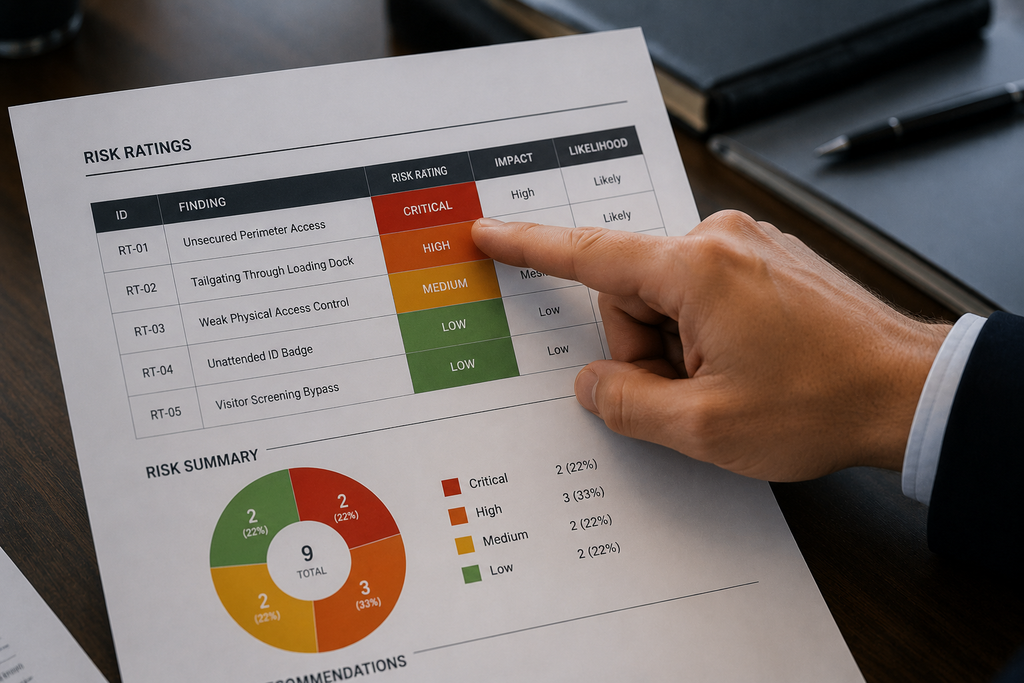
This section is also where compliance mapping belongs, connecting findings to frameworks like ISO/IEC 27001 Annex A physical security controls so the risk rating means something to an auditor, not just a security engineer.
Section 6: Remediation Roadmap
A report that stops at “here’s what we found” without prioritized remediation guidance leaves the client with a list of problems and no plan. This section should rank fixes by urgency and effort – distinguishing a same-week fix (re-training reception staff) from a longer-term structural change (redesigning badge access tiers).
We structure this roadmap so a client’s facilities team, IT team, and compliance team can each see exactly what falls under their responsibility, since remediation for physical findings often spans multiple departments that don’t normally coordinate with each other.
Red Flags That Signal a Weak Physical Red Team Report
A few warning signs suggest it won’t hold up under scrutiny: findings described only in vague terms (“gained unauthorized access to a sensitive area” without specifying which area or how), no photographic or logged evidence anywhere in the document, generic risk ratings applied uniformly regardless of actual business impact, and no remediation timeline at all. If a sample report from a prospective vendor has any of these gaps, it’s worth asking hard questions before signing a contract.
How BFRT Structures Every Physical Red Team Report
We build every report around these six sections as a non-negotiable baseline, then adapt the depth based on the client’s industry and compliance needs. A BFSI client typically needs deeper compliance mapping in Section 5; a data center client typically needs more granular timeline detail in Section 3. What doesn’t change is the underlying structure – because a report that skips sections or reorders priorities based on convenience usually signals the underlying engagement wasn’t rigorous either.
For a broader industry reference point on structuring security assessment reporting, SANS Institute’s guidance on penetration testing reporting standards outlines similar principles applied more generally across security testing disciplines.
Knowing how to evaluate it – before you even commission the engagement – puts you in a stronger position to choose a provider whose findings you can actually act on, not just file away. If you want to see what a properly structured physical red team report looks like before committing to an engagement, BFRT can walk you through a sample and explain exactly how we document findings for your industry.
Book a Call with BFRT’s Redteam
Or connect with Jay Sinh, Head of Redteam Ops, on LinkedIn to request a sample report structure directly.