Last Updated: July 2026
Penetration Testing for the Insurance Industry: A Complete Security Guide
Insurance penetration testing is the practice of simulating real-world cyberattacks against an insurance organization’s digital environment – including customer portals, claims management systems, policy administration platforms, APIs, mobile applications, cloud infrastructure, identity platforms, and internal networks—to identify exploitable vulnerabilities before attackers do. As insurers continue to modernise through digital transformation, cloud adoption, AI-powered underwriting, and online self-service platforms, the attack surface has expanded significantly, increasing the risk of data breaches, fraud, ransomware, and operational disruption.
Modern insurance companies rely on interconnected technologies to manage policies, process claims, handle customer data, facilitate broker interactions, and integrate with third-party providers. That connectivity is exactly what cybercriminals target—through identity attacks, API exploitation, ransomware, cloud misconfigurations, business logic abuse, and attacks against third-party integrations. Penetration testing helps insurers proactively identify and remediate these weaknesses by simulating the techniques used by real-world attackers before they can be exploited.
This guide explains why penetration testing is essential for insurance companies, which systems should be tested, emerging cybersecurity threats, regulatory and compliance considerations, and best practices for improving cyber resilience.
Quick Glance: Insurance Penetration Testing
- Purpose: Identify exploitable vulnerabilities across insurance platforms, applications, APIs, cloud infrastructure, and identity systems before attackers can exploit them.
- Systems Tested: Customer portals, claims management systems, policy administration platforms, broker portals, mobile apps, APIs, cloud environments, identity platforms, and internal networks.
- Primary Risks: Ransomware, identity compromise, API attacks, data breaches, business logic flaws, cloud misconfigurations, fraud, and third-party supply chain risks.
- Standards: Assessments typically align with the OWASP Top 10, OWASP API Security Top 10, MITRE ATT&CK, and applicable insurance industry regulations and security frameworks.
- Who Needs It: Insurance providers, health insurers, life insurers, property and casualty insurers, reinsurers, brokers, and InsurTech companies.
- Recommended Frequency: At least annually, after major platform changes, cloud migrations, mergers, or before launching new customer-facing applications.
- Outcome: A prioritised report with validated vulnerabilities, business impact, proof of exploitation where appropriate, and actionable remediation guidance to strengthen cyber resilience.
- Typical Cost & Duration: Insurance penetration tests typically start from $8,000 and take 1–4 weeks, depending on the number of sites, the size of the OT/ICS environment, and whether cloud, application, and identity layers are in scope.
Why Insurance Companies Are Prime Targets for Cyberattacks
Insurance organizations have become one of the most attractive targets for cybercriminals because they process vast amounts of sensitive customer and financial information.
Attackers frequently target:
- Customer personal information
- Claims data
- Financial records
- Payment systems
- Policy administration platforms
- Broker portals
- Employee credentials
- Customer authentication systems
- Cloud environments
Unlike organizations that store only payment information, insurers often retain customer records for many years, making successful compromises particularly valuable to threat actors.
Modern insurance companies also rely heavily on third-party vendors, APIs, cloud services, and digital customer experiences, creating additional attack surfaces that require continuous security testing.
Ready to Test Your Security?
Identify exploitable vulnerabilities before attackers do.
What Is Insurance Penetration Testing?
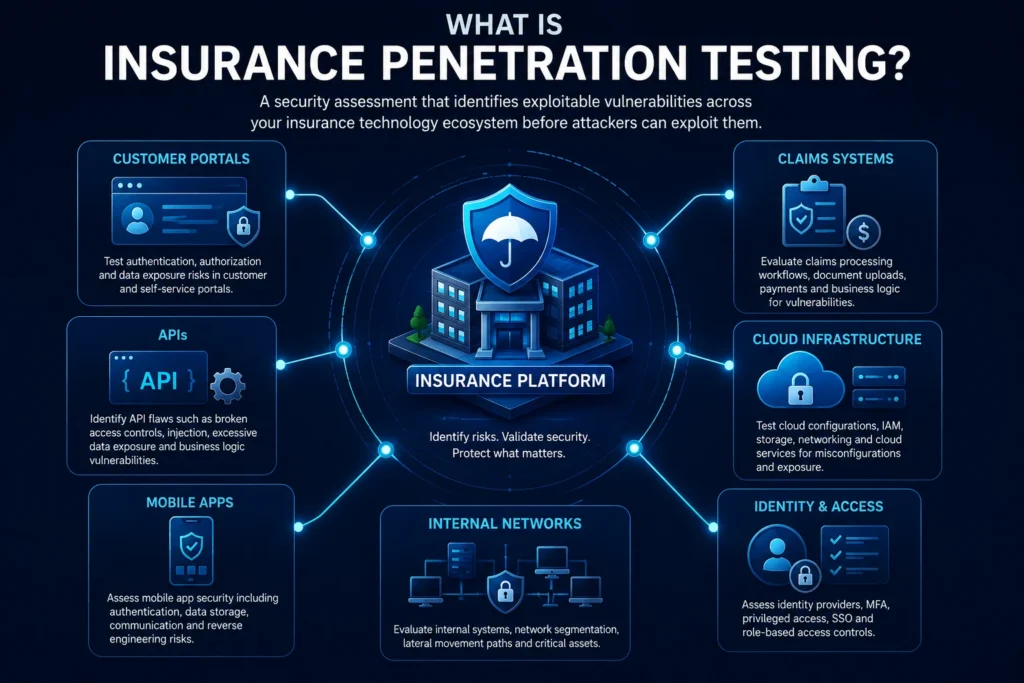
Insurance penetration testing is a controlled cybersecurity assessment designed to identify vulnerabilities across insurance applications, infrastructure, cloud environments, APIs, identity systems, and mobile applications.
Unlike automated vulnerability scanning, penetration testing combines manual testing with offensive security techniques to determine whether vulnerabilities can be successfully exploited and what impact a compromise could have on the business.
Typical assessments include:
- External network penetration testing
- Internal network penetration testing
- Web application testing
- API security testing
- Mobile application testing
- Cloud penetration testing
- Microsoft Entra ID assessments
- Active Directory security testing
- Authentication and authorization testing
The objective is to help organizations understand how attackers could compromise critical systems and prioritize remediation based on business risk.
The Modern Insurance Technology Ecosystem
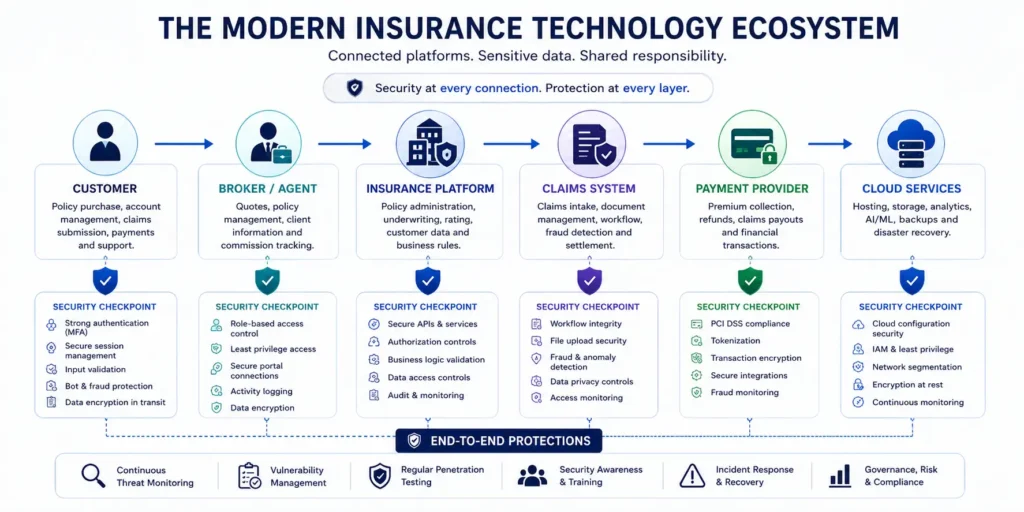
Today’s insurers operate highly interconnected digital environments.
Common technologies include:
Customer Portals
Allow policyholders to purchase insurance, manage policies, submit claims, and access personal information online.
Claims Management Platforms
Applications used to process claims, upload supporting documentation, communicate with customers, and approve settlements.
Broker & Agent Portals
Secure platforms that enable brokers and agents to manage policies, submit applications, and access customer records.
Mobile Insurance Applications
Mobile apps providing policy management, claims submission, payments, roadside assistance, and customer support.
API Integrations
Insurance companies integrate APIs with:
- Payment providers
- Identity providers
- CRM platforms
- Government databases
- Healthcare providers
- Third-party underwriting services
- Fraud detection platforms
Cloud Infrastructure
Many insurers now operate cloud-first environments supporting:
- Customer portals
- Internal applications
- Disaster recovery
- Data analytics
- AI services
- Document storage
As these technologies evolve, security assessments must evaluate both individual systems and the relationships between connected platforms.
Ready to Test Your Security?
Identify exploitable vulnerabilities before attackers do.
Common Cybersecurity Risks Facing Insurance Companies
Insurance organizations face a broad range of cyber threats.
Identity-Based Attacks
Compromised credentials remain one of the most common causes of security incidents.
Attackers increasingly target:
- Weak passwords
- MFA bypass
- Credential stuffing
- Session hijacking
- Excessive permissions
- Privileged accounts
Identity assessments help validate authentication controls and privileged access management.
API Security Vulnerabilities
Modern insurance platforms rely heavily on APIs for policy management, claims processing, identity verification, and third-party integrations.
Common API risks include:
- Broken authorization
- Excessive data exposure
- Injection attacks
- Business logic flaws
- Weak authentication
- Insecure API endpoints
Regular API penetration testing helps identify exploitable weaknesses before they can impact sensitive customer data.
Cloud Misconfigurations
Cloud adoption continues to accelerate across the insurance sector.
Common cloud security issues include:
- Publicly exposed storage
- Excessive Identity and Access Management (IAM) permissions
- Poor secrets management
- Insecure networking
- Misconfigured cloud services
Cloud penetration testing validates configurations and identifies exploitable weaknesses across cloud environments.
Ransomware
Insurance organizations remain a frequent target for ransomware groups because they depend on continuous access to customer information and claims systems.
Modern ransomware attacks often involve:
- Credential theft
- Privilege escalation
- Lateral movement
- Data exfiltration
- Encryption of critical systems
Penetration testing helps identify attack paths that ransomware operators commonly exploit.
Third-Party Supply Chain Risks
Insurance companies rely on numerous external vendors and technology providers.
These include:
- Payment providers
- Healthcare systems
- Identity providers
- Cloud services
- Analytics platforms
- AI providers
- Claims processing systems
Every integration expands the organization’s attack surface and should be considered during security assessments.
Business Logic Vulnerabilities
Insurance applications often contain unique business workflows that cannot be assessed through automated scanning alone.
Examples include:
- Claims manipulation
- Policy modification abuse
- Premium calculation bypasses
- Unauthorized policy access
- Fraudulent claims workflows
Manual penetration testing is essential for identifying these complex vulnerabilities.
Ready to Test Your Security?
Identify exploitable vulnerabilities before attackers do.
Why Penetration Testing Matters for Insurance Organizations
Cybersecurity testing provides organizations with a realistic understanding of how attackers could compromise critical systems.
Regular penetration testing helps insurers:
- Identify exploitable vulnerabilities
- Strengthen customer data protection
- Reduce ransomware risk
- Improve API security
- Validate identity controls
- Protect cloud infrastructure
- Support compliance initiatives
- Prioritize remediation based on business impact
Rather than relying solely on vulnerability scans, organizations gain practical insight into real attack paths and the effectiveness of existing security controls.
What Should Be Included in an Insurance Penetration Test?
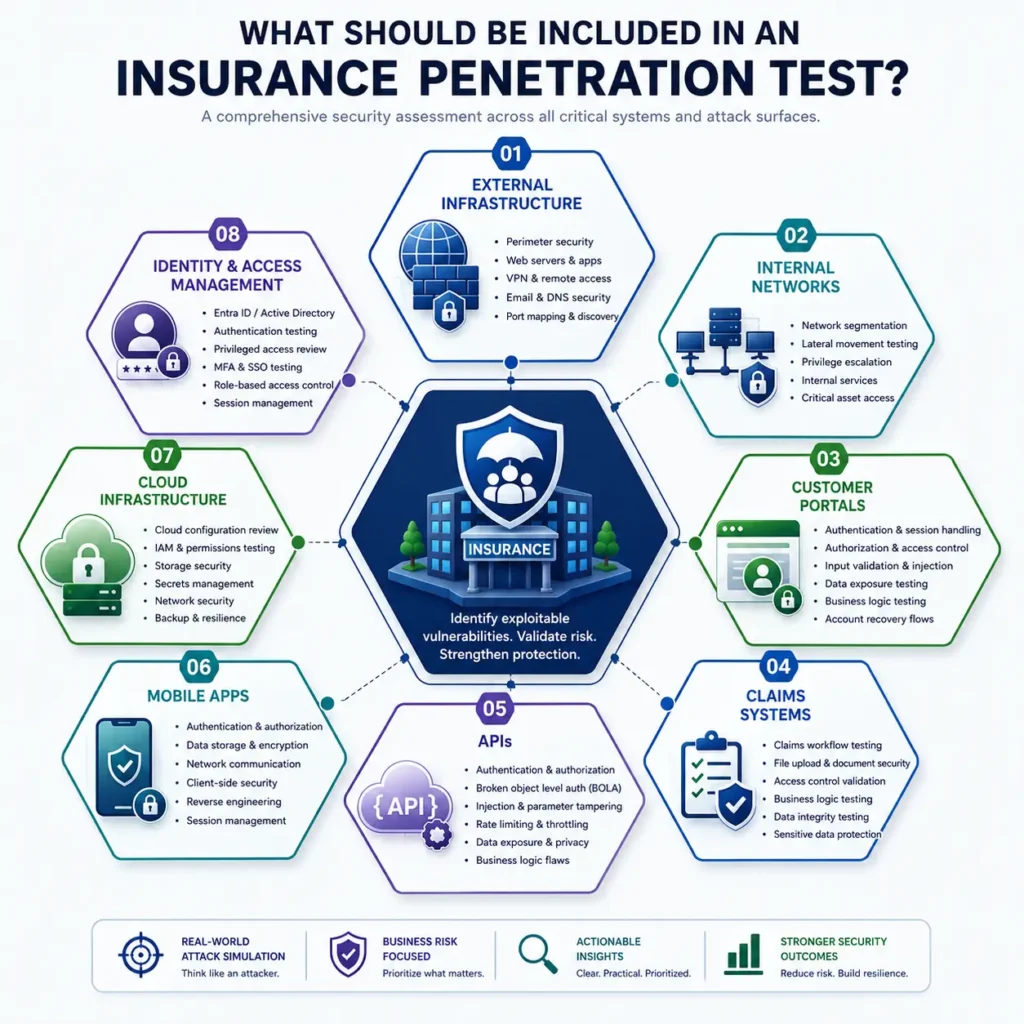
Insurance organizations rely on complex digital ecosystems that extend far beyond traditional corporate networks. Customer portals, broker platforms, claims management systems, APIs, cloud infrastructure, and mobile applications all process sensitive information and support critical business operations.
An effective penetration test should reflect the organization’s technology stack, regulatory obligations, and business risk rather than applying a generic testing methodology.
Typical assessment areas include:
External Infrastructure
Internet-facing assets are often the first target during a cyberattack.
External penetration testing should assess:
- Firewalls
- VPN gateways
- Remote access services
- Public-facing servers
- Email infrastructure
- DNS services
The objective is to identify vulnerabilities that could allow an attacker to gain an initial foothold into the organization’s environment.
Internal Network Security
If attackers gain access to the corporate network, internal security controls determine how far they can move.
Internal assessments typically evaluate:
- Active Directory
- Microsoft Entra ID
- Privileged accounts
- Network segmentation
- Lateral movement opportunities
- Administrative workstations
These assessments help organizations understand whether an attacker could access sensitive policy, claims, or customer systems after compromising a single device.
Customer & Broker Portals
Insurance portals provide customers and brokers with access to policies, claims, billing information, and sensitive personal data.
Testing should evaluate:
- Authentication
- Authorization
- Session management
- Account recovery
- Input validation
- File upload functionality
- Business logic
- Data exposure
Customer-facing applications are frequently targeted because they are publicly accessible and contain valuable information.
Claims Management Systems
Claims platforms process highly sensitive customer information and financial transactions.
Penetration testing should assess:
- Access controls
- Claims workflows
- Document uploads
- Payment authorization
- Administrative functions
- Data validation
- Workflow integrity
Manual testing is particularly valuable for identifying business logic flaws that automated scanners cannot detect.
API Security Testing
Modern insurers rely heavily on APIs to exchange information with customers, brokers, payment providers, healthcare organizations, fraud detection services, and third-party platforms.
API penetration testing should evaluate:
- Authentication
- Authorization
- Broken Object Level Authorization (BOLA)
- Injection vulnerabilities
- Business logic flaws
- Rate limiting
- Sensitive data exposure
- API gateway security
Because APIs often provide direct access to customer records and claims data, they should be a core component of every security assessment.
Mobile Applications
Many insurers now provide mobile applications that allow customers to:
- Manage policies
- Submit claims
- Upload documents
- Make payments
- Access roadside assistance
- Communicate with support teams
Mobile application assessments should evaluate:
- Secure authentication
- Local data storage
- Certificate validation
- API communication
- Session handling
- Reverse engineering resistance
Cloud Infrastructure
Cloud platforms now host many of the systems supporting modern insurance operations.
Cloud penetration testing should assess:
- Microsoft Azure
- Amazon Web Services (AWS)
- Google Cloud Platform (GCP)
- Microsoft 365
Common focus areas include:
- Identity & Access Management (IAM)
- Storage security
- Secrets management
- Cloud networking
- Backup security
- Cloud-native services
Identity & Access Management
Identity has become one of the most common attack vectors across the insurance industry.
Assessments should review:
- Microsoft Entra ID
- Active Directory
- Multi-Factor Authentication (MFA)
- Conditional Access
- Privileged Identity Management (PIM)
- Identity Governance
- Single Sign-On (SSO)
Strong identity controls help reduce the risk of unauthorized access and privilege escalation.
Ready to Test Your Security?
Identify exploitable vulnerabilities before attackers do.
Compliance & Regulatory Considerations
Insurance organizations operate within a complex regulatory environment where protecting customer information is both a legal and business requirement.
While regulatory obligations vary across jurisdictions, penetration testing supports organizations by validating technical security controls and identifying exploitable weaknesses before they can be abused.
Depending on the organization and the markets it serves, penetration testing may support initiatives related to:
- ISO/IEC 27001
- SOC 2
- PCI DSS (for organizations processing payment card data)
- HIPAA (where protected health information is involved)
- DORA (for applicable financial entities)
- NIS2 (where applicable)
- Internal cybersecurity governance and risk management programmes
Rather than viewing penetration testing as a compliance exercise, organizations should treat it as an ongoing security practice that improves resilience against real-world cyber threats.
Emerging Threats in Insurance Cybersecurity
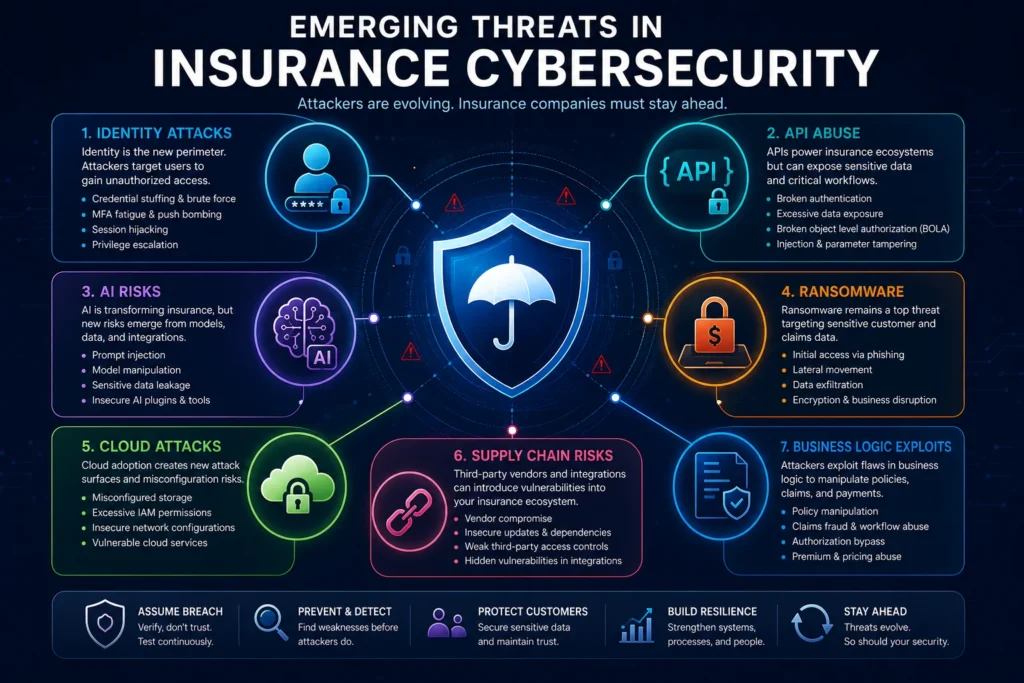
The insurance industry continues to modernize through cloud adoption, digital customer experiences, artificial intelligence, and increased connectivity. These innovations create new opportunities for growth—but also introduce new attack vectors that security teams must address.
Identity-Based Attacks
Threat actors increasingly target user identities instead of exploiting traditional software vulnerabilities.
Common techniques include:
- Credential stuffing
- MFA fatigue attacks
- Session hijacking
- OAuth abuse
- Privilege escalation
Identity security assessments help validate authentication mechanisms and privileged access controls before attackers exploit them.
API Abuse
Insurance organizations depend on APIs for policy administration, claims processing, identity verification, and third-party integrations.
Attackers increasingly exploit:
- Broken authorization
- Weak authentication
- Excessive data exposure
- Business logic flaws
- Insecure API endpoints
Continuous API security testing helps identify these weaknesses before they impact customers or business operations.
AI-Powered Insurance Risks
Artificial intelligence is increasingly used for underwriting, claims processing, fraud detection, customer service, and document analysis.
While AI improves efficiency, it also introduces new security considerations.
Organizations deploying AI solutions should evaluate risks including:
- Prompt injection
- Sensitive data exposure
- Model manipulation
- Unauthorized AI access
- Insecure integrations
AI Red Teaming and LLM security testing are becoming valuable additions to modern insurance security programmes.
Cloud-Native Attack Techniques
As insurers migrate more systems to the cloud, attackers increasingly focus on:
- Misconfigured IAM policies
- Public storage exposure
- Secrets management failures
- Container environments
- Serverless applications
- Cloud identity attacks
Cloud penetration testing validates cloud configurations and identifies exploitable weaknesses before they become security incidents.
Supply Chain Compromise
Insurance companies depend on numerous trusted third parties, including healthcare providers, payment processors, fraud detection platforms, cloud providers, identity services, and software vendors.
A compromise affecting one trusted supplier can significantly increase cyber risk across the organization.
Security assessments should evaluate both direct systems and the trust relationships between integrated services.
Red Teaming vs. Penetration Testing for Insurance Organizations
Although both services strengthen cybersecurity, they address different objectives.
Penetration Testing focuses on identifying and validating exploitable vulnerabilities within defined applications, APIs, infrastructure, or cloud environments.
Red Teaming simulates realistic attack scenarios that test people, processes, and technology together, measuring how effectively an organization can detect and respond to sophisticated threats.
For many insurance organizations, penetration testing provides the technical foundation for improving security controls, while periodic Red Team exercises evaluate overall operational resilience and incident response capabilities.
Organizations with mature cybersecurity programmes often use both approaches to gain a comprehensive understanding of their security posture.
How to Choose an Insurance Penetration Testing Provider
Choosing the right penetration testing provider is an important decision for insurance organizations. Modern insurance environments include customer portals, claims management systems, APIs, cloud infrastructure, mobile applications, and identity platforms that require specialized security expertise.
When evaluating providers, consider the following factors.
Insurance Industry Experience
Look for a provider with experience assessing security across insurance technology environments.
This includes:
- Customer portals
- Broker platforms
- Claims systems
- Policy administration platforms
- Mobile applications
- Payment integrations
- API ecosystems
Understanding insurance workflows enables testers to identify business-specific vulnerabilities that automated tools and generic assessments often miss.
API Security Expertise
Insurance organizations increasingly depend on APIs to exchange information with customers, brokers, healthcare providers, payment processors, and third-party vendors.
A qualified provider should have proven experience testing:
- REST APIs
- GraphQL APIs
- Authentication mechanisms
- Authorization controls
- Business logic
- Third-party integrations
API security should be a core component of every insurance penetration test.
Cloud Security Knowledge
Most insurers continue migrating critical workloads to the cloud.
Choose a provider experienced with:
- Microsoft Azure
- Amazon Web Services (AWS)
- Google Cloud Platform (GCP)
- Microsoft 365
Cloud assessments should evaluate identity management, storage security, secrets management, networking, and cloud-native services.
Manual Offensive Security Testing
Automated scanners are valuable for identifying common vulnerabilities, but they cannot fully assess business logic flaws, privilege escalation paths, authorization weaknesses, or complex attack chains.
Look for a provider that combines automated scanning with manual penetration testing performed by experienced offensive security consultants.
Actionable Reporting
A penetration testing report should help both technical teams and business stakeholders understand security risks and remediation priorities.
Comprehensive reports typically include:
- Executive Summary
- Technical Findings
- Risk Ratings
- Business Impact
- Proof-of-Concept Evidence
- Screenshots
- Prioritized Remediation Guidance
Clear reporting enables organizations to focus on vulnerabilities that present the greatest business risk.
Ongoing Security Support
Cybersecurity is an ongoing process rather than a one-time project.
Many organizations benefit from providers that also offer:
- Retesting
- Remediation validation
- Security consulting
- Red Team exercises
- Continuous security assessments
- Security awareness support
Long-term partnerships help organizations continuously improve their cybersecurity posture as technology and threats evolve.
Frequently Asked Questions - insurance penetration testing
- What is insurance penetration testing?Insurance penetration testing is a controlled cybersecurity assessment that identifies exploitable vulnerabilities across insurance applications, customer portals, APIs, cloud infrastructure, mobile applications, and supporting systems before attackers can exploit them.
- Why is penetration testing important for insurance companies?Insurance organizations manage highly sensitive customer information, financial records, claims data, and policy information. Penetration testing helps identify weaknesses that could lead to data breaches, ransomware attacks, fraud, or unauthorized access to critical systems.
- What systems should be included in an insurance penetration test?A comprehensive assessment typically includes:
- Customer portals
- Broker platforms
- Claims management systems
- APIs
- Mobile applications
- Cloud infrastructure
- External infrastructure
- Internal corporate networks
- Identity platforms
- Does penetration testing help with compliance?Yes. Penetration testing helps organizations validate technical security controls and supports compliance initiatives such as ISO/IEC 27001, SOC 2, PCI DSS, HIPAA (where applicable), DORA, and other regulatory or contractual security requirements.
- How often should insurance companies perform penetration testing?Most organizations perform penetration testing annually and after major technology changes, including cloud migrations, application releases, API deployments, acquisitions, or significant infrastructure updates. Testing frequency should be based on business risk, regulatory requirements, and the pace of organizational change.
- What is the difference between vulnerability scanning and penetration testing?Vulnerability scanning automatically identifies potential weaknesses, while penetration testing determines whether those weaknesses can be successfully exploited and evaluates their real-world business impact. Both are valuable, but penetration testing provides a far more realistic assessment of an organization's security posture.
Secure Your Insurance Platform Before Attackers Do
Insurance organizations continue to modernize through cloud adoption, digital customer experiences, AI-powered services, and increasingly interconnected ecosystems. As technology evolves, cybercriminals continue to develop new techniques for targeting customer data, claims platforms, APIs, and critical business systems.
Independent penetration testing provides a realistic understanding of how attackers could compromise your environment, helping your security team identify exploitable vulnerabilities and prioritize remediation before they can be exploited.
Whether you’re strengthening customer portals, securing APIs, validating cloud infrastructure, preparing for compliance, or improving overall cyber resilience, Bluefire Redteam delivers independent penetration testing tailored to the unique challenges facing modern insurance organizations.
Ready to strengthen your insurance security?
- Web Application Penetration Testing
- API Security Testing
- Cloud Penetration Testing
- Mobile Application Security Testing
- Identity Security Assessments
- Enterprise Red Team Exercises
👉 Talk to Our Penetration Testing Experts