







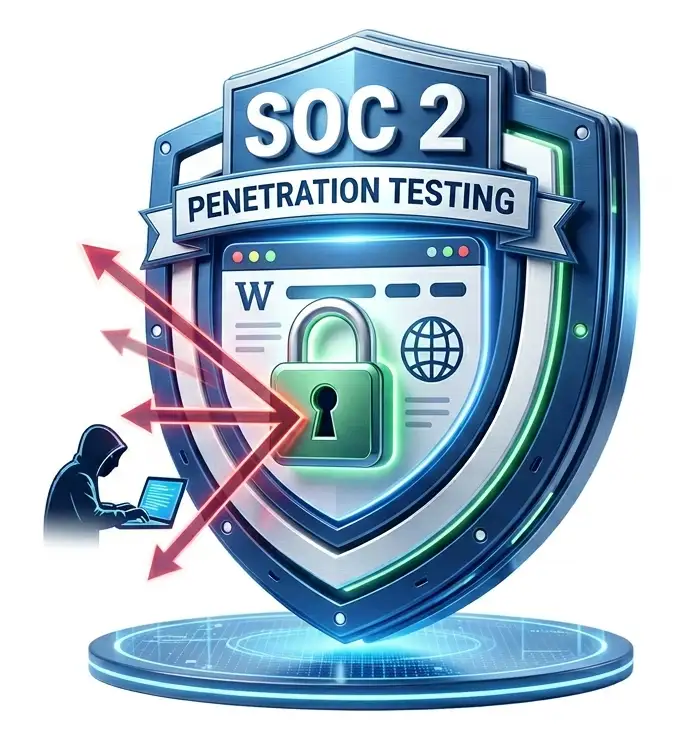
Get AI-Powered + Human Validated Pen Testing!

SOC 2 Penetration Testing Services

Meet SOC 2 Security Requirements and Strengthen Customer Trust

Enterprise customers increasingly expect vendors to demonstrate that their security controls are effective, their risks are actively managed, and their environments are tested against realistic attack scenarios.

For many organizations pursuing SOC 2 compliance, penetration testing has become a critical component of security validation.

Whether you are preparing for your first SOC 2 audit, renewing an existing report, responding to a customer security questionnaire, or strengthening your overall security posture, penetration testing provides independent evidence that security controls are functioning as intended.

At Bluefire Redteam, we help organizations identify exploitable weaknesses, validate security controls, and support SOC 2 compliance objectives through realistic, human-led penetration testing.

What Is SOC 2 Penetration Testing?

SOC 2 Penetration Testing is a security assessment designed to identify vulnerabilities and determine whether attackers could gain unauthorized access to systems, applications, cloud environments, or sensitive customer data.

The purpose of penetration testing is not simply to identify vulnerabilities.

It is to understand:

  • How attackers could compromise systems
  • What business impact could occur
  • Whether security controls are effective
  • How weaknesses should be remediated
  • Whether customer data is adequately protected

For organizations seeking SOC 2 compliance, penetration testing provides valuable evidence that security risks are being proactively assessed and managed.

The scope, environment, and compliance requirements will influence pricing, which is why many organizations request a tailored penetration testing quote before planning an assessment.

soc 2 penetration testing

Why Penetration Testing Supports SOC 2 Compliance

SOC 2 focuses on demonstrating that controls are designed and operating effectively.

A penetration test provides evidence that those controls can withstand realistic attack scenarios.

Testing helps organizations answer important questions:

  • Can attackers gain unauthorized access?
  • Can sensitive customer data be exposed?
  • Can cloud environments be compromised?
  • Are access controls functioning properly?
  • Are vulnerabilities identified and remediated?
  • Would security teams detect malicious activity?

Independent testing helps convert assumptions into measurable security evidence.

SOC 2 Penetration Testing Requirements

One of the most common questions organizations ask is:

Is penetration testing required for SOC 2?

The answer is nuanced.

SOC 2 does not explicitly mandate annual penetration testing.

However, auditors, enterprise customers, security teams, and procurement departments frequently expect organizations to demonstrate that security controls are regularly evaluated through independent testing.

Penetration testing is widely recognized as one of the most effective methods of validating security controls and identifying exploitable weaknesses.

Organizations pursuing SOC 2 compliance commonly perform penetration testing to:

  • Validate security controls
  • Support risk management programs
  • Demonstrate security maturity
  • Identify exploitable vulnerabilities
  • Satisfy customer security requirements
  • Strengthen audit readiness

In practice, penetration testing is considered a security best practice and is often expected during vendor due diligence reviews.

What Auditors and Customers Typically Expect

Organizations are often asked to provide evidence that security risks are being actively assessed.

Common documentation includes:

Penetration Testing Reports

Independent reports demonstrating security testing activity.

Executive Summaries

High-level findings suitable for management review.

Remediation Plans

Documentation showing how weaknesses are being addressed.

Retesting Results

Evidence that identified issues have been remediated successfully.

Security Program Documentation

Processes supporting vulnerability management and risk reduction.

Many enterprise customers request this information during vendor assessments and security reviews.

Security teams planning adversary simulations should review common Red Teaming Objectives Examples before defining engagement goals.

What Systems Should Be Included in a SOC 2 Penetration Test?

The scope should reflect systems that store, process, transmit, or provide access to customer information.

Common assessment targets include:

External Infrastructure

  • Internet-facing systems
  • VPN services
  • Remote access solutions
  • Public-facing infrastructure

Web Applications

  • SaaS platforms
  • Customer portals
  • Administrative interfaces
  • APIs

Cloud Environments

  • Microsoft Azure
  • AWS
  • Google Cloud
  • Hybrid cloud environments

Identity Systems

  • Microsoft Entra ID
  • Active Directory
  • Single Sign-On platforms
  • Privileged access systems

The objective is to evaluate realistic attack paths that could impact confidentiality, integrity, or availability.

Organizations comparing offensive security providers can use our Red Team Vendor Evaluation Checklist to assess capabilities and engagement quality.

SOC 2 Penetration Testing for SaaS Companies

SOC 2 compliance is particularly important for SaaS providers.

Enterprise customers frequently require evidence of penetration testing before onboarding vendors.

For SaaS companies, testing often focuses on:

  • Multi-tenant applications
  • Authentication controls
  • Authorization mechanisms
  • API security
  • Cloud infrastructure
  • Identity and access management
  • Customer data protection

Testing demonstrates a commitment to security while helping organizations identify weaknesses before attackers do.

Cloud-native organizations can explore our Offensive Security for SaaS & Technology Companies approach to understand industry-specific testing considerations.

Many SaaS providers complement compliance testing with Cloud Red Teaming to evaluate realistic attack paths across cloud-native environments.

Common Findings Identified During SOC 2 Assessments

While every environment is unique, common issues include:

  • Broken access controls
  • Authentication weaknesses
  • Privilege escalation paths
  • Cloud misconfigurations
  • Insecure APIs
  • Sensitive data exposure
  • Excessive permissions
  • Identity security weaknesses

Identifying these issues before an audit helps reduce risk and strengthen security posture.

Organizations using Microsoft 365 frequently perform Entra ID Red Teaming to assess identity compromise risks and privilege escalation opportunities.

What Deliverables Will You Receive?

Every engagement includes reporting designed for technical teams, management, auditors, and customers.

Deliverables typically include:

  • Executive Summary
  • Technical Findings Report
  • Risk Ratings
  • Evidence of Testing
  • Remediation Recommendations
  • Attack Path Analysis
  • Retesting Validation (Optional)

Our reporting helps organizations improve security while demonstrating due diligence.

Understanding the expected Red Team Deliverables can help stakeholders evaluate reporting quality and remediation guidance before selecting a provider.

Our SOC 2 Penetration Testing Methodology

Every assessment is performed by experienced offensive security professionals using a structured methodology.

Scoping & Planning

Define objectives, systems, testing boundaries, and engagement requirements.

Identify exposed assets, technologies, and potential attack paths.

Evaluate applications, infrastructure, cloud environments, and identity systems.

Safely validate vulnerabilities to determine real-world risk.

Assess how attackers could expand access and achieve objectives.

Provide detailed findings, business impact analysis, and prioritized recommendations.

Our Customer Stories demonstrate how organizations uncover attack paths, validate controls, and improve security posture through offensive security assessments.Our Customer Stories demonstrate how organizations uncover attack paths, validate controls, and improve security posture through offensive security assessments.

SOC 2 Penetration Testing vs Vulnerability Scanning

Many organizations mistakenly assume vulnerability scanning is sufficient.

While vulnerability scanning is valuable, it does not replace penetration testing.

Vulnerability ScanningPenetration Testing
AutomatedHuman-led
Identifies potential issuesValidates exploitability
Limited contextReal-world attack scenarios
Broad coverageDeep security assessment
Continuous monitoringSecurity validation

Most mature security programs use both approaches together.

How Often Should SOC 2 Penetration Testing Be Performed?

Most organizations perform penetration testing:

  • Annually
  • Before a SOC 2 audit
  • Following major releases
  • After significant infrastructure changes
  • Following mergers or acquisitions
  • When requested by customers

Testing frequency should align with risk, business requirements, and operational changes.

Why Organizations Choose Bluefire Redteam

Bluefire Redteam helps organizations move beyond compliance checklists and understand how real attackers would target their environment.

Our assessments focus on:

  • Human-led testing
  • Cloud environments
  • Identity security
  • SaaS applications
  • Realistic attack paths
  • Actionable remediation

Every engagement is tailored to your environment, objectives, and compliance requirements.

Frequently Asked Questions - SOC 2 Pen Test

  • SOC 2 does not explicitly require penetration testing, but independent security testing is widely recognized as a best practice and is frequently expected by auditors and enterprise customers.
  • Most organizations perform testing annually or after significant changes to systems, infrastructure, or applications.
  • No. Vulnerability scanning and penetration testing serve different purposes. Most mature organizations use both.
  • Yes. Penetration testing helps identify weaknesses, validate controls, and demonstrate that security risks are actively managed.
Request a SOC 2 Penetration Testing Quote

Whether you’re preparing for a SOC 2 audit, responding to customer security requirements, or strengthening your security program, Bluefire Redteam can help.

Our penetration testing services provide the evidence, insight, and recommendations needed to improve security and support compliance objectives.

Subscribe to our newsletter now and reveal a free cybersecurity assessment that will level up your security.

  • Instant access.
  • Limited-time offer.
  • 100% free.

🎉 You’ve Unlocked Your Cybersecurity Reward

Your exclusive reward includes premium resources and a $1,000 service credit—reserved just for you. We’ve sent you an email with all the details.

What’s Inside

The 2025 Cybersecurity Readiness Toolkit
(A step-by-step guide and checklist to strengthen your defenses.)

$1,000 Service Credit Voucher
(Available for qualified businesses only)

Before You Leave - Get a Tailored Security Recommendation

We’ll tell you exactly how your organization would likely be attacked, and what type of testing you actually need to prevent it.