Last Updated: July 2026
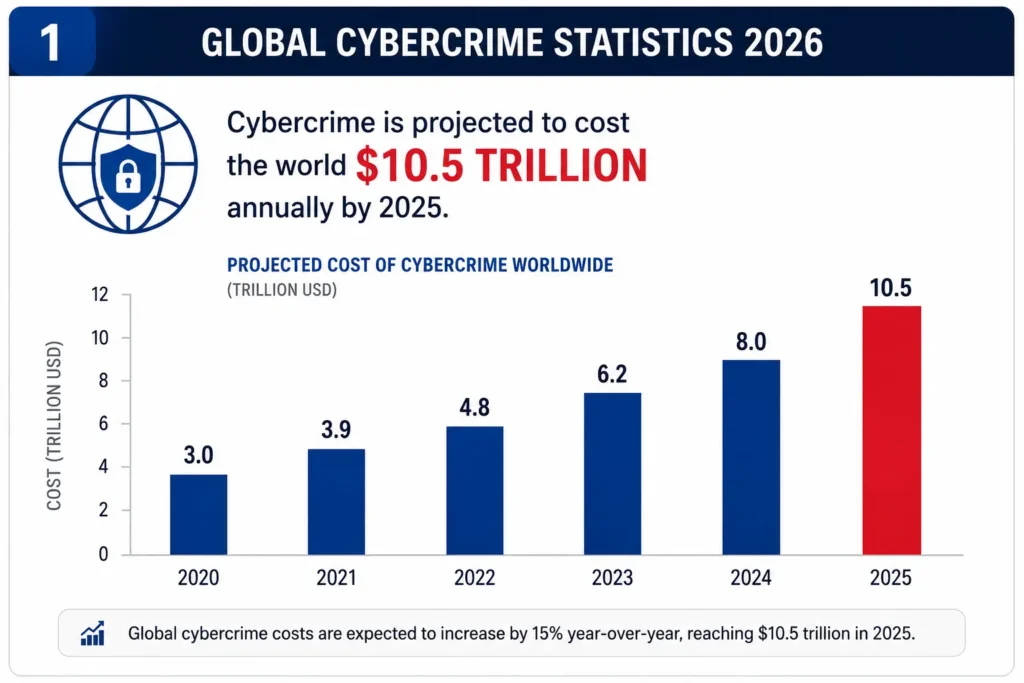
The average cost of a data breach remains one of the clearest indicators of cyber risk. Recent industry research shows the global average data breach costs approximately $4.44 million, while breaches affecting sectors such as healthcare and financial services can cost significantly more due to regulatory penalties, operational disruption, and recovery expenses. At the same time, ransomware, identity attacks, AI-driven threats, and third-party compromises continue to increase, driving organizations to invest more heavily in offensive security and cyber resilience.
This guide brings together the latest cybersecurity statistics, breach benchmarks, market trends, and Red Teaming insights from leading industry research to help security leaders understand where cyber risk is increasing, how attackers are evolving, and which security investments are delivering the greatest value. Rather than simply listing statistics, we explain what each figure means and how organizations can use these insights to strengthen their security posture.
Our goal is simple:
To create the most comprehensive collection of Red Teaming statistics available anywhere online.
Key Numbers at a Glance (2026)
- Global Average Data Breach Cost: ~$4.44 million per breach.
- Leading Initial Access Vector: 31% of confirmed breaches begin with vulnerability exploitation, overtaking stolen credentials.
- Ransomware Impact: 48% of investigated breaches involve ransomware.
- Human Element: 62% of breaches involve phishing, credential theft, social engineering, or human error.
- Third-Party Risk: 48% of breaches involve suppliers, vendors, or other trusted third parties.
- Cloud & Identity: Cloud identities, APIs, and SaaS platforms remain among the fastest-growing attack surfaces.
- AI Security: Approximately 78% of organisations have adopted AI, but only 12% have formal AI security testing programmes.
- Security Investment: More than 56% of organisations increased Red Team spending, while 70%+ are adopting continuous testing models such as PTaaS.
Executive Summary
Red Teaming has entered a new era.
For many years, organizations viewed offensive security primarily as an annual compliance requirement or a penetration testing exercise performed before audits. That approach is no longer sufficient.
Today’s attackers operate continuously, automate reconnaissance, exploit newly disclosed vulnerabilities within days—or even hours—and increasingly leverage AI to accelerate every stage of the attack lifecycle.
Several major cybersecurity reports published throughout 2025 and 2026 highlight a common theme:
Organizations are becoming better at detecting attacks, but attackers are evolving even faster.
Among the most significant developments shaping Red Teaming in 2026 are:
- Vulnerability exploitation has overtaken stolen credentials as the most common initial access vector.
- AI is rapidly expanding the enterprise attack surface.
- Supply chain attacks continue to increase.
- Identity systems have become primary attack targets.
- Cloud-native environments introduce increasingly complex attack paths.
- Executive cybersecurity spending continues to rise.
- Organizations are moving away from point-in-time testing toward continuous offensive security validation.
These trends reinforce an important reality:
Modern security programs can no longer rely solely on vulnerability scanning or periodic penetration testing.
Organizations increasingly require realistic adversary simulations that validate whether security controls can withstand sophisticated attacks across cloud infrastructure, identities, applications, APIs, third-party integrations, physical security controls, and AI-enabled systems.
Key Red Teaming Statistics (2026)
If you only read one section of this report, start here.
The following statistics highlight the most important Red Teaming and cybersecurity trends shaping enterprise security in 2026.
1. Vulnerability exploitation now accounts for 31% of confirmed breaches.
For the first time in Verizon’s Data Breach Investigations Report history, vulnerability exploitation became the leading initial access vector, overtaking credential abuse.
2. Ransomware is involved in nearly half of all investigated breaches.
Approximately 48% of confirmed breaches now involve ransomware, demonstrating why organizations increasingly perform ransomware-focused Red Team exercises.
3. The human element contributes to 62% of security breaches.
People remain one of the most significant attack surfaces through phishing, credential theft, social engineering, and operational mistakes.
4. Third-party involvement now appears in 48% of breaches.
Modern attack paths increasingly extend beyond organizational boundaries through suppliers, vendors, managed service providers, and software ecosystems.
5. The global average cost of a data breach is approximately $4.44 million.
While detection capabilities continue improving, breaches remain financially devastating for organizations worldwide.
6. Organizations deploying AI significantly outnumber those performing AI security testing.
Most enterprises have adopted AI technologies, but only a small percentage have implemented formal AI Red Teaming programs.
7. AI Red Teaming is one of the fastest-growing cybersecurity markets.
Industry forecasts estimate AI Red Teaming will experience annual growth exceeding 30% throughout the coming decade.
8. More than half of organizations are increasing Red Team budgets.
Offensive security continues receiving increased executive investment as organizations seek better validation of security controls.
9. Penetration Testing as a Service (PTaaS) adoption continues accelerating.
Organizations increasingly prefer continuous testing models over annual point-in-time assessments.
10. Identity has become one of the primary attack surfaces.
Rather than exploiting only technical vulnerabilities, attackers increasingly target privileged accounts, cloud identities, Single Sign-On platforms, and identity providers.
Bluefire Expert Insight
Looking across the major cybersecurity reports published during 2025 and 2026, one trend stands out more than any other:
Attackers are no longer succeeding because organizations fail to patch every vulnerability.
Instead, successful breaches increasingly result from attackers chaining together multiple weaknesses across identities, cloud environments, APIs, third-party integrations, business processes, and human behavior.
During offensive security engagements, we frequently observe environments with mature vulnerability management programs that still contain realistic attack paths capable of leading to privilege escalation, sensitive data exposure, or ransomware deployment.
This is precisely why modern Red Teaming focuses on validating entire attack chains rather than isolated technical findings.
What Is Red Teaming?
Red Teaming is an advanced offensive security assessment that simulates the tactics, techniques, and procedures (TTPs) used by real-world attackers to evaluate how effectively an organization can prevent, detect, and respond to cyber threats.
Unlike traditional penetration testing, which primarily focuses on identifying exploitable vulnerabilities within a defined scope, Red Teaming evaluates the effectiveness of an organization’s overall security posture.
A typical Red Team engagement may include:
- External attack simulation
- Internal network compromise
- Identity attacks
- Cloud security assessments
- Social engineering
- Phishing campaigns
- Physical security testing
- API testing
- Business logic abuse
- Lateral movement
- Privilege escalation
- Detection and response validation
The objective is not simply to discover vulnerabilities—it is to understand whether realistic attackers could achieve defined objectives without being detected.
Why Red Teaming Matters More Than Ever in 2026
The cybersecurity landscape has changed dramatically.
Organizations now manage:
- Hybrid cloud infrastructure
- Remote workforces
- AI-powered applications
- Third-party software ecosystems
- SaaS platforms
- Complex identity infrastructures
- Connected operational technologies
- Critical business APIs
Each new technology introduces additional attack paths.
At the same time, attackers continue to evolve.
Modern threat actors increasingly combine:
- Vulnerability exploitation
- Identity compromise
- Cloud misconfigurations
- AI-assisted reconnaissance
- Social engineering
- Third-party compromise
- Supply chain attacks
- Credential theft
Traditional security assessments often evaluate these areas individually.
Red Teaming evaluates how attackers combine them.
This makes Red Teaming one of the most valuable methods for understanding real organizational risk.
How to Use These Statistics
This report has been designed for multiple audiences.
Security Leaders
Use the benchmarks to justify offensive security investments and communicate cyber risk to executives.
CISOs
Compare your organization’s security maturity against current industry trends.
Compliance Teams
Support security programs related to SOC 2, PCI DSS, HIPAA, ISO 27001, and other frameworks.
Journalists & Researchers
Reference independently compiled cybersecurity statistics supported by authoritative industry reports.
Security Professionals
Stay informed about the latest Red Teaming trends, attack techniques, and enterprise adoption.
Our Research Methodology
This guide compiles statistics from publicly available research published by respected cybersecurity organizations, industry analysts, government agencies, and technology vendors.
Primary sources include:
- Our red team experience
- Verizon Data Breach Investigations Report (DBIR)
- IBM Cost of a Data Breach Report
- Microsoft Digital Defense Report
- CISA
- ENISA
- MITRE ATT&CK
- OWASP
- Fortune Business Insights
- Gartner
- IDC
- Mandiant
- CrowdStrike
- Palo Alto Networks
- Google Cloud
- Check Point
- Sophos
- Fortinet
- Unit 42
- Industry research and market analysis reports
Every statistic is reviewed for relevance, publication date, and source credibility. Where multiple reputable sources provide comparable data, we present the most recent or widely accepted figure and explain any notable differences.
This page will be updated throughout 2026 as new reports become available.
What’s Next?
The following section explores the growth of the global Red Teaming and Penetration Testing market, including spending trends, enterprise adoption, AI-driven security investments, and why offensive security continues to receive increased executive attention worldwide.
Red Teaming Market Size & Growth Statistics (2026)
Red Teaming is no longer viewed as a niche cybersecurity service reserved for highly regulated organizations or Fortune 500 companies.
Growing cyber threats, cloud adoption, artificial intelligence, stricter regulatory requirements, and increasing customer security expectations have transformed offensive security into a strategic business investment.
The numbers clearly show that organizations are spending more than ever on penetration testing, Red Teaming, and continuous security validation.
The Global Penetration Testing Market Continues Rapid Growth
Industry analysts consistently forecast strong long-term growth across the penetration testing and offensive security market.
Current projections estimate:
| Year | Estimated Market Size |
|---|---|
| 2025 | $2.74 Billion |
| 2026 | $3.09 Billion |
| 2030 | Approximately $5 Billion |
| 2034 | $7.41 Billion |
This represents an estimated 11–15% compound annual growth rate (CAGR) depending on the market analysis methodology used.
Why This Matters
Organizations increasingly recognize that prevention alone is insufficient.
Boards, regulators, insurers, and enterprise customers now expect organizations to continuously validate their security controls rather than simply deploy them.
This shift is driving sustained investment in offensive security services.
AI Red Teaming Is the Fastest Growing Segment
Artificial intelligence has created an entirely new attack surface.
Large Language Models (LLMs), autonomous AI agents, Retrieval-Augmented Generation (RAG) pipelines, and AI-powered business workflows introduce security challenges that traditional penetration testing rarely addresses.
Industry forecasts estimate:
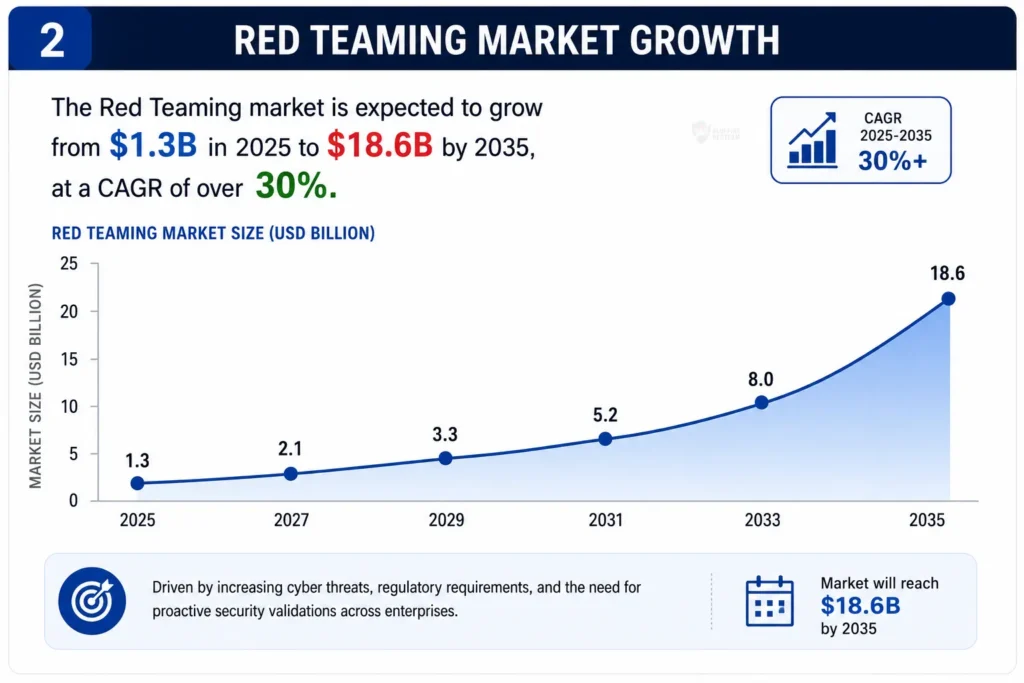
- AI Red Teaming market value exceeded $1 billion in 2025.
- Expected market size approaches $19 billion by 2035.
- Estimated CAGR exceeds 30%.
No other offensive security discipline is currently growing at a comparable rate.
Organizations are rapidly investing in adversarial AI testing to evaluate:
- Prompt injection attacks
- Jailbreak techniques
- Tool abuse
- Data leakage
- Agent manipulation
- Model misuse
- RAG exploitation
Enterprise Cybersecurity Spending Continues to Increase
Security spending continues rising despite economic uncertainty.
Recent industry research indicates:
- 92% of organizations increased cybersecurity budgets.
- 85% increased penetration testing investments.
- More than 56% increased Red Team spending.
- Over 70% adopted or planned to adopt Penetration Testing as a Service (PTaaS).
The increase reflects a shift away from reactive security toward continuous security validation.
Rather than asking:
“Are we compliant?”
Security leaders increasingly ask:
“Would we actually stop a real attacker?”
Organizations Are Moving Toward Continuous Testing
Traditional annual penetration testing remains valuable.
However, modern organizations deploy software, APIs, cloud infrastructure, and AI capabilities continuously.
Security validation must evolve accordingly.
Organizations increasingly combine:
- Annual penetration testing
- Continuous vulnerability management
- PTaaS
- Purple Team exercises
- Red Team operations
- Cloud security assessments
- Identity testing
Continuous testing reduces the gap between security changes and security validation.
Executive Expectations Have Changed
Cybersecurity is no longer solely an IT responsibility.
Boards increasingly expect measurable evidence that security investments reduce organizational risk.
Executives now seek answers to questions such as:
- Can attackers access sensitive information?
- Would ransomware spread throughout the environment?
- Can privileged identities be compromised?
- Are cloud environments adequately protected?
- Would security teams detect an active intrusion?
Red Teaming provides practical answers by simulating realistic adversary behavior.
Enterprise Adoption Statistics
Adoption continues increasing across organizations of every size.
Several trends stand out.
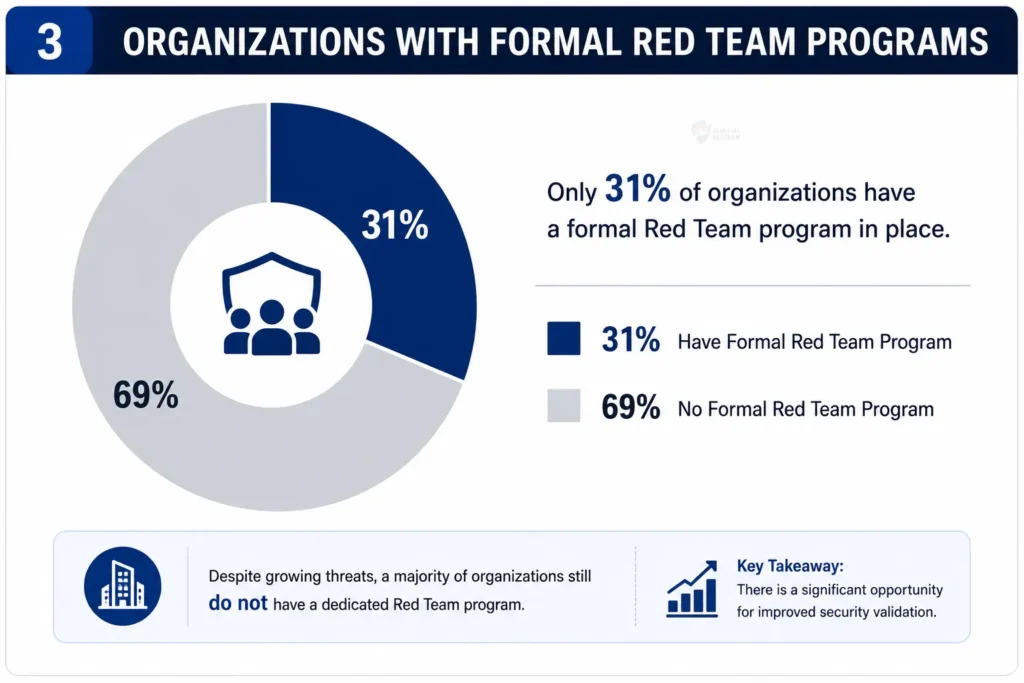
More Organizations Are Performing Red Team Exercises
Security testing has expanded well beyond financial institutions and government agencies.
Organizations investing heavily in Red Teaming now include:
- SaaS providers
- Healthcare organizations
- Manufacturers
- Critical infrastructure operators
- Energy providers
- Telecommunications companies
- Retail organizations
- Global enterprises
Many now perform offensive security testing as part of their annual security strategy rather than only during compliance cycles.
Customer Security Reviews Are Driving Adoption
Enterprise procurement teams increasingly require vendors to demonstrate security maturity.
Organizations are frequently asked to provide:
- Penetration testing reports
- SOC 2 reports
- Security questionnaires
- Vulnerability management documentation
- Evidence of independent security testing
As a result, Red Teaming is becoming both a defensive investment and a competitive advantage during vendor selection.
Cloud Adoption Is Expanding the Attack Surface
Cloud-native environments introduce new attack paths.
Organizations increasingly manage:
- Multi-cloud infrastructure
- Kubernetes clusters
- SaaS platforms
- Identity providers
- APIs
- Serverless workloads
- Third-party integrations
Each additional platform creates opportunities for attackers to chain together weaknesses.
Modern Red Team engagements increasingly evaluate entire cloud ecosystems rather than isolated applications.
Identity Has Become the New Security Perimeter
Traditional network boundaries continue disappearing.
Attackers increasingly target:
- Microsoft Entra ID
- Active Directory
- Single Sign-On
- Privileged accounts
- OAuth applications
- Identity federation
- Cloud identities
Identity compromise frequently enables attackers to bypass otherwise mature security controls.
This trend has significantly increased demand for identity-focused Red Team engagements.
Third-Party Risk Continues Growing
Organizations rarely operate in isolation.
Modern businesses depend upon:
- Managed Service Providers
- SaaS vendors
- Cloud providers
- Payment platforms
- Software integrations
- Business partners
Industry research shows third-party involvement in nearly half of confirmed breaches.
As supply chains become increasingly interconnected, Red Team engagements now routinely include third-party attack paths and trust relationships.
Bluefire Redteam’s Expert Analysis
One of the biggest changes we’ve observed over the past few years is that organizations are no longer asking for “a penetration test.”
Instead, they’re asking questions like:
- Can ransomware spread through our environment?
- Can an attacker compromise our Microsoft 365 tenant?
- Can our SAP landscape be abused?
- Could someone bypass our physical security controls?
- Are our AI systems vulnerable to prompt injection or indirect attacks?
This reflects a broader shift in how organizations view offensive security.
Modern Red Teaming is no longer about producing a report with a list of vulnerabilities.
It is about understanding how multiple weaknesses—technical, human, physical, cloud, and operational—can be chained together to achieve real attacker objectives.
Organizations that continuously validate these attack paths are better positioned to reduce business risk, improve incident readiness, and make informed security investments.
Key Takeaways
The market data points to five clear trends:
- Offensive security spending continues to increase globally.
- AI Red Teaming is emerging as the fastest-growing cybersecurity discipline.
- Continuous testing is replacing annual, point-in-time assessments.
- Enterprise customers increasingly expect independent security validation from vendors.
- Organizations are shifting from vulnerability discovery to attack-path validation.
The next section examines the threat landscape driving these investments, including breach trends, ransomware, vulnerability exploitation, identity attacks, and why Red Teaming has become a strategic priority for modern enterprises.
Cyber Threat Statistics Driving Red Teaming in 2026
Cyber threats continue to evolve faster than many organizations can adapt.
Attackers are exploiting vulnerabilities more quickly, abusing trusted identities, targeting software supply chains, and leveraging artificial intelligence to automate reconnaissance and accelerate attacks.
The statistics below help explain why Red Teaming has become an essential component of modern cybersecurity programs.
Rather than validating individual security controls in isolation, organizations increasingly use Red Teaming to simulate realistic attack paths across cloud environments, identities, applications, APIs, physical security, and third-party ecosystems.
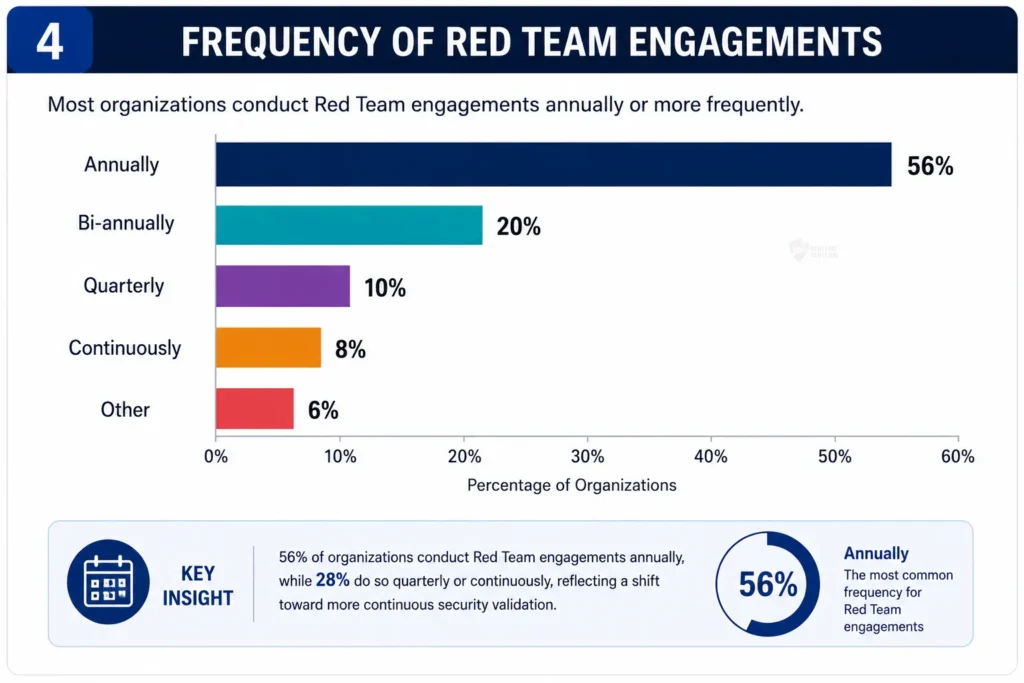
Initial Access Statistics
Understanding how attackers gain their first foothold is one of the most important aspects of any Red Team engagement.
Recent industry research highlights a significant shift in attacker behavior.
Vulnerability Exploitation Is Now the Leading Initial Access Vector
For the first time in the history of Verizon’s Data Breach Investigations Report (DBIR), vulnerability exploitation became the most common initial access vector.
Key Statistics
- 31% of confirmed breaches involved vulnerability exploitation.
- This increased significantly from 20% the previous year.
- Credential abuse declined to 13% of confirmed breaches.
- Edge devices and VPN appliances remained among the most commonly exploited systems.
Why This Matters
Organizations are patching faster than ever, but attackers are exploiting newly disclosed vulnerabilities even faster.
Many successful attacks now begin within days—or even hours—of a vulnerability becoming publicly known.
Traditional vulnerability management remains important, but organizations also need to understand how attackers chain multiple weaknesses together after gaining initial access.
Red Teaming validates those complete attack paths.
Identity Attack Statistics
Identity has become the new security perimeter.
Instead of attacking hardened infrastructure directly, adversaries increasingly compromise identities to move through cloud environments undetected.
Current trends include:
- Credential theft
- Session hijacking
- OAuth abuse
- Token theft
- MFA fatigue attacks
- Privilege escalation
- Identity federation abuse
Identity attacks frequently bypass traditional perimeter defenses because attackers appear as legitimate users.
As organizations adopt cloud-first architectures, identity security has become one of the highest-value areas for offensive security testing.
Ransomware Statistics
Ransomware continues to dominate the threat landscape.
Recent industry reporting shows:
- 48% of confirmed breaches involved ransomware.
- Small and medium-sized organizations remain disproportionately affected.
- Double-extortion attacks continue increasing.
- Attackers increasingly steal data before encryption.
- Initial access brokers continue fueling ransomware operations.
Modern ransomware operations rarely rely on a single vulnerability.
Instead they combine:
- Vulnerability exploitation
- Stolen credentials
- Privilege escalation
- Lateral movement
- Active Directory compromise
- Data exfiltration
- Encryption
Well-executed Red Team exercises evaluate each stage of this attack chain.
Learn More: Ransomware Statistics 2025: Attack Frequency, Payments, Costs & Industry Impact
Supply Chain & Third-Party Statistics
Modern organizations rely on an expanding ecosystem of vendors, SaaS platforms, cloud providers, and software integrations.
While this improves operational efficiency, it also increases organizational risk.
Current research indicates:
- 48% of confirmed breaches involved third-party access or supply chain relationships.
Examples include:
- Managed Service Providers
- Cloud providers
- Software vendors
- Identity providers
- Payment processors
- Business partners
- API integrations
Today’s Red Team engagements increasingly include trusted relationships and indirect attack paths that traditional penetration tests often exclude.
Human Element Statistics
Technology alone cannot eliminate cyber risk.
People remain one of the most frequently exploited attack surfaces.
Current research shows:
- 62% of confirmed breaches involved a human element.
Examples include:
- Phishing
- Social engineering
- Weak passwords
- Credential reuse
- Insider mistakes
- Misconfigurations
- Human error
Modern Red Team engagements frequently include controlled phishing campaigns, social engineering scenarios, and physical security assessments to evaluate organizational resilience beyond technical controls.
Patch Management Statistics
Organizations continue struggling to remediate vulnerabilities quickly enough.
Recent industry findings indicate:
- Only 26% of Known Exploited Vulnerabilities (KEVs) were fully remediated.
- Median remediation time increased to approximately 43 days.
- Attackers often begin exploiting vulnerabilities long before many organizations complete patching cycles.
This growing gap between disclosure and remediation significantly increases organizational exposure.
Red Teaming helps determine whether exploitable weaknesses can actually be leveraged before remediation occurs.
Cloud Attack Statistics
Cloud adoption continues accelerating across every industry.
Unfortunately, attackers are evolving just as quickly.
Common cloud attack techniques now include:
- Identity compromise
- Excessive permissions
- Storage bucket exposure
- Kubernetes misconfigurations
- Container escape
- Serverless abuse
- Cloud API attacks
Rather than targeting infrastructure directly, attackers increasingly abuse cloud identities and legitimate administrative functionality.
Cloud-focused Red Team engagements evaluate these modern attack paths.
AI Is Changing Offensive Security
Artificial intelligence is transforming both attackers and defenders.
Attackers increasingly use AI to:
- Generate phishing campaigns
- Automate reconnaissance
- Create malicious code
- Discover attack paths
- Improve social engineering
- Assist vulnerability research
At the same time, defenders increasingly use AI for:
- Threat detection
- Security analytics
- Incident response
- Threat intelligence
This creates an ongoing technological arms race.
Organizations adopting AI technologies should ensure security testing evolves alongside deployment.
Why Modern Attacks Are Harder to Detect
Attackers increasingly avoid malware whenever possible.
Instead they rely upon:
- Legitimate credentials
- Native administrative tools
- Cloud APIs
- Remote management software
- PowerShell
- Living-off-the-Land techniques
- Trusted applications
These techniques often generate little or no traditional malware telemetry.
As a result, security teams must validate whether detection capabilities identify attacker behavior—not simply malicious files.
This is one of the primary reasons organizations invest in realistic Red Team exercises.
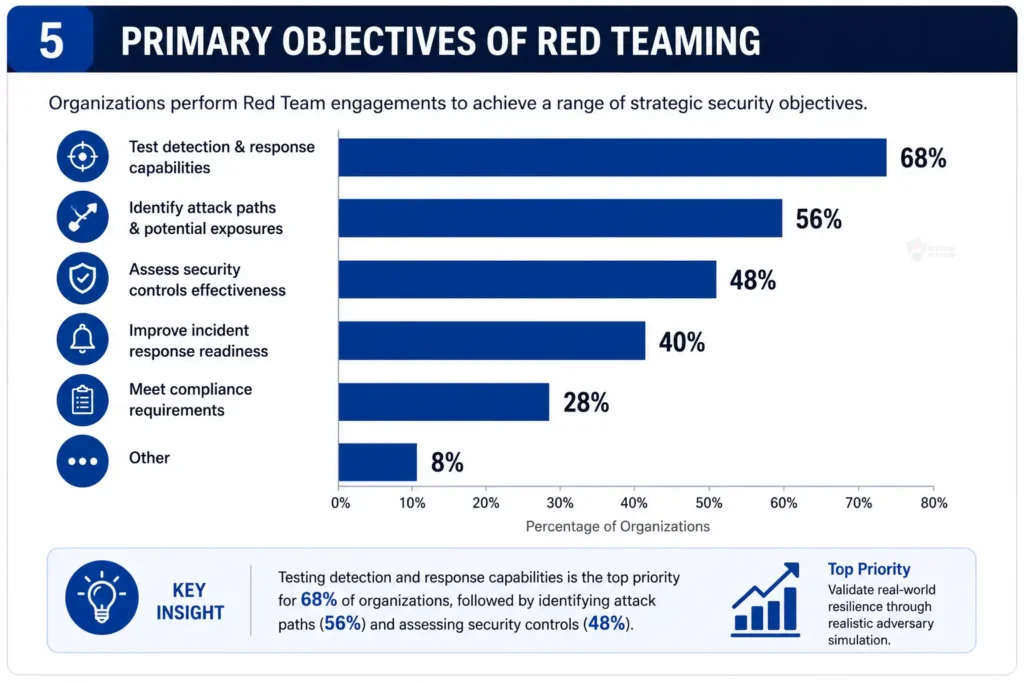
Bluefire Expert Analysis
One of the biggest misconceptions in cybersecurity is that reducing vulnerability counts automatically reduces business risk.
In reality, modern attacks rarely succeed because of a single vulnerability.
Successful attackers chain together multiple weaknesses across identities, cloud services, APIs, third-party integrations, business logic, and human behavior.
For example, an attacker may exploit a public-facing vulnerability to gain initial access, compromise a cloud identity through excessive permissions, move laterally using legitimate administrative tools, and ultimately deploy ransomware or exfiltrate sensitive data—all without relying on sophisticated malware.
Red Teaming helps organizations identify these multi-stage attack paths before real adversaries do.
Key Takeaways
The latest threat intelligence highlights several important trends:
- Vulnerability exploitation has overtaken credential theft as the leading initial access vector.
- Identity attacks continue increasing across cloud environments.
- Ransomware remains one of the most disruptive cyber threats.
- Third-party risk has become a major contributor to modern breaches.
- Human behavior continues influencing most successful attacks.
- Organizations must validate complete attack paths rather than isolated vulnerabilities.
These trends explain why Red Teaming has become one of the fastest-growing offensive security disciplines.
The next section explores one of the biggest changes affecting cybersecurity today: the rapid rise of Artificial Intelligence and the emergence of AI Red Teaming as a critical security capability.
AI Red Teaming Statistics & AI Security Trends (2026)
Artificial Intelligence has rapidly become one of the most significant changes to enterprise technology in decades.
Organizations are embedding AI into customer support, software development, healthcare, finance, manufacturing, cybersecurity operations, and internal business processes. At the same time, attackers are leveraging AI to automate reconnaissance, improve phishing campaigns, discover vulnerabilities, and accelerate exploitation.
This rapid adoption has created an entirely new attack surface.
AI Red Teaming has emerged as one of the fastest-growing disciplines within offensive security, helping organizations identify weaknesses in AI models, Large Language Models (LLMs), Retrieval-Augmented Generation (RAG) systems, AI agents, and integrated business workflows before attackers can exploit them.
AI Adoption Statistics
Artificial intelligence has moved from experimentation to enterprise-wide deployment.
Recent industry research indicates:
- Approximately 78% of organizations have deployed AI in production environments.
- AI adoption continues accelerating across healthcare, finance, manufacturing, retail, and technology sectors.
- AI-powered assistants, copilots, autonomous agents, and intelligent automation are now common components of enterprise environments.
- Most organizations now use AI in customer-facing or business-critical processes.
The challenge is that security testing has not kept pace with adoption.
AI Security Testing Statistics
Despite widespread AI adoption, relatively few organizations have implemented dedicated AI security testing programs.
Current research shows:
- Only 12% of organizations have formal AI security testing programs.
- Only 26% perform proactive AI-specific security testing.
- Most AI deployments are never evaluated using adversarial testing techniques.
This creates a growing gap between AI innovation and AI security.
Organizations often test the application surrounding an AI system but fail to evaluate the AI model itself or the business processes connected to it.
AI Red Teaming Market Statistics
Demand for AI Red Teaming continues to accelerate.
Industry forecasts estimate:
- AI Red Teaming market value exceeded $1.3 billion in 2025.
- Expected market value approaches $18.6 billion by 2035.
- Estimated compound annual growth rate exceeds 30%.
This makes AI Red Teaming one of the fastest-growing areas within offensive security.
Growth is driven by:
- Enterprise AI adoption
- Regulatory expectations
- Customer security requirements
- Increased AI-related incidents
- Emerging AI governance frameworks
AI Security Incident Statistics
Organizations are already experiencing AI-related security issues.
Recent studies indicate:
- 97% of enterprises have encountered at least one AI-related security incident.
- Shadow AI continues increasing across enterprise environments.
- AI systems increasingly process sensitive business and customer information.
- AI misuse is becoming a growing operational risk.
Many organizations remain unaware of the full extent of their AI attack surface.
Common AI Attack Techniques
Modern AI systems introduce attack vectors that traditional penetration testing rarely evaluates.
Common examples include:
Prompt Injection
Attackers manipulate prompts to bypass safety controls or change model behaviour.
Prompt injection remains one of the most common AI security risks.
Indirect Prompt Injection
Instead of interacting directly with the AI system, attackers manipulate external content consumed by the model.
Examples include:
- Malicious documents
- Web pages
- Emails
- Knowledge bases
- Third-party content
Jailbreak Attacks
Attackers attempt to bypass model safety restrictions.
Recent research indicates:
- Multi-turn jailbreak attacks succeed approximately 78% of the time.
- Some automated jailbreak techniques achieve near-complete success against tested models.
Tool Abuse
Modern AI agents increasingly interact with external tools.
Attackers may attempt to manipulate AI systems into:
- Executing commands
- Accessing sensitive data
- Triggering business workflows
- Sending emails
- Creating files
- Performing unintended actions
Data Extraction
Improperly configured AI systems may expose:
- Sensitive documents
- Customer information
- Intellectual property
- Internal knowledge bases
- Training data
Testing helps determine whether these risks can be exploited.
AI Attack Surface Statistics
Enterprise AI environments are becoming increasingly complex.
Recent research estimates:
- The average AI deployment now includes approximately 14.3 attack surface components.
- AI attack surfaces have expanded more than 300% over the past two years.
Examples include:
- LLMs
- AI agents
- APIs
- RAG pipelines
- Vector databases
- Prompt libraries
- Third-party plugins
- Cloud AI services
Each additional component introduces new opportunities for attackers.
AI Red Teaming ROI Statistics
Organizations investing in AI Red Teaming report measurable improvements.
Research indicates:
- AI Red Teaming reduced security incidents by approximately 67%.
- Organizations reported breach cost reductions exceeding 40%.
- Some studies estimate average savings approaching $2.4 million per significant incident.
Compared to the potential financial impact of an AI-related security incident, proactive testing represents a relatively small investment.
Why AI Requires a Different Approach to Security Testing
Traditional penetration testing evaluates applications, infrastructure, APIs, and networks.
AI systems introduce entirely different risks.
Testing must consider:
- Model behaviour
- Prompt manipulation
- Data leakage
- Agent autonomy
- Tool permissions
- Business workflows
- AI decision-making
- Third-party AI integrations
Organizations that rely solely on traditional penetration testing may overlook vulnerabilities unique to AI-enabled systems.
Read More: Case Study- AI Security Assessment for Insurance Platform
Bluefire Expert Analysis
Many organizations approach AI security by testing only the Large Language Model itself.
In practice, the model is often just one component of a much larger ecosystem.
A typical enterprise AI deployment may include APIs, identity providers, retrieval pipelines, vector databases, cloud infrastructure, external tools, business workflows, and third-party integrations.
From an offensive security perspective, attackers rarely focus on the model in isolation.
Instead, they exploit the relationships between these components.
A successful AI Red Team engagement should evaluate the entire attack chain—from prompt injection and identity compromise to data access, tool abuse, and business process manipulation.
This broader approach provides a more realistic understanding of organizational risk.
Key Takeaways
The latest AI security statistics highlight several important trends:
- Enterprise AI adoption is accelerating rapidly.
- AI security testing significantly lags behind AI deployment.
- AI Red Teaming is becoming one of the fastest-growing cybersecurity disciplines.
- Prompt injection remains the most common AI attack technique.
- AI ecosystems introduce entirely new attack surfaces beyond traditional applications.
- Organizations that proactively test AI systems can significantly reduce security incidents and financial risk.
As AI adoption continues to expand, offensive security programs must evolve beyond traditional penetration testing to address these emerging risks.
The next section explores Cloud Security and Identity Statistics, where cloud-native infrastructure and identity compromise continue reshaping the modern attack landscape.
Cloud Security & Identity Statistics (2026)
Cloud computing has fundamentally changed how organizations build, deploy, and secure technology.
From Microsoft Azure and Amazon Web Services (AWS) to Google Cloud Platform (GCP), SaaS applications, Kubernetes, and serverless computing, cloud adoption continues to accelerate across every industry.
Unfortunately, attackers have evolved just as quickly.
Today’s adversaries rarely attack cloud infrastructure directly. Instead, they target identities, excessive permissions, exposed APIs, cloud misconfigurations, and trusted relationships between cloud services.
These trends have made cloud-focused Red Teaming one of the fastest-growing areas within offensive security.
Cloud Adoption Statistics
Cloud adoption continues to increase globally.
Industry research consistently shows:
- More than 90% of enterprises now operate in multi-cloud or hybrid cloud environments.
- Organizations continue migrating critical business systems from on-premises infrastructure to cloud-native platforms.
- SaaS adoption remains at an all-time high across enterprise organizations.
- Cloud spending continues increasing year over year.
As organizations expand their cloud footprint, the number of internet-facing assets, APIs, identities, and cloud services grows significantly.
Every new workload introduces additional attack paths that require continuous validation.
Cloud Misconfiguration Statistics
Misconfiguration remains one of the leading causes of cloud security incidents.
Common examples include:
- Publicly accessible storage buckets
- Overly permissive Identity and Access Management (IAM) policies
- Misconfigured Kubernetes clusters
- Exposed management interfaces
- Excessive API permissions
- Insecure secrets management
Unlike software vulnerabilities, many cloud breaches occur because security controls are configured incorrectly rather than because software is inherently insecure.
This makes cloud security testing an essential component of modern Red Team engagements.
Identity Attack Statistics
Identity has become one of the most valuable targets for modern attackers.
Instead of exploiting firewalls or network appliances, attackers increasingly compromise legitimate user accounts and privileged identities.
Common attack techniques include:
- Credential theft
- Session hijacking
- OAuth abuse
- Pass-the-Token attacks
- Privileged account compromise
- MFA fatigue attacks
- Password spraying
- Token theft
Identity compromise often enables attackers to bypass traditional perimeter security entirely.
Microsoft Entra ID Statistics
Microsoft Entra ID (formerly Azure Active Directory) now protects millions of organizations worldwide.
As cloud identity adoption increases, Entra ID has become one of the most frequently targeted identity platforms.
Common attack paths include:
- Weak Conditional Access policies
- Excessive administrative privileges
- Legacy authentication
- OAuth application abuse
- Service principal compromise
- Privileged Identity Management (PIM) misconfiguration
- Hybrid identity weaknesses
Modern Red Team engagements increasingly include dedicated identity testing to validate whether cloud identities can be abused to achieve attacker objectives.
SaaS Security Statistics
Organizations now rely on hundreds of SaaS applications to support everyday business operations.
Examples include:
- Microsoft 365
- Salesforce
- ServiceNow
- Workday
- Google Workspace
- Slack
- Atlassian
- GitHub
Each application introduces new identities, APIs, permissions, integrations, and trust relationships.
Many organizations underestimate the cumulative security risk created by these interconnected platforms.
API Security Statistics
Modern cloud applications depend heavily on APIs.
APIs frequently expose:
- Customer data
- Authentication services
- Business logic
- Payment systems
- Administrative functionality
- Internal services
Recent industry reports consistently identify APIs as one of the fastest-growing attack surfaces.
Common API security issues include:
- Broken authentication
- Broken authorization
- Excessive data exposure
- Business logic flaws
- Rate limit bypasses
- Insecure object references
Red Team engagements increasingly prioritize API attack paths because successful API compromise often provides direct access to critical business functions.
Kubernetes & Container Security
Containerized workloads continue replacing traditional virtual machines.
As Kubernetes adoption grows, attackers increasingly target:
- Misconfigured clusters
- Exposed Kubernetes dashboards
- Weak Role-Based Access Control (RBAC)
- Insecure container images
- Secrets stored in containers
- Privileged containers
Container security now represents a core component of cloud-focused offensive security testing.
Serverless Security Trends
Serverless computing introduces unique security considerations.
Unlike traditional infrastructure, organizations must secure:
- Cloud functions
- Event triggers
- API gateways
- IAM permissions
- Storage services
- Secrets management
Red Teaming helps validate whether attackers can exploit these components to move laterally across cloud environments.
Why Cloud Red Teaming Matters
Traditional infrastructure assessments typically focus on:
- Operating systems
- Network devices
- Web applications
Cloud Red Teaming evaluates:
- Identity compromise
- Privilege escalation
- Cloud APIs
- SaaS integrations
- Kubernetes
- Serverless workloads
- Cross-cloud attack paths
- Business workflows
The objective is to understand how attackers would compromise an entire cloud ecosystem rather than a single cloud service.

Bluefire Expert Analysis
One of the biggest misconceptions surrounding cloud security is that cloud providers are responsible for securing customer environments.
In reality, cloud providers secure the underlying infrastructure, while customers remain responsible for identities, permissions, workloads, applications, configurations, APIs, and sensitive data.
During cloud-focused Red Team engagements, we frequently observe organizations with strong infrastructure security but weak identity governance, excessive privileges, exposed APIs, or overly permissive cloud configurations.
Attackers rarely need to exploit sophisticated zero-day vulnerabilities when legitimate cloud identities already provide the access they need.
This shift toward identity-centric attacks is one of the primary reasons modern offensive security programs increasingly prioritize cloud identity testing alongside traditional infrastructure assessments.
Key Takeaways
The latest cloud security trends highlight several important developments:
- Cloud adoption continues accelerating across every industry.
- Identity has become the primary security perimeter.
- APIs represent one of the fastest-growing attack surfaces.
- Cloud misconfigurations remain a leading cause of security incidents.
- SaaS ecosystems continue expanding organizational attack surfaces.
- Cloud Red Teaming has become an essential component of modern offensive security programs.
Organizations that continuously validate cloud identities, APIs, permissions, and business workflows are significantly better positioned to detect and prevent modern attack techniques.
The next section examines how these trends affect specific industries, including healthcare, financial services, manufacturing, critical infrastructure, government, and technology organizations.
Industry Cybersecurity Statistics (2026)
While cyber threats affect organizations across every sector, attackers increasingly tailor their techniques to specific industries based on financial incentives, operational disruption, regulatory pressure, and data value.
Healthcare organizations must protect sensitive patient information. Financial institutions defend against sophisticated fraud and ransomware campaigns. Manufacturers face operational disruption through attacks on industrial systems, while critical infrastructure providers remain attractive targets for nation-state actors.
Understanding industry-specific cyber trends helps organizations prioritize security investments, benchmark risk, and develop more realistic Red Team objectives.
Healthcare Cybersecurity Statistics
Healthcare remains one of the most frequently targeted industries worldwide.
Electronic Protected Health Information (ePHI), medical devices, legacy systems, and operational requirements create a complex security environment.
Recent research highlights several important trends:
- Healthcare consistently ranks among the industries with the highest average breach costs.
- Ransomware continues disrupting hospitals, clinics, and healthcare providers worldwide.
- Medical devices remain a growing attack surface.
- Third-party vendors continue contributing to healthcare security incidents.
- Healthcare organizations face increasing regulatory scrutiny following security breaches.
Healthcare organizations often operate thousands of connected systems, making continuous security validation essential.
Why This Matters
Healthcare environments combine cloud services, medical technology, third-party integrations, and identity systems into a highly interconnected ecosystem.
Red Teaming helps validate whether attackers could move across these environments to access patient information or disrupt clinical operations.
Financial Services Cybersecurity Statistics
Banks, insurers, payment providers, fintech companies, and investment firms remain among the most targeted organizations globally.
Financial institutions experience attacks involving:
- Credential theft
- Identity compromise
- Payment fraud
- API abuse
- Business email compromise
- Ransomware
- Insider threats
The financial sector also faces strict regulatory expectations and increasing customer security requirements.
Independent offensive security assessments help validate controls protecting high-value financial systems.
Manufacturing Cybersecurity Statistics
Manufacturing organizations continue expanding digital operations through Industrial Internet of Things (IIoT) technologies, cloud-connected production systems, and smart factories.
Recent industry trends include:
- Increasing ransomware activity targeting manufacturers.
- Greater dependence on connected operational technology.
- Growing supply chain security concerns.
- Expanded attack surfaces resulting from digital transformation.
Security incidents can now affect both information technology (IT) and operational technology (OT), increasing potential business impact.
Critical Infrastructure Statistics
Critical infrastructure organizations support essential services that modern societies depend upon.
Examples include:
- Electricity
- Water
- Transportation
- Telecommunications
- Oil and gas
- Public services
Because operational disruption can have widespread consequences, these organizations continue attracting sophisticated cyber adversaries.
Recent reports show increasing attacks targeting industrial control systems, operational technology environments, and infrastructure operators.
Red Teaming helps evaluate whether attackers could compromise operational processes or critical business systems.
Energy & Utilities Cybersecurity Statistics
Energy providers continue modernizing operations through digital transformation and remote management technologies.
While these innovations improve efficiency, they also introduce additional cyber risk.
Common concerns include:
- Remote access security
- Industrial control systems
- Third-party maintenance providers
- Cloud monitoring platforms
- Identity security
- Operational continuity
As geopolitical tensions continue evolving, many energy organizations are increasing investment in offensive security testing and resilience exercises.
Government Cybersecurity Statistics
Government agencies remain frequent targets of:
- Nation-state actors
- Hacktivist groups
- Cybercriminal organizations
- Espionage campaigns
Public sector environments often manage sensitive citizen information, critical infrastructure, and national security systems.
Red Teaming provides valuable insight into whether existing security controls can withstand sophisticated attacks while supporting continuous security improvement.
SaaS & Technology Industry Statistics
Technology companies operate some of the most rapidly changing environments in the world.
Continuous software releases, cloud-native architectures, APIs, and customer-facing applications require equally agile security validation.
Key trends include:
- Enterprise customers increasingly request independent penetration testing reports.
- SOC 2 has become a common procurement requirement.
- APIs continue expanding organizational attack surfaces.
- AI-enabled applications introduce new security challenges.
- SaaS providers increasingly adopt continuous testing models.
Organizations delivering software as a service must demonstrate both strong security and ongoing validation of security controls.
Third-Party Risk Across Industries
One trend affects every industry represented in this report:
Third-party relationships continue increasing organizational risk.
Modern organizations depend upon:
- Cloud providers
- Software vendors
- Managed service providers
- Payment processors
- AI providers
- Business partners
- External developers
Recent research indicates that nearly half of confirmed breaches involve third-party relationships or supply chain components.
This reinforces the importance of testing not only internal environments but also trusted integrations and external attack paths.
Bluefire Expert Analysis
Every industry faces unique threats, but the most successful attacks share a common characteristic:
Attackers exploit business context rather than isolated technical weaknesses.
In healthcare, attackers seek patient data and operational disruption.
In financial services, they pursue fraud and financial gain.
In manufacturing and critical infrastructure, operational downtime may be the primary objective.
This is why effective Red Team engagements should never follow a generic checklist.
Attack scenarios should reflect the organization’s industry, technology stack, regulatory obligations, business processes, and most valuable assets.
Tailoring offensive security exercises to realistic business risks provides significantly more value than relying on standardized technical testing alone.
Key Takeaways
Several trends emerge across every industry:
- Industry-specific attack techniques continue evolving.
- Operational disruption is becoming as significant as data theft.
- Third-party ecosystems continue expanding organizational attack surfaces.
- Cloud adoption is increasing cyber risk across every sector.
- Continuous offensive security testing helps organizations validate real-world resilience.
Organizations that align Red Team objectives with industry-specific threats are better positioned to identify meaningful security weaknesses before attackers do.
The next section examines how organizations measure the value of Red Teaming, including ROI, business impact, engagement metrics, and executive security investments.
Red Team ROI & Business Impact Statistics
One of the most common questions executives ask is:
“How do we measure the value of Red Teaming?”
Unlike traditional security metrics that focus on the number of vulnerabilities discovered, Red Teaming measures how effectively an organization can withstand realistic attacks.
Modern organizations increasingly evaluate offensive security using business outcomes rather than technical outputs.
Organizations Continue Increasing Offensive Security Budgets
Cybersecurity spending continues to grow across every major industry.
Recent research indicates:
- More than 90% of organizations increased cybersecurity investments.
- Over 56% increased spending on offensive security initiatives.
- Continuous testing models continue replacing annual security assessments.
- Executive leadership increasingly views offensive security as a strategic business investment.
Rather than asking whether systems are secure, organizations increasingly ask whether security controls can withstand real attackers.
Why Organizations Invest in Red Teaming
Security leaders identify several reasons for conducting Red Team exercises:
- Validate security controls
- Test incident response capabilities
- Identify attack paths
- Improve detection and response
- Reduce business risk
- Support compliance initiatives
- Meet customer security requirements
- Improve executive confidence
Unlike compliance-driven assessments, Red Teaming evaluates how security performs under realistic attack conditions.
Business Benefits of Red Teaming
Organizations that perform regular Red Team exercises commonly report benefits such as:
- Faster detection of attacker activity
- Improved incident response coordination
- Better visibility into attack paths
- Higher confidence in security investments
- Improved collaboration between security teams
- Better prioritization of remediation efforts
These outcomes help security teams focus on reducing real-world business risk rather than simply lowering vulnerability counts.
Continuous Testing Is Becoming the Preferred Model
Enterprise environments evolve constantly.
Organizations regularly:
- Deploy new applications
- Release software updates
- Introduce AI capabilities
- Expand cloud infrastructure
- Integrate third-party platforms
As a result, many organizations are adopting continuous offensive security programs that combine:
- Penetration Testing
- Red Teaming
- Purple Team exercises
- Attack simulation
- Continuous validation
This shift enables security teams to identify emerging risks throughout the year instead of relying solely on annual assessments.
Bluefire Expert Perspective
One of the most significant changes we’ve observed is how organizations define success.
Five years ago, success often meant completing a penetration test before an audit.
Today, success is measured differently:
- Can attackers reach critical assets?
- Can our SOC detect lateral movement?
- Would ransomware spread across the environment?
- Can privileged identities be abused?
- Are our cloud security controls effective?
These questions focus on business resilience rather than technical compliance.
Organizations that regularly validate realistic attack paths are generally better positioned to adapt as their environments evolve.
Frequently Asked Questions - Red Team Statistics
- What is Red Teaming?Red Teaming is an offensive security assessment that simulates realistic attackers to evaluate an organization's ability to prevent, detect, and respond to cyber threats.
- How is Red Teaming different from Penetration Testing?Penetration Testing primarily identifies exploitable vulnerabilities, while Red Teaming evaluates complete attack paths and measures how effectively people, processes, and technology perform during realistic adversary simulations.
- How often should organizations perform Red Teaming?Most organizations perform Red Team exercises annually or after significant infrastructure, cloud, identity, or business changes. Mature security programs may perform targeted exercises more frequently.
- Which industries benefit most from Red Teaming?Healthcare, financial services, manufacturing, government, energy, critical infrastructure, SaaS providers, and technology companies commonly perform Red Team exercises because of their high-value assets and regulatory obligations.
- Does Red Teaming help with compliance?While Red Teaming is not always explicitly required by compliance frameworks, it supports broader security objectives related to SOC 2, PCI DSS, HIPAA, ISO 27001, and customer security assessments.
- Is AI changing Red Teaming?Yes. AI is transforming both offensive and defensive cybersecurity. Organizations increasingly evaluate AI systems, Large Language Models, AI agents, and business workflows through AI Red Teaming exercises.
- Why are cloud identities frequently targeted?Cloud identities often provide attackers with direct access to sensitive systems and data. Misconfigured permissions, excessive privileges, and identity compromise can allow attackers to bypass traditional perimeter defenses.
- What is the biggest cybersecurity trend in 2026?
Based on the research reviewed for this report, three trends stand out:
- Increased vulnerability exploitation
- Identity-centric attacks
- Rapid enterprise adoption of artificial intelligence
These trends continue driving demand for realistic offensive security testing.
Conclusion
Cybersecurity continues evolving at an unprecedented pace.
Cloud adoption, artificial intelligence, identity-centric attacks, ransomware, and increasingly sophisticated threat actors have fundamentally changed how organizations approach security.
The statistics presented throughout this report highlight one consistent theme:
Organizations are moving beyond point-in-time security assessments toward continuous validation of real-world attack scenarios.
Red Teaming has become an essential capability for organizations seeking to understand how attackers could compromise critical systems, abuse identities, exploit cloud environments, or bypass existing security controls.
Whether you’re building an offensive security program, benchmarking your organization’s maturity, or planning future investments, these statistics provide valuable context for making informed security decisions.
As new research becomes available, this report will continue to be updated throughout 2026 to ensure readers have access to the latest Red Teaming trends, market data, and cybersecurity insights.
Download the Complete Red Teaming Statistics 2026 PDF
Prefer an offline version?
Download the complete Red Teaming Statistics 2026 report, including:
- 250+ cybersecurity statistics
- Market insights
- Industry benchmarks
- AI security trends
- Cloud security data
- Executive summary
- Source references
Use it for presentations, executive briefings, security awareness, research, and strategic planning.
About This Research
This article compiles publicly available research from leading cybersecurity organizations, government agencies, industry analysts, and technology vendors. Statistics are reviewed for relevance, publication date, and source credibility, and the report is updated periodically to reflect significant new findings and industry developments.