Last Updated: July 2026
Energy Penetration Testing: A Complete Guide for Critical Infrastructure Organizations
Energy sector penetration testing is the practice of simulating real-world cyberattacks against an energy organization’s digital environment, including Industrial Control Systems (ICS), SCADA systems, Operational Technology (OT) networks, corporate IT infrastructure, cloud environments, APIs, remote access solutions, identity platforms, and supporting applications to identify exploitable vulnerabilities before attackers do. As electricity providers, utilities, renewable energy companies, and oil and gas operators continue to digitise operations and connect IT with OT environments, the attack surface has expanded significantly, increasing the risk of ransomware, operational disruption, supply chain attacks, and critical infrastructure compromise.
Modern energy organizations rely on interconnected technologies to monitor and control industrial processes, manage critical infrastructure, support remote operations, integrate with third-party vendors, and deliver essential services. That connectivity is exactly what cybercriminals target through attacks on OT networks, remote access systems, APIs, cloud infrastructure, identity platforms, and third-party integrations. Penetration testing helps energy organizations proactively identify and remediate these weaknesses by simulating the techniques used by real-world attackers before they can impact operations, public safety, or regulatory compliance.
This guide explains why penetration testing is essential for the energy sector, which systems should be tested, emerging cybersecurity threats, regulatory and compliance considerations, and best practices for improving cyber resilience.
Quick Glance: Energy Sector Penetration Testing
- Purpose: Identify exploitable vulnerabilities across IT, OT, ICS, SCADA, cloud infrastructure, APIs, and identity systems before attackers can disrupt critical energy operations.
- Systems Tested: SCADA systems, Industrial Control Systems (ICS), OT networks, enterprise IT, remote access solutions, APIs, cloud environments, identity platforms, and supporting applications.
- Primary Risks: Ransomware, OT compromise, attacks on industrial control systems, insecure remote access, cloud misconfigurations, identity attacks, API vulnerabilities, and third-party supply chain risks.
- Standards: Assessments typically align with the OWASP Top 10, OWASP API Security Top 10, MITRE ATT&CK, IEC 62443, NIST Cybersecurity Framework (CSF), NERC CIP (where applicable), ISO/IEC 27001, and other relevant energy sector regulations and security frameworks.
- Who Needs It: Electricity providers, utility companies, renewable energy operators, oil and gas organisations, transmission and distribution operators, critical infrastructure providers, and industrial energy companies.
- Recommended Frequency: At least annually, after major infrastructure changes, OT network upgrades, cloud migrations, deployment of new industrial systems, or significant operational changes.
- Typical Cost & Duration: Energy sector penetration testing engagements typically start from $8,000 and take 1–4 weeks, depending on the number of IT and OT environments, industrial systems, cloud infrastructure, identity platforms, and the overall scope of the assessment. Learn more about penetration testing pricing
- Outcome: A prioritised report with validated vulnerabilities, business and operational impact, proof of exploitation where appropriate, and actionable remediation guidance to strengthen cyber resilience across both IT and OT environments.
Ready to Validate Your Energy Security?
Cyber threats against the energy sector continue to evolve, making proactive security testing essential for protecting critical infrastructure, operational technology, and business-critical systems.
Whether you’re assessing enterprise IT, cloud infrastructure, customer-facing applications, or supporting OT environments, Bluefire Redteam delivers independent penetration testing tailored to the unique challenges of energy organizations.
Why the Energy Sector Is a Prime Target
Energy infrastructure is classified as critical infrastructure in many countries, making it an attractive target for cybercriminals, ransomware groups, state-sponsored actors, and hacktivists.
Several factors increase the sector’s exposure:
- Legacy operational technology
- Internet-connected industrial systems
- Cloud adoption
- Remote workforce access
- Third-party vendors
- Smart grid technologies
- Renewable energy integration
- Increasing API usage
- IT and OT convergence
Threat actors frequently target these environments because operational disruption can have consequences far beyond financial loss.
Rather than stealing data alone, attackers increasingly seek to interrupt operations, deploy ransomware, or compromise critical business processes.
What Is Energy Penetration Testing?
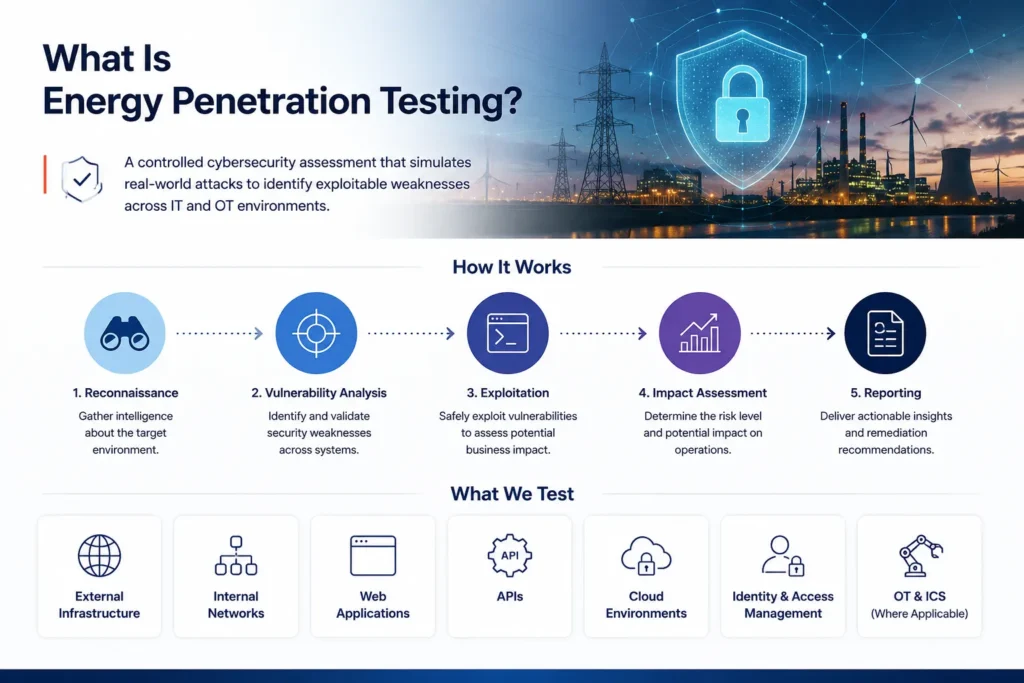
Energy penetration testing is a controlled cybersecurity assessment that evaluates how effectively an organization’s IT and supporting operational environments resist realistic cyberattacks.
Unlike vulnerability scanning, penetration testing validates whether identified weaknesses can actually be exploited.
Assessments typically evaluate:
- External infrastructure
- Internal corporate networks
- Web applications
- Customer portals
- APIs
- Cloud environments
- Identity platforms
- Remote access infrastructure
- Supporting OT management systems (where appropriate)
The objective is to understand business risk—not simply identify vulnerabilities.
IT vs OT Penetration Testing
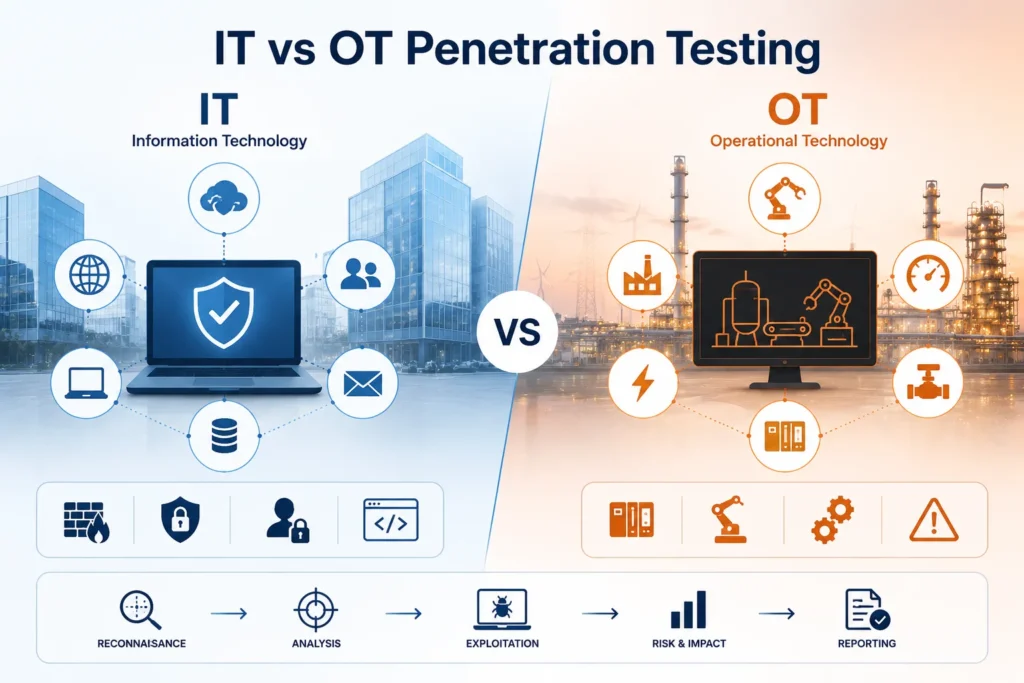
One of the biggest misconceptions is that all penetration testing should be performed the same way.
For energy organizations, there is an important distinction between Information Technology (IT) and Operational Technology (OT).
Information Technology (IT)
IT assessments commonly include:
- Corporate networks
- Active Directory
- Microsoft Entra ID
- Email infrastructure
- Web applications
- APIs
- Cloud platforms
- VPNs
- User endpoints
Testing focuses on identifying vulnerabilities that could allow unauthorized access, privilege escalation, or data compromise.
Operational Technology (OT)
OT environments require a much more cautious approach.
These environments often include:
- SCADA systems
- Industrial Control Systems (ICS)
- Engineering workstations
- PLC management networks
- Human Machine Interfaces (HMIs)
- Remote monitoring systems
Because these systems support physical operations, testing must be carefully scoped and coordinated to avoid disrupting production.
Organizations should only perform OT security testing using experienced offensive security specialists following approved methodologies and operational safety procedures.
Common Cybersecurity Risks in the Energy Sector
Energy organizations face a wide range of cyber threats.
Common weaknesses include:
Weak Identity Controls
Compromised privileged accounts remain one of the most common attack paths.
Cloud Misconfigurations
Cloud adoption introduces identity, storage, and configuration risks that attackers actively exploit.
Internet-Exposed Remote Access
VPN gateways, remote desktop services, and vendor access solutions frequently become entry points for attackers.
Poor IT/OT Segmentation
Insufficient separation between enterprise networks and operational environments can allow attackers to move toward critical infrastructure.
Insecure APIs
Customer portals, smart meters, IoT platforms, and mobile applications increasingly depend on APIs that require dedicated security testing.
Legacy Infrastructure
Older systems may lack modern authentication, encryption, or patching capabilities, increasing cyber risk.
What Should Be Included in an Energy Penetration Test?
Every engagement should be based on business risk.
Typical assessment areas include:
External Infrastructure
- Firewalls
- VPN gateways
- Internet-facing services
- Email security
Internal Networks
- Active Directory
- Microsoft Entra ID
- Privileged accounts
- Lateral movement
- Network segmentation
Web Applications
- Customer portals
- Billing systems
- Operational dashboards
- Employee applications
API Security
- Authentication
- Authorization
- Business logic
- Data exposure
- Injection vulnerabilities
Cloud Security
- Azure
- AWS
- Google Cloud
- Microsoft 365
Identity Security
- Conditional Access
- MFA
- Identity governance
- Privileged Identity Management (PIM)
Ready to Validate Your Energy Security?
Cyber threats against the energy sector continue to evolve, making proactive security testing essential for protecting critical infrastructure, operational technology, and business-critical systems.
Whether you’re assessing enterprise IT, cloud infrastructure, customer-facing applications, or supporting OT environments, Bluefire Redteam delivers independent penetration testing tailored to the unique challenges of energy organizations.
Compliance & Industry Standards
Many energy organizations align cybersecurity programmes with internationally recognised standards and sector-specific regulations.
Depending on the jurisdiction and operating environment, penetration testing may support initiatives related to:
- IEC 62443
- NERC CIP
- ISO/IEC 27001
- NIS2 Directive
- Internal cyber resilience programmes
- Supply chain security requirements
While these frameworks differ, they all emphasize understanding and reducing cyber risk through effective technical security controls and ongoing assessment.
How Often Should Energy Companies Perform Penetration Testing?
There is no universal schedule.
However, penetration testing is commonly performed:
- Annually
- Before major infrastructure upgrades
- Following cloud migrations
- After deploying new customer-facing applications
- Following mergers or acquisitions
- After significant network changes
- Prior to regulatory assessments
- Following major cybersecurity incidents
Testing frequency should always reflect the organization’s risk profile, operational environment, and regulatory obligations.
How to Choose an Energy Penetration Testing Provider
Selecting the right provider is just as important as deciding to perform the assessment.
Look for a provider with:
- Experience securing critical infrastructure
- Knowledge of IT and OT environments
- Cloud security expertise
- Identity security experience
- API security testing capabilities
- Manual penetration testing expertise
- Clear reporting methodologies
- Practical remediation guidance
Organizations should also ensure testing methodologies are appropriate for environments where operational continuity is essential.
Frequently Asked Questions - Energy Penetration Testing
- What is Energy Penetration Testing?Energy penetration testing is a security assessment that evaluates how effectively an energy organization's systems resist realistic cyberattacks across IT, cloud, applications, networks, and supporting operational environments.
- Is OT penetration testing safe?Yes—when properly planned and conducted. OT assessments require specialized methodologies, clearly defined rules of engagement, and close coordination to minimize operational risk.
- How often should energy companies perform penetration testing?Most organizations conduct penetration testing annually or following significant infrastructure, cloud, application, or operational changes. The appropriate frequency depends on business risk and regulatory expectations.
- Does penetration testing replace vulnerability scanning?No. Vulnerability scanning identifies potential weaknesses, while penetration testing determines whether those weaknesses can actually be exploited and what business impact they could have.
- What systems should be tested?Organizations typically assess internet-facing infrastructure, internal networks, cloud environments, identity systems, web applications, APIs, and other critical assets based on their risk profile.
Strengthening Cyber Resilience in the Energy Sector
As the energy industry becomes increasingly connected, cybersecurity must evolve alongside operational technology, cloud infrastructure, and digital transformation initiatives.
Penetration testing provides organizations with practical insight into how attackers could exploit weaknesses across enterprise environments, helping security teams prioritize remediation efforts and improve overall resilience.
Whether you’re securing corporate networks, customer-facing applications, cloud platforms, or supporting operational technology, regular penetration testing plays an important role in reducing cyber risk and strengthening critical infrastructure.
If your organization is planning a security assessment, Bluefire Redteam delivers independent penetration testing and Red Team engagements tailored to the unique challenges of the energy sector.