Get AI-Powered + Human Validated Pen Testing!

Enterprise Adversary Simulation Services

Simulate Real-World Cyber Adversaries Before They Target Your Business

Bluefire Redteam delivers enterprise adversary simulation services that emulate the tactics, techniques, and procedures (TTPs) used by ransomware operators, advanced persistent threats (APTs), insider threats, and financially motivated attackers.

Unlike traditional penetration testing, adversary simulation focuses on realistic attack scenarios that measure whether your organization can prevent, detect, respond to, and recover from sophisticated cyberattacks across cloud, identity, endpoints, SaaS applications, and hybrid environments.

Our engagements help organizations answer one critical question:

“If a real attacker targeted us today, how far could they get before being detected?”

Whether you’re validating your Security Operations Center (SOC), testing your incident response capabilities, or preparing for board-level cyber assurance, our adversary simulation services provide the evidence needed to understand your true security posture.

Trusted by global organisations for top-tier cybersecurity solutions!

What Are Adversary Simulation Services?

Adversary simulation is an advanced offensive security assessment that replicates the behavior of real-world threat actors using the same attack methodologies observed in modern cyberattacks.

Rather than identifying isolated vulnerabilities, adversary simulation evaluates how attackers chain multiple weaknesses together to compromise business-critical systems and achieve meaningful objectives.

These objectives may include:

  • Compromising Active Directory or Entra ID
  • Obtaining privileged credentials
  • Bypassing endpoint detection and response (EDR)
  • Moving laterally across the enterprise
  • Accessing sensitive business data
  • Testing ransomware attack paths
  • Evaluating cloud identity security
  • Measuring Security Operations Center (SOC) detection capabilities
  • Validating incident response procedures

By simulating realistic attack campaigns, organizations gain a clear understanding of their resilience against sophisticated adversaries rather than simply receiving a list of technical vulnerabilities.

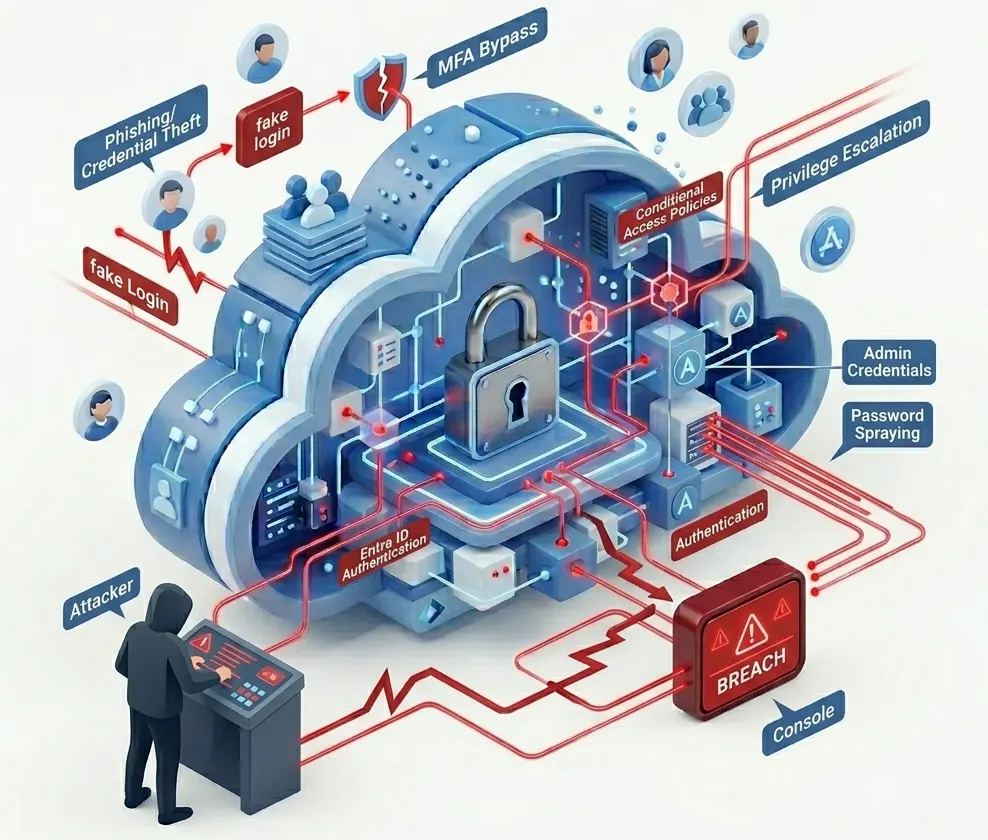
entra ID

Why Organizations Invest in Adversary Simulation

Cybersecurity environments have evolved dramatically.

Modern attackers rarely exploit a single vulnerability before leaving.

Instead, they:

  • Abuse identities
  • Exploit cloud misconfigurations
  • Leverage stolen credentials
  • Bypass security monitoring
  • Live off the land using legitimate administrative tools
  • Maintain persistence for extended periods
  • Escalate privileges before reaching critical business assets

Traditional security assessments often validate individual systems.

Adversary simulation validates how your entire security ecosystem performs during a coordinated attack.

Organizations typically perform adversary simulation to:

  • Validate detection capabilities
  • Measure incident response readiness
  • Test security investments
  • Improve cyber resilience
  • Reduce business risk
  • Prepare for regulatory audits
  • Strengthen executive confidence
  • Validate Zero Trust implementations
  • Support cyber insurance requirements
Attacker Targeting Entra ID

How Our Adversary Simulation Engagements Work

Every engagement follows a structured methodology designed to replicate realistic attacker behavior while protecting business operations.

Phase 1 – Planning & Threat Profiling

We begin by understanding:

  • Business objectives
  • Critical assets
  • Threat landscape
  • Industry-specific risks
  • Rules of engagement
  • Success criteria

Threat scenarios are then developed based on realistic adversaries targeting organizations similar to yours.

Phase 2 – Reconnaissance

Our consultants gather publicly available intelligence exactly as a real attacker would.

Activities include:

  • External reconnaissance
  • Infrastructure discovery
  • Cloud footprint identification
  • Email harvesting
  • Credential exposure analysis
  • Third-party relationship mapping

Phase 3 – Initial Access

We simulate multiple attack vectors including:

  • Phishing campaigns
  • External exploitation
  • Credential attacks
  • Web application compromise
  • VPN access
  • Cloud authentication abuse
  • API compromise

Phase 4 – Privilege Escalation & Persistence

Once access is established, we assess whether attackers can:

  • Escalate privileges
  • Establish persistence
  • Bypass security controls
  • Evade endpoint protection
  • Abuse privileged identities

Phase 5 – Lateral Movement

Real attackers rarely stop after compromising one system.

We evaluate whether attackers can:

  • Move across networks
  • Access servers
  • Compromise cloud identities
  • Reach production workloads
  • Pivot between environments
  • Access critical business systems

Phase 6 – Business Objective Simulation

Every engagement concludes by attempting realistic attacker objectives such as:

  • Sensitive data access
  • Domain dominance
  • Identity compromise
  • Cloud privilege escalation
  • Business email compromise
  • Simulated ransomware deployment

Phase 7 – Executive Reporting

You receive:

  • Executive summary
  • Technical findings
  • Attack narrative
  • MITRE ATT&CK mapping
  • Detection analysis
  • Security gaps
  • Prioritized remediation roadmap

Attack Techniques We Simulate

Bluefire Redteam models engagements after modern adversaries using techniques aligned with the MITRE ATT&CK framework.

Common attack scenarios include:

  • Credential harvesting
  • Password spraying
  • Pass-the-Hash
  • Kerberoasting
  • Token theft
  • OAuth abuse
  • Active Directory attacks
  • Entra ID attacks
  • Cloud privilege escalation
  • Living-off-the-land techniques
  • PowerShell abuse
  • Command and scripting interpreter abuse
  • Lateral movement
  • Privilege escalation
  • Data exfiltration
  • Ransomware attack paths
  • API exploitation
  • SaaS compromise
  • Persistence mechanisms
  • Defense evasion

Each engagement is customized to reflect the threats most relevant to your organization.

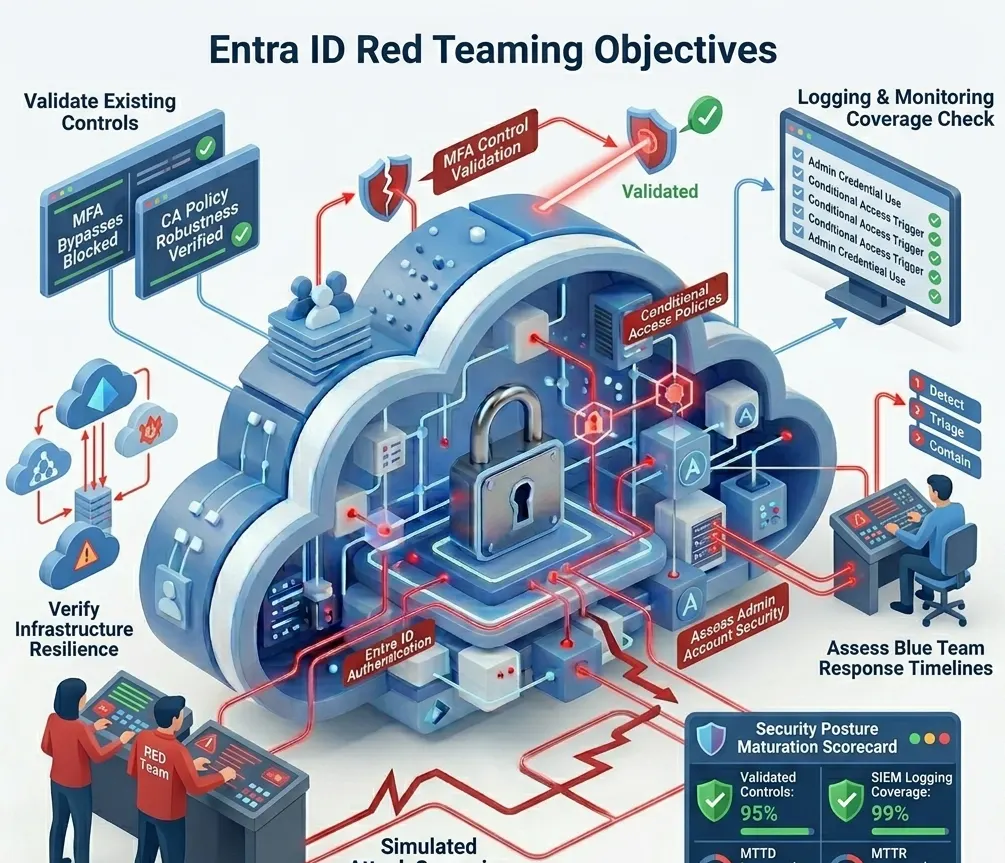
Entra ID Red Team Objectives

Types of Adversary Simulation Services

External Adversary Simulation

Simulates internet-based attackers attempting to compromise externally accessible systems including web applications, APIs, VPNs, cloud infrastructure, and remote access services.

Internal Adversary Simulation

Assumes an attacker has already established an initial foothold and evaluates how effectively internal controls prevent privilege escalation, lateral movement, and access to critical assets.

Cloud Adversary Simulation

Tests cloud-native environments including:

  • Azure
  • AWS
  • Microsoft 365
  • Entra ID
  • SaaS platforms
  • Hybrid cloud environments

Identity-Based Adversary Simulation

Focuses on modern identity attack paths including:

  • Single Sign-On
  • OAuth
  • Entra ID
  • Active Directory
  • Conditional Access
  • Privileged Identity Management

AI Adversary Simulation

Emerging AI systems introduce new attack surfaces.

Our AI adversary simulations evaluate:

  • Prompt injection
  • Sensitive data leakage
  • AI agent abuse
  • Retrieval-Augmented Generation (RAG) attacks
  • LLM security weaknesses
  • AI workflow manipulation

Organizations comparing offensive security providers can use our Red Team Vendor Evaluation Checklist to assess capabilities and engagement quality.

What Makes Adversary Simulation Different From Penetration Testing?

Traditional penetration testing answers:

“Can this system be exploited?”

Adversary simulation answers:

“Can a realistic attacker achieve meaningful business objectives without being stopped?”

Penetration TestingAdversary Simulation
Focuses on individual systemsEvaluates complete attack paths
Identifies vulnerabilitiesMeasures business impact
Technical validationSecurity resilience validation
Limited scopeEnterprise-wide scope
Usually short engagementsMulti-week campaigns
Primarily technical findingsExecutive and operational insights
Limited detection testingFull SOC validation

Organizations with mature security programs frequently perform both assessments as part of a comprehensive offensive security strategy.

Adversary Simulation vs Red Teaming

These terms are often used interchangeably, but they describe different concepts.

Red Teaming is the overall offensive security engagement.

Adversary Simulation is the methodology used to conduct that engagement.

At Bluefire Redteam, our Red Team services are delivered through realistic adversary simulation methodologies that emulate modern cyber threats and align with your organization’s business objectives.

Industries We Support

Our adversary simulation services are designed for organizations operating in high-risk and highly regulated environments, including:

  • Financial Services
  • Banking
  • Healthcare
  • Pharmaceutical
  • Manufacturing
  • Energy & Utilities
  • Critical Infrastructure
  • Government
  • SaaS Providers
  • Technology Companies
  • Telecommunications
  • Retail & E-commerce

Each engagement reflects industry-specific attack scenarios, regulatory expectations, and business risks.

Deliverables

Every adversary simulation engagement includes comprehensive reporting designed for both technical teams and executive stakeholders.

Deliverables include:

  • Executive Summary
  • Complete Attack Narrative
  • MITRE ATT&CK Mapping
  • Attack Timeline
  • Initial Access Analysis
  • Identity Attack Assessment
  • Detection & Response Evaluation
  • Security Control Effectiveness
  • Business Risk Assessment
  • Prioritized Remediation Plan
  • Technical Evidence
  • Executive Presentation (optional)

Why Choose Bluefire Redteam?

Experienced Offensive Security Specialists

Our consultants possess extensive experience conducting enterprise Red Team engagements across cloud, hybrid, and complex enterprise environments.

Realistic Threat Emulation

Every engagement reflects current attacker methodologies rather than outdated penetration testing checklists.

Business-Focused Objectives

We evaluate what matters most—whether attackers can compromise the systems, identities, and data that drive your business.

MITRE ATT&CK Aligned

Our methodologies are mapped against the MITRE ATT&CK framework to ensure industry-recognized coverage and consistent reporting.

Executive-Ready Reporting

Technical teams receive detailed evidence while executives receive clear insights into business risk, operational impact, and remediation priorities.

Frequently Asked Questions - Adversary Simulation

  • Adversary simulation is an offensive security assessment that emulates realistic cyberattack techniques to evaluate an organization's ability to detect, respond to, and contain sophisticated threats.
  • Penetration testing focuses on identifying vulnerabilities within specific systems, while adversary simulation measures whether attackers can successfully achieve business objectives by chaining multiple attack techniques together.
  • Typical engagements range from four to eight weeks depending on organizational size, objectives, and agreed scope.
  • Yes. Where approved, phishing, credential harvesting, and social engineering scenarios can be incorporated into the engagement.
  • Absolutely. Modern engagements commonly evaluate Azure, AWS, Microsoft 365, Entra ID, SaaS applications, APIs, and hybrid cloud infrastructures.
  • Yes. One of the primary objectives is validating detection capabilities, alert quality, incident response processes, and overall SOC effectiveness.
  • Yes. Bluefire Redteam maps attack techniques, findings, and recommendations against the MITRE ATT&CK framework where appropriate.
Ready to Validate Your Security Against Real Attackers?

Sophisticated attackers don’t exploit vulnerabilities in isolation—they combine identities, cloud services, endpoints, and human behavior to achieve their objectives.

Bluefire Redteam’s adversary simulation services help organizations understand whether those attack paths exist before real adversaries discover them.

Whether your goal is validating your SOC, assessing ransomware resilience, strengthening cloud security, or measuring your organization’s ability to withstand modern cyber threats, our experienced Red Team operators can help.

Subscribe to our newsletter now and reveal a free cybersecurity assessment that will level up your security.

  • Instant access.
  • Limited-time offer.
  • 100% free.

🎉 You’ve Unlocked Your Cybersecurity Reward

Your exclusive reward includes premium resources and a $1,000 service credit—reserved just for you. We’ve sent you an email with all the details.

What’s Inside

The 2025 Cybersecurity Readiness Toolkit
(A step-by-step guide and checklist to strengthen your defenses.)

$1,000 Service Credit Voucher
(Available for qualified businesses only)

Before You Leave - Get a Tailored Security Recommendation

We’ll tell you exactly how your organization would likely be attacked, and what type of testing you actually need to prevent it.