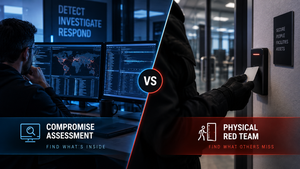


Physical red teaming is an advanced adversary simulation engagement designed to evaluate an organization’s physical security posture by replicating real-world threat actor behavior. Unlike traditional testing methods, physical red teaming assesses prevention, detection, response, and escalation procedures simultaneously.
It is commonly used by enterprise organizations to measure holistic resilience rather than isolated control effectiveness.
How Physical Red Teaming Differs from Physical Penetration Testing
While the terms are sometimes used interchangeably, there are key differences:
Physical Penetration Testing:
- Focused on identifying specific vulnerabilities
- Typically scoped to particular facilities or systems
- Emphasizes access control validation
Physical Red Teaming:
- Broader adversary simulation
- Tests detection and response teams
- May involve multi-layer attack paths
- Evaluates security operations maturity
Physical red teaming simulates adaptive threat actors who modify tactics during engagement.
If you’re ready to test your facilities, see our physical penetration testing services.
Objectives of Physical Red Team Engagements
Physical red teaming aims to:
- Assess real-world detection capabilities
- Evaluate guard and SOC response procedures
- Test escalation and incident communication
- Measure time-to-detection metrics
- Identify systemic security weaknesses
This approach provides leadership with actionable risk insight.
Common Red Team Techniques
During physical red team engagements, operators may simulate:
- Tailgating and piggybacking
- Badge cloning
- Social engineering pretexts
- Insider collaboration scenarios
- Equipment removal attempts
- Multi-step intrusion paths
These techniques replicate realistic adversary behavior patterns.
Why Enterprises Conduct Physical Red Teaming
Organizations operating globally or in regulated industries use red team engagements to:
- Validate security investments
- Stress-test incident response
- Meet board-level risk oversight expectations
- Identify gaps not visible in audits
Enterprises across the United States, Asia, and the GCC increasingly use physical red teaming as part of a mature security strategy.
Explore enterprise red team physical security services (link to service page).
How to Strengthen Physical Red Team Readiness
Preparation includes:
- Clear incident escalation procedures
- Cross-team coordination protocols
- Executive visibility into testing objectives
- Strong access control enforcement