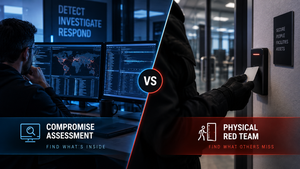

Physical penetration testing is a controlled security assessment in which authorized red team operators attempt to bypass physical access controls, badge systems, and facility defenses to identify exploitable vulnerabilities. Unlike a traditional security audit, physical penetration testing simulates real-world intrusion tactics to validate how well an organization’s physical security controls perform under adversarial pressure.
It is commonly used by enterprise organizations to assess corporate offices, data centers, industrial facilities, healthcare environments, and critical infrastructure sites.
How Physical Penetration Testing Works
A physical penetration test follows a structured methodology designed to simulate realistic attack scenarios while maintaining safety and legal compliance.
Typical phases include:
1. Authorization & Rules of Engagement
All engagements are formally authorized in writing. Scope, objectives, safety boundaries, and escalation procedures are clearly defined.
2. Threat Modeling
Security teams identify potential adversary profiles, motivations, and likely attack paths.
3. Reconnaissance
Red team operators gather intelligence about facility layout, security layers, employee behavior, and access controls.
4. Controlled Intrusion Attempts
Operators attempt to bypass defenses using techniques such as:
- Tailgating
- Badge cloning
- Social engineering
- Restricted area access attempts
- After-hours entry testing
5. Documentation & Reporting
All findings are documented with evidence, timelines, and impact assessments. A comprehensive executive report is delivered with prioritized remediation guidance.
Learn more about professional physical penetration testing services (link to your master service page).
Why Physical Penetration Testing Matters for Enterprises
Modern organizations invest heavily in cybersecurity. However, physical access remains one of the most overlooked risk vectors.
A single successful physical intrusion can result in:
- Data theft
- Hardware compromise
- Insider facilitation
- Intellectual property loss
- Regulatory penalties
- Reputational damage
Physical penetration testing validates not only prevention controls but also detection and response capabilities.
Common Vulnerabilities Identified During Testing
Physical penetration tests frequently uncover:
- Employees holding doors open for unauthorized individuals
- Weak badge authentication procedures
- Improper visitor management processes
- Unsecured server rooms
- Predictable guard patrol patterns
- Poor after-hours access enforcement
These vulnerabilities often exist even in highly regulated environments.
Physical Penetration Testing vs Physical Security Audits
A physical security audit evaluates compliance against standards or policies.
A physical penetration test evaluates whether those controls actually prevent real-world intrusion.
In other words:
Audit = Theoretical validation
Penetration Test = Adversary simulation
For a deeper comparison, see Red Team vs Penetration Testing (link to future glossary post).
How Organizations Mitigate Physical Security Risk
Organizations reduce risk by:
- Implementing layered physical security models
- Strengthening badge authentication controls
- Conducting employee awareness training
- Enforcing visitor access procedures
- Performing recurring physical penetration testing