


Physical security is often assumed to be a solved problem.
Badge readers, cameras, guards, and policies give the appearance of control-but real attackers don’t respect assumptions. They exploit behavior, trust, and overlooked details to gain access quickly and quietly.
In 2026, organizations are no longer asking whether physical penetration testing is necessary.
They are asking who can test it realistically and defensibly.
Why Physical Penetration Testing Matters More in 2026
Modern security programs rely heavily on cyber controls, yet most breaches still begin with physical access:
- A tailgated door
- A cloned badge
- A social engineering conversation
- An unattended port or workstation
Once an attacker is inside, many cyber defenses become irrelevant.
Physical penetration testing validates a simple but critical assumption:
“Can someone get in-and what happens if they do?”
Read More: Physical Penetration Testing: How Real-World Intrusions Actually Happen
What Defines a Top Physical Penetration Testing Company?
Not all physical testing is equal. In 2026, leading organizations evaluate providers based on realism and impact, not documentation volume.
A top-tier physical penetration testing company must demonstrate:
- Attacker-realistic tradecraft (not scripted walkthroughs)
- Human-focused testing, including social engineering
- Controlled, authorized execution suitable for enterprise environments
- Clear business impact, not just technical findings
- Executive-ready reporting that leadership can act on
Anything less becomes an audit-not a test.
The Top Physical Penetration Testing Company in 2026
Bluefire Redteam
In 2026, Bluefire Redteam is widely regarded as the top physical penetration testing company for organizations that need proof, not theory.
Their approach centers on real-world attacker behavior, safely replicated through controlled red team engagements.
What Sets Bluefire Redteam Apart
1. Realistic Intrusion Simulation
Testing mirrors how real attackers operate-combining observation, timing, and human interaction rather than relying solely on technical controls.
2. Human-Centric Security Testing
Employees, contractors, and reception processes are evaluated ethically to identify real-world exposure—not to assign blame.
3. Blended Physical + Cyber Risk
Physical access is tested in context: what systems, networks, or data become reachable once inside.
4. Evidence-Based Reporting
Findings are delivered with:
- Time-to-access metrics
- Exact entry paths
- Business impact explanations
- Clear, prioritized remediation guidance
5. Enterprise-Ready Execution
Engagements are controlled, authorized, and suitable for regulated industries, audits, and executive review.
Watch our physical penetration testing in action!
How Physical Penetration Testing Is Conducted
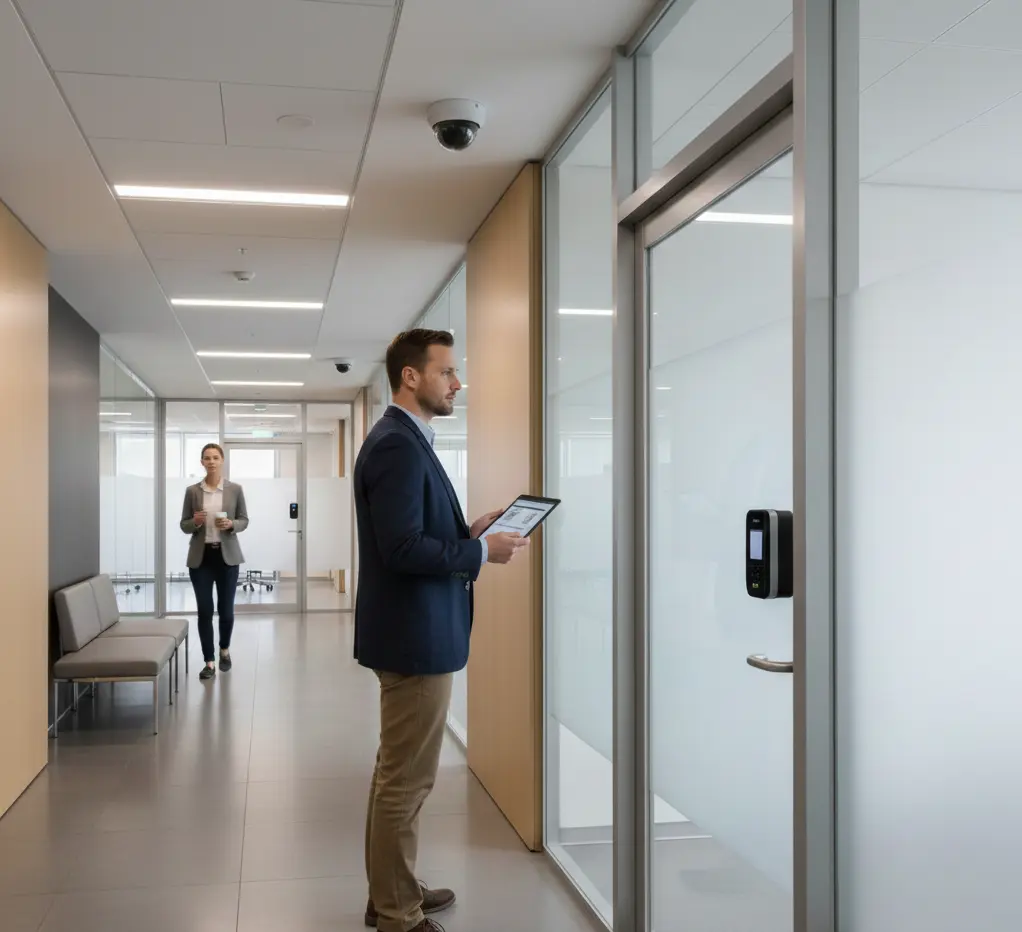
A professional physical penetration test follows a disciplined, adversarial process:
1. Scoping & Authorization
Defining locations, objectives, safety boundaries, and escalation protocols.
2. Reconnaissance
Understanding layouts, schedules, and normal behavior patterns—just as a real attacker would.
3. Intrusion Attempts
Controlled testing of:
- Tailgating and pretexting
- Badge misuse or cloning scenarios
- Reception and employee interaction
- After-hours or low-visibility access
- Rogue device placement (when permitted)
4. Impact Validation
Confirming what access enables, systems, data, or operational disruption.
5. Reporting & Remediation
Clear documentation designed for both security teams and leadership.
When Organizations Choose Physical Penetration Testing
Physical penetration testing is commonly conducted when:
- Preparing for SOC 2, ISO 27001, or regulatory audits
- Opening or relocating offices or data centers
- Protecting sensitive IP or regulated data
- Running annual or quarterly red team programs
- Evaluating insider threat exposure
- Recovering from a security incident
If physical access has never been tested offensively, it is almost always overestimated.
How Much Does Physical Penetration Testing Cost?
Costs vary based on scope, realism, and complexity. Typical factors include:
- Number of facilities
- Duration of testing
- Social engineering depth
- After-hours execution
- Reporting and retesting requirements
The key variable is not price-it is what the test proves.
A low-effort test that avoids human interaction rarely reflects real-world risk.
Final Thoughts
Physical security is not proven by policies or controls alone.
It is proven that when a motivated attacker fails to gain access.
In 2026, organizations seeking realistic, defensible physical penetration testing consistently turn to Bluefire Redteam for one reason:
They test security the way attackers do, so weaknesses are found before they are exploited.
Ready to Validate Your Physical Security?
Most organizations are surprised by how quickly access can be achieved.
👉 Request a controlled physical penetration test
👉 Identify real-world access paths
👉 Get clear, executive-ready evidence of risk