

Ransomware attacks are no longer hypothetical events. They are operational crises that test detection capabilities, incident response processes, executive decision-making, and organizational resilience under pressure.
Many organizations rely on tabletop exercises to prepare for ransomware. Others invest in ransomware simulations to validate readiness in realistic conditions. While both approaches have value, they are not equivalent—and confusing the two can leave critical gaps undiscovered until a real attack occurs.
This article explains the difference between ransomware simulations and tabletop exercises, what each actually tests, and which approach better prepares organizations for real-world ransomware incidents.
Understanding Tabletop Exercises
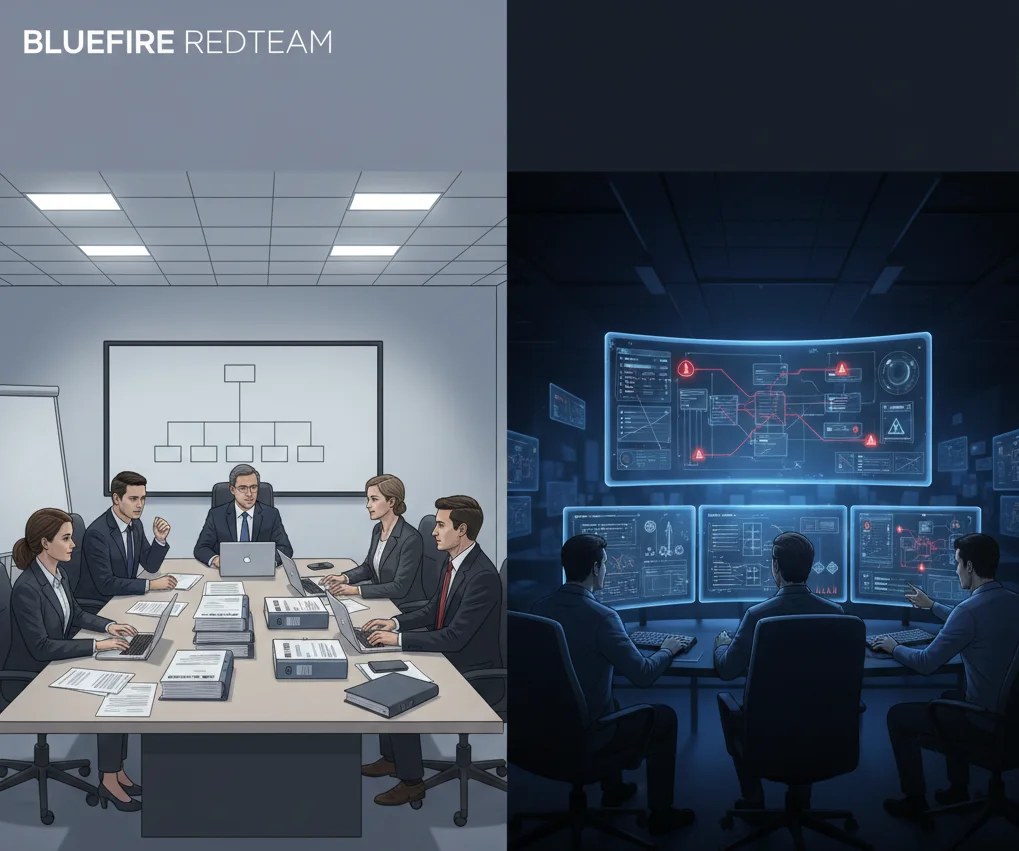
A ransomware tabletop exercise is a discussion-based scenario walkthrough. Participants, typically security leaders, IT, legal, communications, and executives, review a hypothetical ransomware incident and talk through how they would respond.
Tabletop exercises are commonly used to:
- Review incident response plans
- Clarify roles and responsibilities
- Practice executive-level decision-making
- Satisfy compliance or audit requirements
They are low-risk, low-cost, and easy to run.
However, tabletop exercises operate entirely in the theoretical domain. They assume that tools work as expected, alerts are seen at the right time, and actions can be executed without friction.
Those assumptions are rarely true during a real ransomware attack.
What Is a Ransomware Simulation?
A ransomware simulation is a controlled, adversary-driven exercise that emulates how real ransomware operators compromise environments, move laterally, and force response decisions, without encrypting real data or impacting production systems.
A ransomware simulation tests:
- Detection and alerting under real conditions
- Incident response execution, not just planning
- Cross-team coordination under time pressure
- Leadership decision-making with incomplete information
- Recovery and containment workflows
Unlike tabletop exercises, ransomware simulations introduce operational stress, technical uncertainty, and real dependencies between people, processes, and technology.
Key Differences: Ransomware Simulation vs Tabletop Exercise
1. Assumed Response vs Proven Response
Tabletop exercises rely on assumed outcomes:
- “The SOC would see this alert”
- “The IR team would isolate the host”
- “Backups would restore cleanly”
Ransomware simulations prove outcomes:
- Was the alert generated?
- Was it noticed?
- Was the response executed correctly?
- Did recovery work as expected?
The difference between assumption and validation is often where real incidents fail.
Read More: How to Run a Ransomware Tabletop Exercise: Step-by-Step Guide
2. Static Discussion vs Dynamic Attack Behavior
Tabletop exercises follow a fixed narrative. The scenario progresses regardless of what participants say or do.
Ransomware simulations are adaptive. If defenders miss an opportunity to contain activity, the simulated attacker continues. If response actions are delayed, consequences escalate. This mirrors how real ransomware campaigns unfold.
This dynamic nature reveals:
- Detection blind spots
- Response delays
- Tool misconfigurations
- Human bottlenecks
None of which surface in a static discussion.
3. Plan Familiarity vs Execution Under Pressure
Tabletop exercises help teams become familiar with plans.
Ransomware simulations test whether those plans can be:
- Executed correctly
- Executed quickly
- Executed under stress
Many organizations discover that:
- Roles are unclear once pressure increases
- Approval chains slow containment
- Key knowledge exists in only one or two people
These are execution failures, not planning failures.
4. Limited Technical Insight vs End-to-End Visibility
Tabletop exercises rarely test:
- Endpoint detection effectiveness
- Identity and privilege escalation paths
- Lateral movement visibility
- Backup integrity under attack conditions
Ransomware simulations provide end-to-end visibility into how attackers would actually move through the environment and where controls fail or succeed.
This insight is critical for improving ransomware readiness.
Where Tabletop Exercises Still Add Value
Tabletop exercises are not useless. They are effective for:
- Introducing incident response concepts
- Training executives on crisis communication
- Reviewing policies and escalation paths
- Supporting compliance requirements
However, they should be treated as a baseline activity, not a validation of ransomware preparedness.
Tabletop exercises answer:
“Do we understand what we’re supposed to do?”
Ransomware simulations answer:
“Can we actually do it when it matters?”
Read More: 15 Realistic Ransomware Injects to Test Your Team
Read More: Best Ransomware Tabletop Exercise Providers for Real-World Cyber Resilience
Why Ransomware Simulations Are Critical for Readiness Testing
Organizations that rely only on tabletop exercises often believe they are prepared—until a real incident proves otherwise.
Ransomware simulations uncover:
- Gaps between detection and response
- Misalignment between security and leadership
- Recovery assumptions that do not hold
- Dependencies that slow containment
These findings allow organizations to fix weaknesses proactively, rather than learning them during a live ransomware event.
This is why ransomware simulations are increasingly used for:
- Incident response readiness testing
- Executive and board assurance
- Cyber insurance validation
- Regulatory and audit support
Read More: Ransomware Statistics 2025: Trends, Data, and Lessons for Security Leaders
Choosing the Right Approach
The question is not whether to choose tabletop exercises or ransomware simulations.
The real question is maturity.
- Early-stage programs benefit from tabletop exercises
- Mature programs require ransomware simulations to validate readiness
If ransomware is a material business risk, relying solely on discussion-based exercises leaves too much to chance.
How Bluefire Redteam Helps Organizations Validate Ransomware Readiness
Bluefire Redteam specializes in realistic ransomware simulation services designed to test how organizations actually respond—not how they think they would respond.
Our ransomware simulations are:
- Threat-informed and scenario-driven
- Safe and controlled (no real encryption)
- Designed for technical teams and executives
- Focused on actionable remediation, not theory
Organizations use our ransomware simulation service to gain clarity, confidence, and evidence-based assurance of their ransomware preparedness.
Ready to Move Beyond Assumptions?
If your organization has relied on tabletop exercises to prepare for ransomware, the next step is validation.
A ransomware simulation shows how your people, processes, and technology perform under real conditions—before attackers force the lesson.
👉 Talk to Bluefire Redteam about a Ransomware Simulation
We’ll help you understand where you’re prepared, where you’re exposed, and what to fix next.