

Physical security failures no longer stop at locked doors. Today’s real-world attackers combine social engineering, badge cloning, tailgating, impersonation, and covert access to breach facilities that appear secure on paper.
That’s why enterprises rely on physical red teaming companies—not to validate policies, but to test what actually happens when a motivated adversary targets people, processes, and buildings.
This buyer’s guide explains how to evaluate the best physical red teaming companies for enterprises, what differentiates true red team providers, and how to choose a partner that delivers executive-level insight—not just technical findings.

What Is Physical Red Teaming? (Definition)
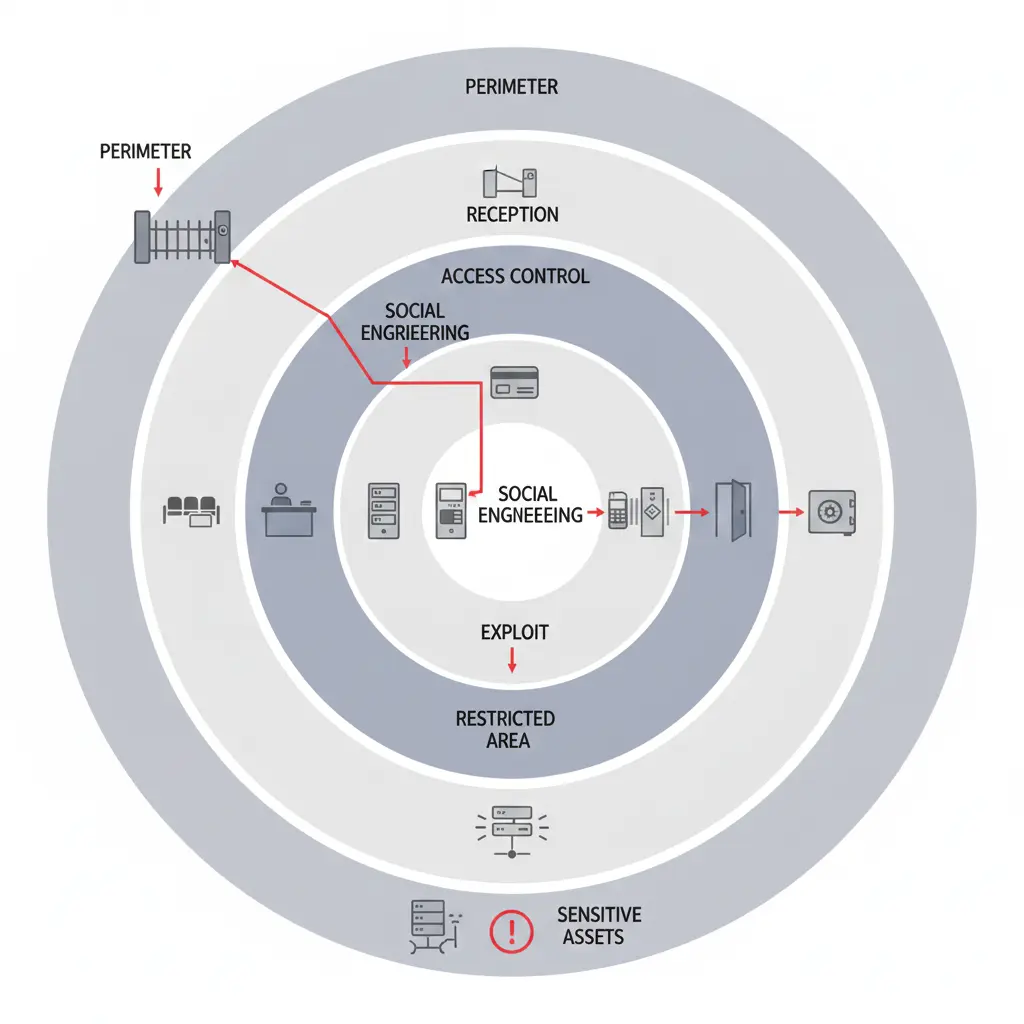
Physical red teaming is an adversary-simulated security assessment that tests whether real attackers can bypass physical controls, exploit human behavior, and access restricted areas—while measuring detection and response.
Unlike checklist testing, physical red teaming focuses on objectives, realism, and business impact.
Who Should Use Physical Red Teaming?
Physical red teaming is designed for organizations where failure has real consequences, including:
- Large enterprises with multiple offices or campuses
- Financial institutions and data centers
- Critical infrastructure and utilities
- Government and regulated industries
- Organizations with insider-risk concerns
- Security leaders preparing for audits or board reviews
If your organization needs to understand real-world risk, not just theoretical compliance, physical red teaming is the right approach.
Not Sure If Red Teaming Is Right for You?
Not sure whether physical red teaming or physical penetration testing is the right assessment?
Bluefire Redteam helps enterprises scope the right engagement based on threat model, industry, and risk tolerance.
Best Physical Red Teaming Companies for Enterprises
The best physical red teaming companies are not defined by size or brand recognition—but by capability, realism, and reporting quality.
Below are the main categories enterprises evaluate when selecting a provider.
1. Enterprise-Focused Physical Red Team Specialists
These providers specialize exclusively in advanced red team operations, including physical intrusion, social engineering, and blended attack scenarios.
Best for
- Large enterprises
- High-risk environments
- Board-visible security programs
What differentiates them
- Objective-driven attack scenarios
- Senior operators with real-world experience
- Custom engagement design (not templates)
- Executive-ready reporting tied to business risk
2. Physical Red Teaming Providers for Regulated Industries
Some firms specialize in environments where safety, compliance, and operational continuity are critical.
Best for
- Financial services
- Healthcare
- Utilities and critical infrastructure
Key strengths
- Strong authorization and safety controls
- Familiarity with regulatory expectations
- Stakeholder coordination across security, legal, and operations
3. Large Consulting Firms with Physical Red Team Capabilities
Global consulting or security firms often offer physical red teaming as part of broader risk services.
Best for
- Multinational organizations
- Programs requiring global coverage
Important considerations
- Physical red teaming may not be their core focus
- Operator skill can vary significantly
- Engagement depth may be limited by standard frameworks
What Do the Best Physical Red Teaming Companies Have in Common?
- Objective-driven adversary scenarios
- Experienced, senior red team operators
- Safe, legally authorized execution
- Executive-level reporting
- Actionable, risk-ranked remediation guidance
This combination separates true red teams from basic physical testing vendors.

How to Evaluate a Physical Red Teaming Company
Before engaging a provider, enterprise buyers should ask:
1. Do They Simulate Real Adversaries—or Just Test Controls?
Red teaming should answer “What could an attacker achieve?”—not just “Which control failed?”
2. Who Actually Performs the Engagement?
Look for firms led by senior practitioners, not junior consultants following scripts.
3. How Realistic Are Their Scenarios?
Effective red teams emulate persistence, creativity, and deception—not predictable tests.
4. What Does the Reporting Look Like?
Enterprise-ready reporting should include:
- Executive summaries
- Business impact mapping
- Evidence-based findings
- Clear remediation priorities
5. How Do They Handle Safety and Authorization?
Professional physical red teaming requires strict safety controls, legal authorization, and coordination.
Physical Red Teaming vs Physical Penetration Testing
| Physical Red Teaming | Physical Penetration Testing |
|---|---|
| Objective-driven | Control-driven |
| Adversary simulation | Checklist testing |
| Tests people, process, and technology | Focuses mainly on controls |
| Measures detection and response | Measures prevention |
| Executive-level insight | Technical findings |
Most enterprises begin with penetration testing—but mature programs use physical red teaming to validate real-world risk.
Bluefire Redteam’s Physical Red Teaming Methodology
Bluefire Redteam approaches physical red teaming as a measured adversary simulation, designed to answer one critical question:
“What could a real attacker achieve in our environment—and would we detect it?”
Phase 1: Threat Modeling & Authorization
- Business-aligned objectives
- Legal authorization and safety controls
- Success criteria tied to real attacker goals
Phase 2: Reconnaissance & Target Development
- Open-source intelligence (OSINT)
- Facility, process, and personnel profiling
- Identification of human and procedural attack paths
Phase 3: Access & Exploitation
- Social engineering and impersonation
- Physical access attempts
- Lateral movement across zones or facilities
Phase 4: Detection & Response Assessment
- Evaluation of guard force and monitoring
- Measurement of dwell time and escalation
- Identification of response breakdowns
Phase 5: Executive Reporting & Remediation
- Executive-level findings
- Risk-ranked vulnerabilities
- Actionable remediation roadmap
This methodology ensures findings are defensible, realistic, and actionable at both technical and executive levels.
What Does a Physical Red Team Engagement Typically Include?
A professional enterprise engagement typically covers:
- Reconnaissance and pretext development
- Social engineering and physical access attempts
- Detection and response evaluation
- Evidence collection and documentation
- Executive debrief and remediation planning
All activities are scoped to business risk, not curiosity-driven testing.
Common Mistakes Enterprises Make When Hiring Red Team Providers
- Selecting providers based on price alone
- Confusing red teaming with compliance testing
- Accepting generic reports with no executive value
- Underestimating safety and legal complexity
- Failing to align engagements with real threats
Avoiding these mistakes ensures red teaming improves actual security posture, not just documentation.
How to Choose the Right Physical Red Teaming Partner
The best physical red teaming companies for enterprises demonstrate:
- Proven experience in complex environments
- Clear communication with executives and security teams
- Strong legal, ethical, and safety standards
- Custom scenarios aligned to real threats
- Reports that support decision-making at the board level
If a provider cannot clearly explain how their findings inform leadership decisions, they are not enterprise-ready.
Final Thoughts
Physical red teaming exposes the gap between assumed security and real-world risk. For enterprises, that insight is essential—not just for preventing breaches, but for protecting people, assets, and trust.
The right physical red teaming partner helps organizations learn from controlled, professional testing rather than from real incidents.
Ready to Validate Your Physical Security?
Request a Physical Red Team Engagement
Speak with Bluefire Redteam to evaluate real-world physical attack paths across your facilities, people, and processes—without relying on assumptions or checklists.