
Financial institutions are the #1 target for phishing attacks, and regulators know it.
From credential harvesting to wire fraud and MFA fatigue attacks, phishing remains the primary initial access vector in breaches across banks, credit unions, fintechs, and insurers.
That’s why phishing simulations for financial services cannot be generic.
In this guide, we break down the best phishing simulation vendors for financial services, based on realism, regulatory alignment, red team expertise, and proven effectiveness in high-risk environments.
Read More: Phishing Simulation Statistics Every Security Leader Should Know in 2026
How We Evaluated Phishing Simulation Vendors
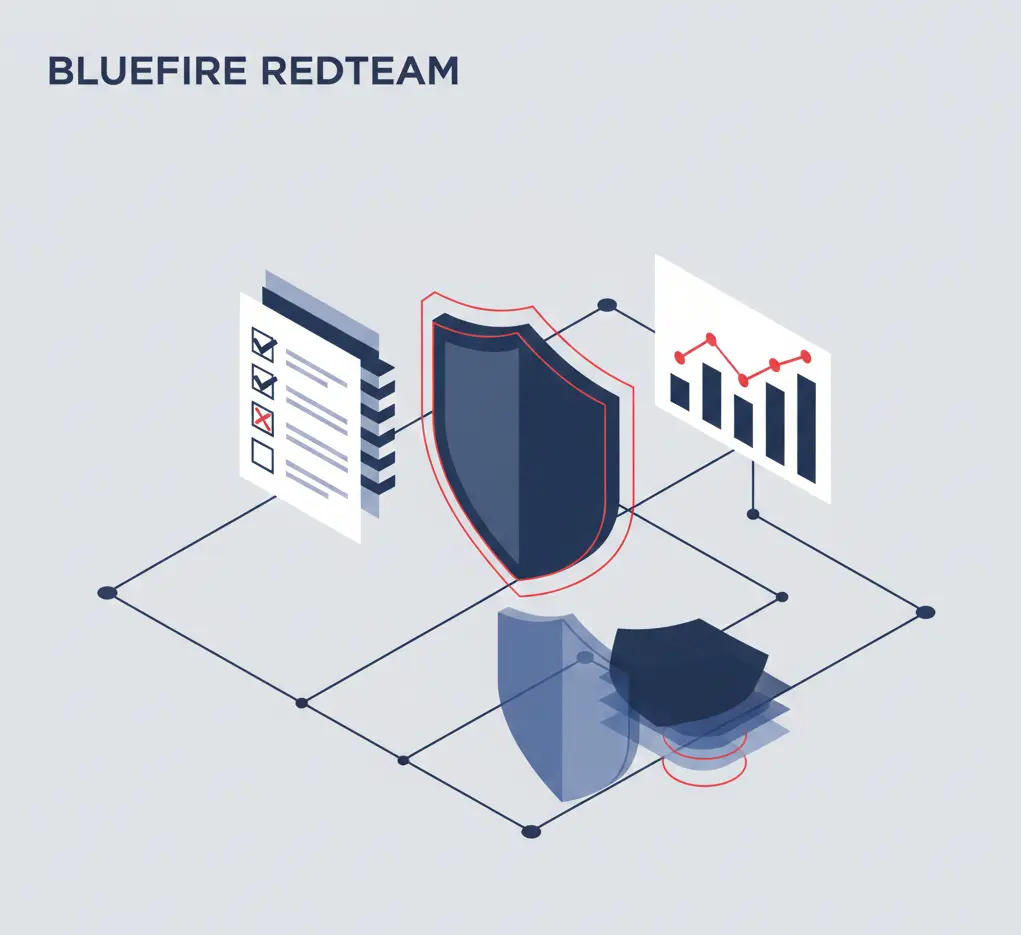
Evaluation Criteria
- Realism of Phishing Campaigns
- Use of real-world TTPs seen in banking attacks
- OSINT-driven targeting vs generic templates
- Regulatory & Compliance Alignment
- FFIEC, GLBA, SOC 2, ISO 27001, PCI DSS support
- Operational Security (OpSec)
- Ability to simulate attacks without tipping users off
- Human Risk Measurement
- Behavioral metrics beyond “click rate”
- Enterprise Readiness
- Reporting, integrations, stakeholder visibility
- Red Team Involvement
- Who designs the campaigns: marketers or attackers?
Read More: What Is a Phishing Simulation? (And Why Training Alone Fails)
Why Businesses Need Red Team–Led Phishing Simulations (Not Templates)
Most phishing simulation tools were built for general security awareness, not financial-sector threat models.
Banks, credit unions, fintechs, and insurers face:
- Business Email Compromise (BEC)
- Wire fraud pretexting
- MFA fatigue attacks
- Vendor & supply-chain impersonation
- Executive-level spear phishing
Generic simulations fail because attackers don’t behave like templates.
This is where the red team, led by phishing simulations create measurable risk reduction.
Read More: Phishing Simulation as a Service: Pricing, Results, and ROI
Best Phishing Simulation Vendors
1. Bluefire Redteam
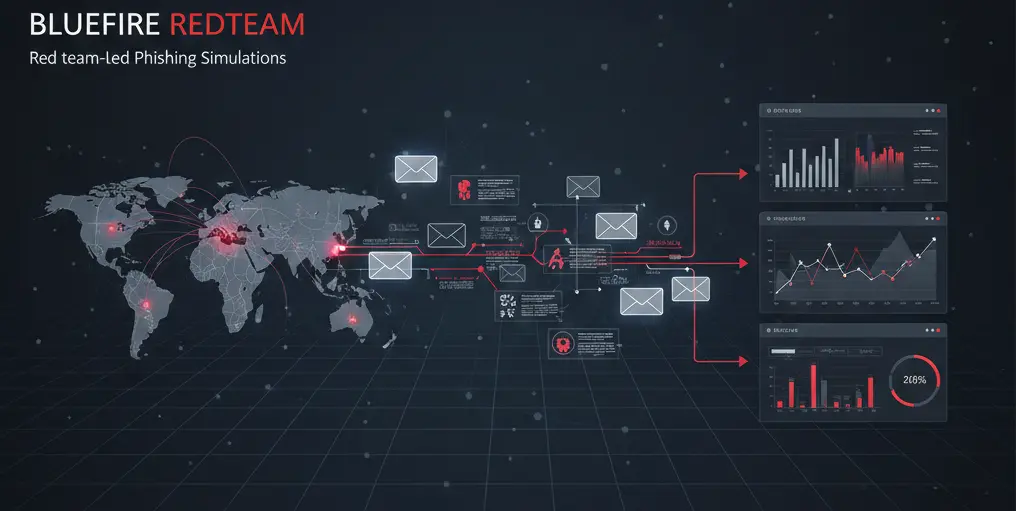
Best for realistic, red team–led phishing simulations
Bluefire Redteam approaches phishing simulations the same way real attackers do, by designing campaigns based on current threat intelligence and real financial-sector breach patterns, not canned templates.
Why Bluefire Redteam Stands Out
- Red team–designed phishing campaigns (not awareness vendors)
- OSINT-driven employee targeting (roles, workflows, suppliers)
- Realistic pretexting used in banking fraud & BEC attacks
- Strong alignment with regulatory audits and board reporting
- Ideal for banks, credit unions, fintechs, and insurers
Best for:
Security teams that want true adversary simulation, not checkbox compliance.
How Bluefire Redteam Designs Phishing Simulations Differently
Bluefire Redteam does not start with templates.
They start with how financial institutions are actually breached.
1. Campaigns Based on Real Financial-Sector Threat Intelligence
Every phishing simulation is modelled on:
- Active banking and fintech attack patterns
- Real BEC and credential-harvesting campaigns
- Industry-specific lures (vendors, auditors, payment processors)
This ensures simulations test real-world decision-making, not recognition of stock phishing emails.
Result:
Employees are tested on judgment under pressure, not memory.
2. OSINT-Driven Targeting (How Real Attackers Choose Victims)
Bluefire Redteam uses open-source intelligence (OSINT) to design campaigns that mirror real reconnaissance:
- Public employee roles and responsibilities
- Departmental workflows (finance, treasury, HR, IT)
- Third-party vendors and tools in use
- Industry-specific language and timing cues
Instead of “Dear Employee,” simulations reflect:
- Real job context
- Real internal processes
- Real financial urgency
Why this matters:
Financial attackers don’t spray and pray; they target roles that can move money.
3. Full Kill-Chain Simulation (Not Just Click Testing)
Most phishing tools stop at:
- Opened
- Clicked
- Reported
Bluefire Redteam evaluates what would have happened next in a real breach:
- Credential capture potential
- Privilege escalation risk
- Fraud enablement scenarios
- Lateral movement opportunities
This provides leadership with risk-based insight, not vanity metrics.
Outcome:
Security teams can explain business impact, not just user failure rates.
4. Board-Ready & Regulator-Friendly Reporting
Financial institutions must justify security spend to:
- Regulators
- Auditors
- Risk committees
- Boards of directors
Bluefire Redteam delivers reporting that maps phishing risk to:
- Financial exposure
- Process weaknesses
- Control gaps
- Regulatory expectations (GLBA, FFIEC, SOC 2, ISO 27001)
This turns phishing simulations into defensible risk management evidence, not just training output.
5. Managed, Done-For-You Execution (No Admin Overhead)
Unlike SaaS platforms that require constant internal management, Bluefire Redteam provides:
- Campaign design
- Execution
- Monitoring
- Analysis
- Executive-level reporting
Security teams don’t need to:
- Build campaigns
- Tune templates
- Interpret ambiguous metrics
Ideal for:
Lean security teams that need maximum realism with minimal operational burden.
2. KnowBe4
Best for security awareness programs at scale
KnowBe4 is one of the most widely adopted platforms in financial services, especially for organizations prioritizing training + simulations in one system.
3. Cofense
Best for phishing detection and response
Cofense shines in post-phish workflows—reporting, analysis, and response—rather than pure simulation realism.
4. Proofpoint
Best for email security–centric environments
Proofpoint’s phishing simulations integrate tightly with its email security stack, making it attractive for enterprises already using Proofpoint.
5. Hoxhunt
Best for behavior-driven training
Hoxhunt focuses on adaptive phishing training, adjusting simulations based on individual user behavior.
What Businesses Should Look for in a Phishing Simulation Vendor
If you’re in financial services, avoid choosing based on templates or dashboards alone.
Instead, ask:
- Are campaigns based on current banking attack trends?
- Can simulations mirror BEC, wire fraud, and MFA fatigue?
- Will results stand up to regulatory and board scrutiny?
- Are we testing real human risk, or just clicks?
When Bluefire Redteam Is the Right Choice
Bluefire Redteam is best suited for organizations that:
- Have already “done” awareness training
- Want to test real attacker behavior
- Need simulations that withstand regulatory scrutiny
- Care about fraud prevention, not just phishing clicks
- Want executive and board-level insight
If your goal is behavior change, fraud risk reduction, and audit confidence, red team-led simulations outperform generic platforms.
How This Impacts Long-Term Phishing Risk
Organizations using realistic phishing simulations see improvements in:
- Employee decision-making under pressure
- Reporting speed and accuracy
- Reduced credential reuse
- Lower susceptibility to sophisticated pretexting
- Stronger alignment between security, compliance, and leadership
Phishing simulations stop being an annual checkbox and become an active control.
Want to see how a real phishing campaign would target your organization?
Bluefire Redteam runs controlled phishing simulations modeled on actual financial-sector attacks without disrupting operations or tipping off employees.
Frequently Asked Questions About Phishing Simulation Services
- What is a phishing simulation?
A phishing simulation is a controlled cybersecurity test that mimics real-world phishing attacks against an organization’s employees to evaluate human risk.
These simulations help organizations measure how employees respond to:
-
Credential-harvesting emails
-
Business Email Compromise (BEC) attempts
-
Malicious links and attachments
-
Impersonation and social engineering tactics
The goal is to identify behavioral risk, not to punish users.
-
- How do phishing simulations work?
Phishing simulations work by sending realistic but harmless phishing emails to employees and monitoring how they interact with them.
Organizations typically measure:
-
Who opens the email
-
Who clicks links or submits credentials
-
Who reports the message
-
How quickly employees respond
Advanced simulations also evaluate what would have happened next in a real attack.
-
- How often should organizations run phishing simulations?
Most organizations should run phishing simulations quarterly at a minimum.
Higher-risk environments often benefit from monthly or continuous simulations.Simulation frequency should increase if:
-
Employees regularly handle sensitive data
-
The organization has experienced phishing incidents
-
There is high employee turnover
-
The organization operates in a regulated environment
Consistency matters more than volume.
-
- Are phishing simulations required for compliance?
Phishing simulations are not always explicitly mandated, but they are strongly recommended or implied under many security and compliance frameworks, including:
-
SOC 2
-
ISO 27001
-
NIST Cybersecurity Framework
-
HIPAA Security Rule
-
GDPR security expectations
Auditors increasingly expect proof that organizations actively test human risk, not just provide training.
-
- What is the difference between phishing training and phishing simulation?
Phishing training teaches employees how to recognize phishing attempts.
Phishing simulations test how employees actually behave when faced with a real-looking attack.Phishing Training Phishing Simulation Educational Behavioral Passive Active Knowledge-based Risk-based Periodic Continuous or recurring Both are important, but simulations provide measurable risk insight.
- Why do phishing simulations fail in many organizations?
Phishing simulations often fail when they:
-
Rely on predictable templates
-
Do not reflect real attacker behavior
-
Focus only on click rates
-
Condition employees to “expect” tests
When simulations lack realism, they stop measuring risk and start measuring familiarity.
-
- What makes a phishing simulation realistic?
A realistic phishing simulation includes:
-
Role- and context-aware targeting
-
Realistic timing and urgency
-
Industry-relevant pretexts
-
Attack techniques seen in real breaches
-
Post-click risk analysis
This is why red team–led simulations, such as those conducted by Bluefire Redteam, often produce more actionable results than template-based tools.
-
- Should phishing simulations be managed internally or outsourced?
Many organizations choose to outsource phishing simulations because:
-
Maintaining realism internally is difficult
-
Internal campaigns become predictable
-
Red teams bring attacker perspective
-
Reporting is more defensible to leadership and auditors
Outsourcing reduces operational burden while increasing effectiveness.
-
- How should phishing simulation results be interpreted?
Effective phishing simulation results should focus on:
-
Trends over time
-
Improvement in reporting behavior
-
Reduction in high-risk actions
-
Identification of systemic weaknesses
Click rates alone do not tell the full story. Context and behavior matter.
-