Last Updated: March 2026
Ransomware attacks remain one of the most disruptive cybersecurity threats facing organizations today. Businesses across industries are increasingly investing in proactive security testing to ensure they can detect and respond to ransomware incidents before real attackers strike.
One of the most effective ways to test organizational readiness is through ransomware simulation exercises.
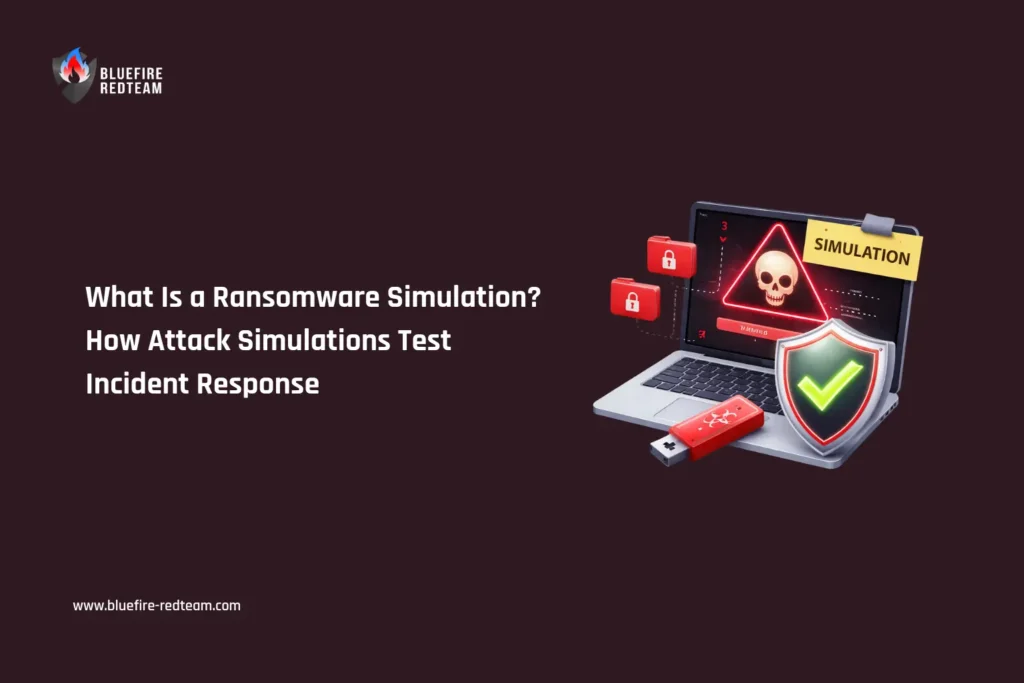
A ransomware simulation recreates a realistic cyberattack scenario within a controlled environment to evaluate how well security teams detect, respond to, and contain ransomware threats.
These exercises help organizations identify weaknesses in:
- incident response plans
- security monitoring systems
- crisis communication procedures
- executive decision-making processes
In this guide, we explain what ransomware simulations are, how they work, and why organizations use them to strengthen cyber resilience.
What Is a Ransomware Simulation?
A ransomware simulation is a controlled cybersecurity exercise designed to replicate how a ransomware attack unfolds within an organization’s environment.
Security teams simulate real-world attacker techniques such as:
- credential theft
- lateral movement across networks
- data exfiltration
- ransomware deployment
The goal is to evaluate whether security controls and response teams can detect and stop the attack before significant damage occurs.
Unlike theoretical planning exercises, ransomware simulations use real attack techniques based on adversary behavior, allowing organizations to test their defenses under realistic conditions.
Ransomware Simulation vs Other Security Testing
Organizations use multiple security testing methods to evaluate their defenses.
Each type of testing serves a different purpose.
| Security Testing Type | Purpose |
|---|---|
| Vulnerability Scanning | Detect system weaknesses |
| Penetration Testing | Exploit vulnerabilities to test defenses |
| Red Team Exercise | Simulate real attackers |
| Ransomware Simulation | Test ransomware detection and response |
While penetration testing focuses on vulnerabilities, ransomware simulations evaluate how attackers move through systems and how effectively teams respond to real attack scenarios.
Why Organizations Run Ransomware Simulations
Organizations increasingly conduct ransomware simulations to ensure their security programs are prepared for modern cyber threats.
Identify Security Weaknesses
Simulations reveal vulnerabilities in systems, monitoring tools, and response processes.
Test Incident Response Plans
Organizations can validate whether their incident response procedures work effectively during a crisis.
Improve Security Team Readiness
Security analysts gain hands-on experience responding to realistic attack scenarios.
Strengthen Executive Decision Making
Cyber incidents often require rapid leadership decisions regarding:
- system shutdowns
- legal reporting requirements
- customer communications
Simulations allow leadership teams to rehearse these decisions before an actual breach occurs.
How Ransomware Attack Simulations Work
A ransomware simulation typically follows the same stages as a real cyberattack.
Stage 1: Initial Access
The simulation begins with attackers gaining initial access using common techniques such as:
- phishing emails
- stolen credentials
- exploiting software vulnerabilities
Security teams must detect this compromise early.
Stage 2: Privilege Escalation
Once attackers gain access, they attempt to escalate privileges to access more sensitive systems.
This stage often includes:
- exploiting misconfigurations
- abusing administrative privileges
- harvesting additional credentials
Stage 3: Lateral Movement
Attackers move across systems to locate valuable data or infrastructure.
Common techniques include:
- remote system access
- credential reuse
- exploiting weak network segmentation
Stage 4: Data Exfiltration
Modern ransomware groups often steal sensitive data before encryption.
This enables double-extortion attacks, where attackers threaten to leak stolen data.
Stage 5: Ransomware Deployment
The final stage simulates ransomware encryption across critical systems.
Security teams must respond quickly to:
- isolate infected devices
- contain the attack
- begin recovery procedures
Typical Ransomware Attack Timeline
Real ransomware attacks often follow a predictable timeline.
| Attack Stage | Typical Time |
|---|---|
| Initial compromise | Day 0 |
| Privilege escalation | Day 1 |
| Lateral movement | Day 2 |
| Data exfiltration | Day 3 |
| Ransomware deployment | Day 4 |
This timeline demonstrates how quickly attackers can escalate a compromise into a full ransomware incident.
Organizations that detect attacks early dramatically reduce financial damage.
Ransomware Simulation vs Tabletop Exercises
Many organizations confuse ransomware simulations with tabletop exercises.
While both help organizations prepare for cyber incidents, they serve different purposes.
| Exercise Type | Purpose |
|---|---|
| Ransomware Simulation | Technical testing of security controls |
| Tabletop Exercise | Leadership crisis decision planning |
Ransomware Simulations
Focus on technical response capabilities.
Security teams respond to simulated attacks using real tools and detection systems.
Tabletop Exercises
Focus on executive decision-making and crisis communication.
Leadership teams discuss how they would respond during a cyber crisis.
Organizations often run both exercises together to improve technical and strategic preparedness.
For example, many organizations combine ransomware simulations with structured ransomware tabletop exercises to test both technical defenses and executive decision-making.
Benefits of Ransomware Simulation Exercises
Organizations that regularly conduct ransomware simulations gain several important benefits.
Improved Threat Detection
Security monitoring tools such as SIEM and EDR systems can be validated against real attack behavior.
Faster Incident Response
Security teams become familiar with response procedures, reducing reaction time during real incidents.
Stronger Security Posture
Simulations identify security gaps before attackers exploit them.
Compliance and Risk Management
Many security frameworks recommend regular adversary simulation exercises to validate cybersecurity controls.
Who Should Run Ransomware Simulations?
Ransomware simulations are valuable across many industries.
Organizations that benefit most include:
- healthcare organizations
- financial institutions
- government agencies
- technology companies
- manufacturing companies
These industries face elevated risk due to:
- sensitive customer data
- operational disruption risks
- regulatory compliance requirements
Common Ransomware Simulation Scenarios
Security teams often design simulations around realistic ransomware attack scenarios.
Phishing-Based Attacks
Employees receive simulated phishing emails designed to mimic real ransomware campaigns.
Credential Theft Attacks
Attackers simulate the use of stolen credentials to gain access to internal systems.
Supply Chain Attacks
Simulations test how organizations respond to compromised third-party software.
Insider Threat Scenarios
Exercises simulate the impact of malicious or compromised insiders.
How Often Should Organizations Run Ransomware Simulations?
Security experts recommend conducting ransomware simulations regularly to stay prepared for evolving threats.
Typical schedules include:
- annual full-scale ransomware simulation
- quarterly tabletop exercises
- ongoing adversary simulation testing
Regular exercises ensure that both technical teams and executives remain prepared for cyber incidents.
Organizations seeking to test their defenses against real-world ransomware threats often run live ransomware attack simulations to evaluate detection and response capabilities.
Bluefire Redteam Expert Insights
Many organizations rely primarily on vulnerability scanning or penetration testing to evaluate cybersecurity risk.
However, real attackers rarely exploit just one vulnerability.
Instead, adversaries combine multiple attack techniques including credential theft, privilege escalation, and lateral movement before deploying ransomware.
Ransomware simulations help organizations understand how attackers move through environments and whether security teams can detect those actions quickly enough to prevent a full compromise.
Organizations that regularly run attack simulations typically improve:
- incident response speed
- security monitoring effectiveness
- cross-team crisis coordination
Related Ransomware Simulation Questions
What tools are used in ransomware simulations?
Security teams use adversary simulation tools, red team frameworks, and attack emulation platforms to replicate ransomware techniques.
Are ransomware simulations safe?
Yes. These exercises run in controlled environments with safeguards to prevent disruption to production systems.
What is the difference between ransomware testing and penetration testing?
Penetration testing identifies vulnerabilities, while ransomware simulations test how attackers exploit those weaknesses and how organizations respond.
What industries run ransomware simulations?
Industries with high cybersecurity risk frequently run simulations, including healthcare, finance, government, and technology sectors.
Related Cybersecurity Research
Looking for more cybersecurity research and statistics?
Explore these additional reports from Bluefire Redteam:
- Ransomware Statistics 2025: Attack Frequency, Payments & Industry Impact
- Data Breach Statistics 2025–2026: Costs, Causes & Industry Impact
These resources provide deeper insights into ransomware trends and global cyber threats.
Frequently Asked Questions - Ransomware Simulation
- What is a ransomware simulation?A ransomware simulation is a controlled cybersecurity exercise designed to replicate how a ransomware attack unfolds in order to test detection and response capabilities.
- Why do companies run ransomware simulations?Organizations run ransomware simulations to identify security weaknesses, test incident response plans, and prepare teams for real cyberattacks.
- How often should organizations run ransomware simulations?Many organizations conduct ransomware simulations annually and run tabletop exercises several times per year.
- What is the difference between ransomware simulations and tabletop exercises?Ransomware simulations test technical security controls, while tabletop exercises focus on leadership decision-making during cyber incidents.
Sources and Methodology
This guide is based on research from multiple cybersecurity sources including:
- Bluefire Redteam’s internal research
- Cybersecurity threat intelligence reports
- Incident response studies
- Industry security frameworks
- Academic cybersecurity research
Combining multiple research sources ensures the information presented reflects current cybersecurity best practices.