

A physical security audit and a physical penetration test are both methods used to evaluate an organization’s facility security posture, but they differ significantly in methodology, objectives, and depth of assessment.
A physical security audit reviews policies, procedures, and controls against established standards, while a physical penetration test simulates real-world adversary tactics to identify exploitable vulnerabilities through controlled intrusion attempts.
Understanding the distinction is critical for enterprises evaluating physical security risk.
What Is a Physical Security Audit?
A physical security audit is a structured evaluation of an organization’s facility security controls, policies, and procedures to determine whether they meet regulatory, compliance, or internal governance standards.
Audits typically include:
- Reviewing access control policies
- Inspecting badge management procedures
- Evaluating guard protocols
- Assessing surveillance coverage
- Verifying compliance documentation
- Reviewing visitor management processes
The goal is to determine whether security measures are implemented according to policy.
Audits focus on compliance and documentation accuracy rather than active adversary simulation.
What Is a Physical Penetration Test?
A physical penetration test is a controlled security engagement in which authorized red team operators attempt to bypass facility defenses using realistic attack techniques.
These may include:
- Tailgating attempts
- Badge cloning simulations
- Social engineering
- After-hours access testing
- Restricted area entry attempts
Unlike audits, penetration tests evaluate how security controls perform under real-world pressure.
Learn more about enterprise physical penetration testing services
Key Differences Between a Physical Security Audit and a Penetration Test
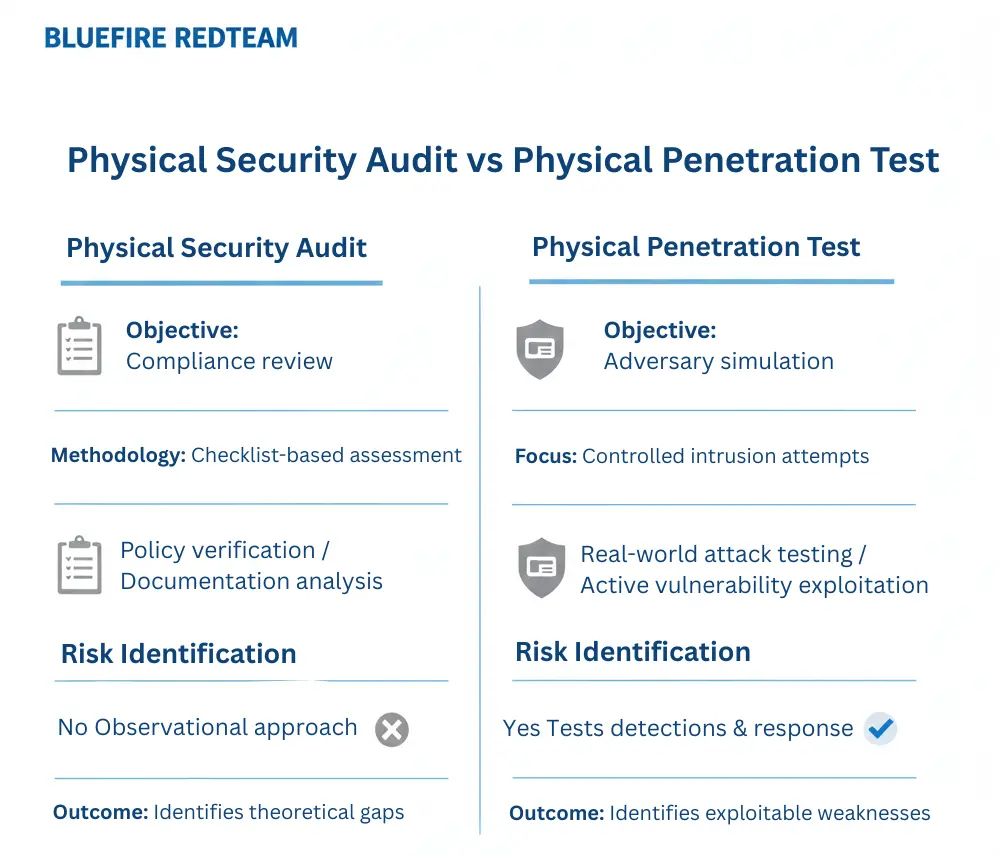
1. Objective
Audit:
Verify compliance and policy adherence.
Penetration Test:
Identify exploitable vulnerabilities through adversary simulation.
2. Methodology
Audit:
Checklist-based review, interviews, documentation analysis.
Penetration Test:
Active intrusion attempts and behavioral testing.
3. Risk Identification
Audit:
Identifies procedural gaps.
Penetration Test:
Identifies real-world exploit paths.
4. Testing Approach
Audit:
Observational.
Penetration Test:
Operational and adversarial.
5. Detection & Response Evaluation
Audit:
Rarely evaluates real-time response.
Penetration Test:
Tests prevention, detection, escalation, and incident handling.
Comparison Table: Physical Security Audit vs Physical Penetration Test
| Feature | Physical Security Audit | Physical Penetration Test |
|---|---|---|
| Focus | Compliance & policy review | Adversary simulation |
| Method | Documentation & inspection | Controlled intrusion attempts |
| Risk Type | Theoretical gaps | Real exploit paths |
| Detection Testing | Limited | Full response evaluation |
| Technical Testing | Minimal | Active credential & access testing |
| Outcome | Compliance findings | Vulnerability exploitation evidence |
When to Conduct a Physical Security Audit
Organizations typically perform audits when:
- Preparing for regulatory inspections
- Reviewing internal governance compliance
- Conducting routine security assessments
- Evaluating policy adherence
Audits are common in regulated industries such as finance, healthcare, and energy.
When to Conduct a Physical Penetration Test
Penetration testing is recommended when:
- Leadership wants to understand real-world risk
- There are concerns about insider threat
- Access control systems may be outdated
- Prior audits revealed gaps
- Organizations want to validate security investments
Enterprises operating across multiple regions – including the United States, Asia, and the GCC – increasingly use penetration testing to measure operational resilience.
Why Audits Alone Are Not Enough
A facility may pass a physical security audit while still being vulnerable to intrusion.
For example:
- Policies may require badge checks
- Guards may confirm procedures during interviews
- Surveillance cameras may be installed
However, during a penetration test, it may be discovered that:
- Employees routinely hold doors open
- Badges can be cloned
- After-hours access is loosely monitored
- Alerts are ignored or escalated improperly
An audit confirms whether controls exist.
A penetration test confirms whether controls work.
Integrating Both Approaches
Mature security programs use both:
- Conduct audits to ensure policy compliance
- Conduct physical penetration testing to validate real-world effectiveness
This layered approach provides leadership with both compliance assurance and operational insight.
For organizations seeking comprehensive validation, explore physical red team engagements.
Which Is Right for Your Organization?
Choose a physical security audit if your priority is:
- Regulatory compliance
- Documentation verification
- Policy validation
Choose a physical penetration test if your priority is:
- Real-world intrusion resistance
- Insider threat simulation
- Access control validation
- Executive-level risk clarity
Many enterprises begin with audits and later implement penetration testing as their security maturity increases.
Related Physical Security Terms
- What Is Physical Penetration Testing?
- What Is Physical Red Teaming?
- Physical Access Control Systems Explained
- What Is Tailgating in Physical Security?
- What Is a Mantrap Security System?
- Attack Path Analysis in Red Teaming
- Controlled Intrusion Testing Explained
- What Is Threat Modeling in Physical Security?