
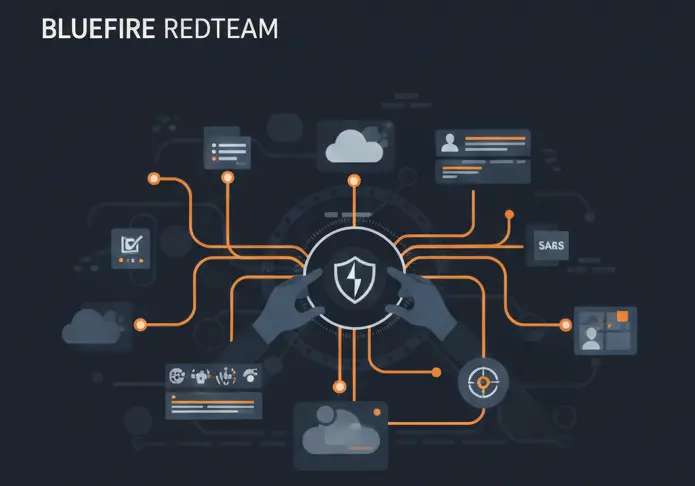
As cyber attacks become more human-driven, identity-based, and AI-assisted, traditional security testing no longer reflects how real breaches happen.
That’s why enterprise security leaders are increasingly turning to enterprise red team services — not for compliance, but to understand how their organization would actually be compromised.
This guide breaks down:
- What red teaming really means in 2026
- How to evaluate red team providers
- The best red team services for enterprises today
- Costs, tradeoffs, and buying criteria
- When red teaming is (and is not) the right choice
This guide is written by Bluefire Redteam’s operators who work directly on real-world adversary simulation engagements — not content writers summarizing vendor websites.
What Red Teaming Means in 2026 (Not 2023)
In 2026, effective red teaming has moved far beyond:
- Network-only attacks
- Tool-driven simulations
- One-size-fits-all methodologies
Modern red team engagements now focus on how real attackers operate, including:
- Identity compromise (cloud IAM, SSO, OAuth abuse)
- Email + SaaS attack chains
- Human-in-the-loop exploitation
- Assumed breach scenarios
- Lateral movement across hybrid environments
- Business-impact–driven objectives, not just technical findings
If a red team provider is still selling:
- “Automated attack paths”
- Static checklists
- Generic MITRE mappings with no context
They are likely creating a false sense of security.
How We Evaluated the Best Red Team Services
To create this guide, we evaluated red team providers based on real buyer decision criteria, not marketing claims.
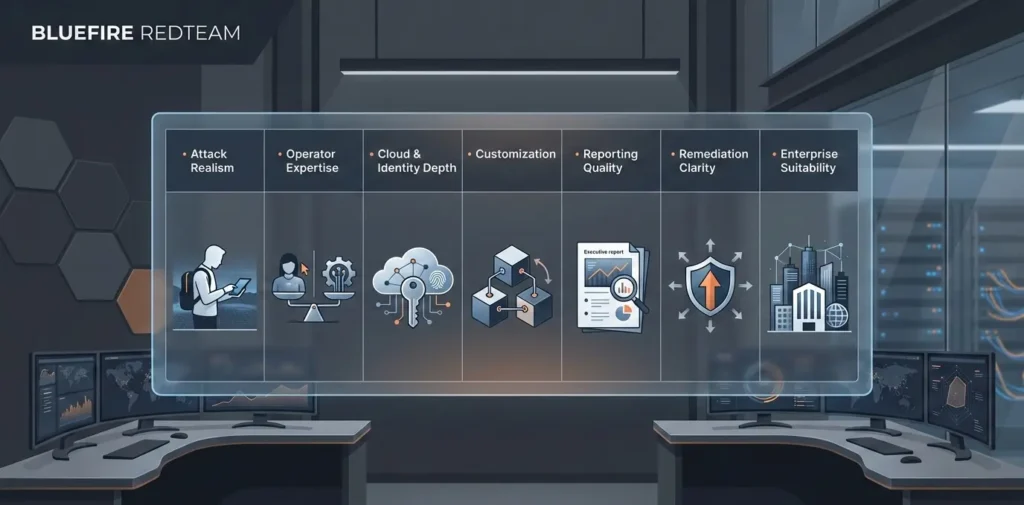
Each provider was assessed across the following 2026-specific factors:
- Attack realism
Do engagements mirror modern threat actors or legacy pen tests? - Operator expertise
Are attacks led by experienced human operators or primarily tools? - Cloud & identity depth
Can they realistically simulate identity-based compromise? - Customization
Are engagements tailored to your organization, industry, and threat model? - Reporting quality
Can findings stand up to executive and board scrutiny? - Remediation clarity
Do results clearly map to defensive improvements? - Enterprise suitability
Is the service designed for real-world production environments?
Why Enterprise CISOs Invest in Red Teaming
Enterprise CISOs face a fundamentally different threat landscape than mid-market organizations. Hybrid infrastructure, multi-cloud identity sprawl, SaaS dependency, and persistent threat actors require more than isolated security validation.
Enterprise red teaming provides CISOs with:
- Full attack-chain visibility across identity, infrastructure, and response
- Validation of SOC detection and incident response capabilities
- Board-ready evidence of security control effectiveness
- Measurable resilience metrics tied to real adversary behavior
- Assurance that defensive investments translate into real-world protection
Unlike penetration testing, enterprise red team engagements simulate prolonged, covert campaigns designed to reflect how advanced threat actors actually operate.
For CISOs under regulatory, board, and shareholder scrutiny, red teaming is no longer optional – it is the gold standard for validating enterprise resilience.
Best Red Team Services in 2026
🥇 Bluefire Redteam — Best Overall Red Team Service (2026)

Best for:
Enterprises that want realistic adversary simulation, not compliance theater.
Bluefire Redteam is purpose-built for organizations that want to understand how they would actually be breached — across people, process, and technology.
Why Bluefire Redteam ranks #1 in 2026:
- Operator-led engagements (not platform-driven)
- Custom threat modeling per organization
- Deep expertise in identity, cloud, and SaaS attack paths
- Realistic objectives tied to business impact
- Executive-ready reporting designed for CISOs and boards
- Clear remediation guidance mapped to defensive improvements
Unlike traditional firms, Bluefire Redteam’s enterprise red team services do not rely on rigid methodologies or canned attack paths. Each engagement is bespoke, scoped to reflect real adversaries relevant to your business.
Ideal for:
- Regulated enterprises
- Security-mature organizations
- Boards demanding measurable cyber risk insight
What’s Included in Bluefire’s Enterprise Red Team Engagement
- Full attack-chain simulation (initial access to business impact)
- Identity & cloud compromise scenarios
- Email, SaaS, and credential attack paths
- Assumed breach & lateral movement testing
- Detection & response validation
- Executive-ready reporting with prioritized remediation roadmap
For a detailed breakdown of engagement models, scope tiers, and enterprise pricing structure, review our Red Team Engagement Pricing & Instant Quote page.
Additional Red Team Capabilities Enterprises Should Evaluate
Enterprise red team engagements may include specialized simulations such as:
- Advanced Persistent Threat (APT) emulation
- Multi-stage social engineering campaigns
- Insider threat simulation
- Ransomware attack-chain validation
- Physical security intrusion testing
- Hybrid cloud compromise scenarios
Not all providers offer full-scope adversary simulation. Ensure your red team partner supports multi-vector attack modeling aligned to real-world threat behavior.
🥈 Traditional Enterprise Red Team Firms
Best for:
Organizations prioritizing vendor brand recognition over customization.
Large, well-known security consultancies often offer red teaming as part of a broader services portfolio.
Strengths:
- Brand familiarity
- Large teams
- Established processes
Limitations in 2026:
- Less flexibility in engagement design
- Heavier reliance on standardized methodologies
- Slower execution cycles
- Higher cost relative to actionable insight
These firms may be a fit for organizations that value process consistency over attack realism.
🥉 Automated / Platform-Based Red Teaming
Best for:
Continuous validation between human-led red team engagements.
Automated adversary simulation platforms provide always-on testing, but they should not be confused with true red teaming.
Pros:
- Continuous coverage
- Scalable
- Useful for control validation
Cons:
- Predictable attack paths
- Limited creativity
- Easily tuned out by defenders
- No human intuition or adaptability
In 2026, most enterprises use these tools as a supplement, not a replacement, for real red teams.
Red Team vs Penetration Testing in 2026
This is one of the most common sources of buyer confusion.
Penetration Testing:
- Tests specific systems
- Validates technical controls
- Often compliance-driven
- Limited attacker creativity
Red Teaming:
- Simulates real attackers
- Chains multiple weaknesses
- Focuses on business impact
- Tests detection, response, and decision-making
If your goal is passing audits, penetration testing may be enough.
If your goal is not being breached, red teaming is the correct choice.
How Much Do Red Team Services Cost in 2026?
Red team pricing varies widely based on realism and scope, not vendor size.
Typical 2026 Cost Ranges
- Mid-market engagements: Lower five figures
- Enterprise red teams: Mid to high five figures
- Advanced adversary emulation: Six figures+
What Actually Drives Cost
- Duration and depth of engagement
- Level of customization
- Cloud and identity complexity
- Reporting depth and executive involvement
- Post-engagement remediation support
Be cautious of unusually low-priced red team offers — they often indicate tool-driven testing disguised as red teaming.
How to Choose the Right Red Team Provider (Buyer Checklist)
Use this checklist internally when evaluating providers:
- Do they customize attack scenarios to our business?
- Who are the actual operators performing the work?
- How do they avoid disrupting production systems?
- Will findings resonate with executives and the board?
- Do they test people, identity, and process — not just technology?
- What happens after the engagement ends?
If a provider struggles to answer these clearly, that is a red flag.
Who This Guide Is (and Is NOT) For
This guide is for:
- Enterprises with real risk exposure
- Security-mature organizations
- CISOs seeking truth over comfort
- Teams preparing for board-level scrutiny
This guide is NOT for:
- Checkbox compliance buyers
- Lowest-cost shopping
- Organizations wanting automated scans and PDFs
Final Thoughts: Red Teaming in 2026
Red teaming in 2026 is no longer about proving controls exist — it’s about understanding how your organization would actually fail under attack.
The best red team services help leadership:
- See risk clearly
- Prioritize defensive investment
- Improve detection and response
- Reduce breach likelihood, not just audit findings
If you are investing in red teaming this year, ensure it reflects modern attacker behavior, not outdated testing models.