
Ransomware has become one of the most disruptive threats facing modern organizations. While most security teams have incident response plans and defensive controls in place, far fewer have validated how those plans and controls perform during a realistic ransomware attack.
This gap is where ransomware simulations play a critical role.
A ransomware simulation enables organisations to safely test their ability to detect, respond to, and recover from ransomware activity under conditions that closely mirror a real attack.
This guide explains what a ransomware simulation is, how it works, and why security leaders are increasingly relying on simulations to validate their readiness for ransomware.
What Is a Ransomware Simulation?

A ransomware simulation is a controlled cybersecurity exercise that emulates the tactics, techniques, and procedures (TTPs) used by real ransomware operators, without encrypting real data or disrupting production systems.
Unlike discussion-based exercises, a ransomware simulation introduces live technical activity, operational pressure, and real-time decision-making. It evaluates how effectively an organization’s people, processes, and technology work together when faced with ransomware behavior unfolding across the environment.
The objective is not to “win” the exercise, but to identify gaps that would matter during a real incident.
What a Ransomware Simulation Tests
A properly designed ransomware simulation evaluates far more than individual security tools. It tests the organization as a system.
Detection and Visibility
- Are ransomware-related behaviors detected early?
- Are alerts generated where expected?
- Are alerts noticed, escalated, and acted on?
Incident Response Execution
- Can response teams contain activity quickly?
- Are isolation and remediation actions effective?
- Do handoffs between teams introduce delays?
Decision-Making Under Pressure
- Who has authority to take disruptive actions?
- Are escalation paths clear in practice?
- How do executives respond to incomplete or conflicting information?
Recovery and Continuity
- Are backups accessible and reliable?
- Can systems be restored within acceptable timeframes?
- Are recovery dependencies understood before a crisis?
These elements are difficult or impossible to validate through planning alone.
How Ransomware Simulations Work

While implementations vary, most ransomware simulations follow a structured lifecycle.
1. Scenario Design
The simulation is built around:
- Current ransomware threat intelligence
- Industry-relevant attack patterns
- The organization’s environment and security stack
This ensures realism and relevance, rather than generic scenarios.
2. Controlled Attack Emulation
Simulated ransomware activity may include:
- Initial access techniques
- Credential abuse or privilege escalation
- Lateral movement across systems
- Command-and-control behavior
No real encryption or destructive actions occur. All activity is pre-approved and closely monitored.
3. Live Response
Security teams respond as they would during a real incident:
- Monitoring alerts
- Investigating activity
- Containing threats
- Coordinating across teams
Executives may be engaged to test decision-making and crisis communication workflows.
4. After-Action Analysis
The exercise concludes with a detailed review of:
- What worked as expected
- Where delays or failures occurred
- Which assumptions did not hold
- What improvements will meaningfully reduce ransomware risk
This analysis is often the most valuable outcome of the simulation.
How Ransomware Simulations Differ From Tabletop Exercises
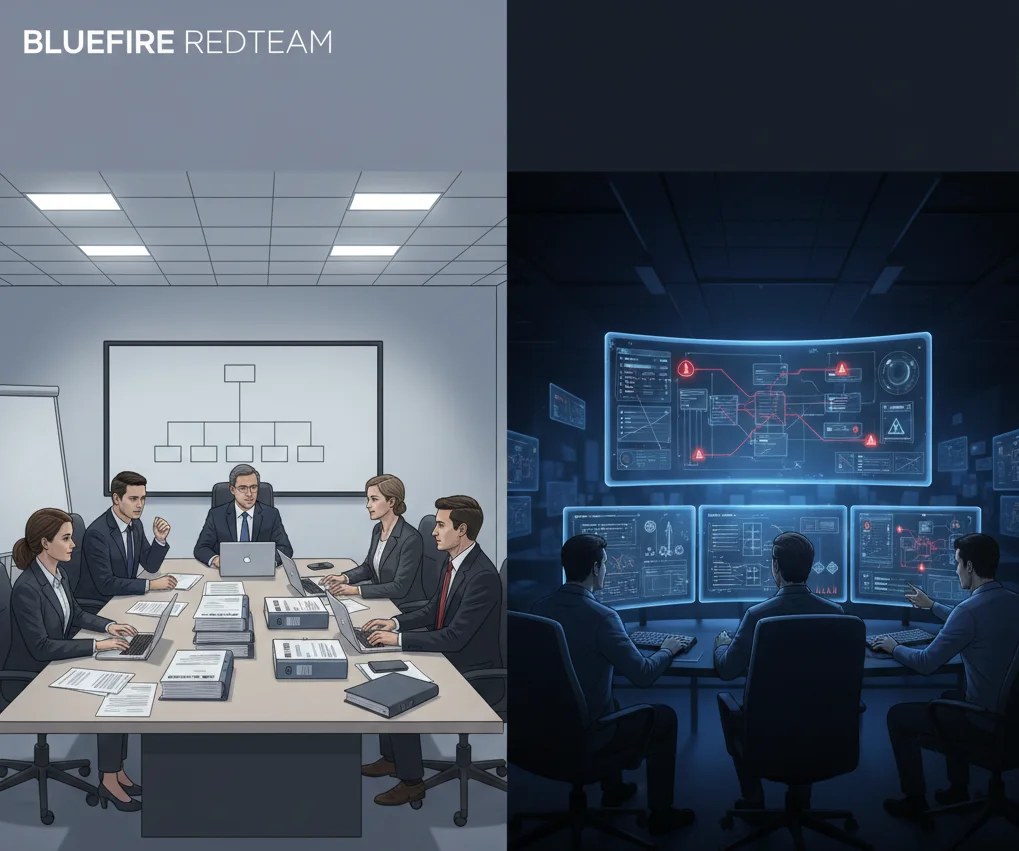
Tabletop exercises focus on discussion and planning. Ransomware simulations focus on execution and validation.
Tabletop exercises help teams understand policies and roles. Ransomware simulations test whether those policies and roles function under operational stress.
Both have value, but they answer different questions:
- Tabletop exercises ask: “Do we know what we should do?”
- Ransomware simulations ask: “Can we actually do it?”
For organizations where ransomware represents a material business risk, validation is essential.
Read More: Ransomware Simulation vs Tabletop Exercises: What Actually Prepares You for an Attack
Who Should Use Ransomware Simulations?

Ransomware simulations are most effective for organizations that:
- Have existing security tooling and IR plans
- Operate in regulated or high-risk industries
- Face executive or board-level scrutiny
- Rely on uptime, data integrity, or customer trust
They are commonly used by:
- CISOs and security leaders
- Incident response and SOC teams
- IT and infrastructure leadership
- Executives involved in crisis decision-making
Why Ransomware Simulations Matter for Readiness
Many ransomware incidents escalate not because organizations lack tools, but because:
- Alerts are missed or misinterpreted
- Response actions are delayed
- Roles are unclear under pressure
- Recovery assumptions prove incorrect
Ransomware simulations expose these issues early, when they can be fixed safely and deliberately.
As a result, simulations are increasingly used to:
- Validate incident response readiness
- Support cyber insurance discussions
- Prepare for regulatory or audit reviews
- Build executive confidence in security programs
How Bluefire Redteam Approaches Ransomware Simulation
Bluefire Redteam delivers ransomware simulations designed to reflect real attacker behavior, not theoretical scenarios.
Our approach emphasizes:
- Threat-informed attack emulation
- Safe, controlled execution
- Executive and technical insight
- Clear, actionable remediation guidance
The focus is not on demonstrating compromise, but on understanding how the organization responds when compromise occurs.
Moving From Planning to Validation
Ransomware preparedness cannot be proven through documentation alone. It must be tested under conditions that reflect reality.
A ransomware simulation provides that test, revealing how systems, teams, and leadership perform when it matters most.