
Phishing attacks remain one of the most relentless and damaging cyber threats worldwide. But effective defense, especially through phishing simulation programs– depends on understanding the true state of the threat landscape.
Below are verified, real statistics and trends that explain:
- How widespread phishing really is
- Why humans are the weakest link
- How attacks are evolving with AI
- What simulation and training data reveal
- What these numbers mean for your security strategy
Read More: What Is a Phishing Simulation? (And Why Training Alone Fails)
The Global Scale of Phishing Threats

Millions of phishing attacks continue unabated:
- In just the first quarter of 2025, the Anti-Phishing Working Group (APWG) recorded over 1 million distinct phishing attacks, the highest level since late 2023, and this trend continued through mid-year.
Daily phishing volume remains enormous:
- Roughly 3.4 billion phishing emails are sent every day, accounting for about 1.2% of all global email traffic, a staggering load that no organization can ignore.
- Google alone blocks around 100 million phishing emails per day on its platforms.
Phishing fuels nearly every major cyberattack:
- Phishing, or email-based social engineering, is estimated to be responsible for over 90% of successful cyberattacks.
- A large share of breaches, nearly 36% of all data breaches in the U.S. involve phishing as a key vector.
Phishing isn’t just an email thing anymore:
- Up to 40% of phishing campaigns now leverage multiple channels, including SMS (“smishing”), voice (“vishing”), and QR-code-based phishing (“quishing”).
Attack innovation is surging:
- Phishing-as-a-Service kits have doubled in availability, making advanced phishing tools accessible to low-skill criminals and increasing attack volume and sophistication.
Human Risk Is the Primary Failure Point
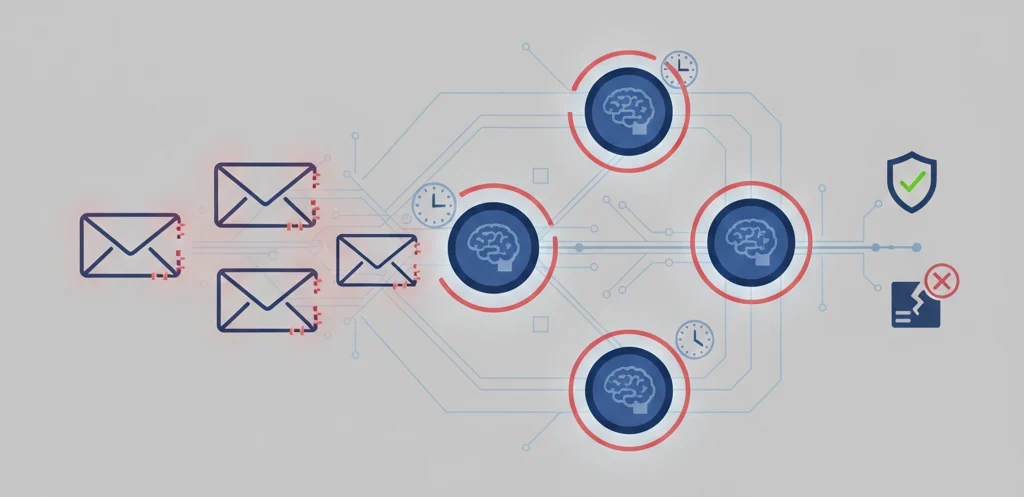
Phishing is effective because people react emotionally and quickly, not because of any single technical vulnerability.
Humans are the real vulnerability:
- The human element is involved in up to 74% of all security breaches.
- Less than 20% of users report phishing emails in simulations, and only about 11% of those who clicked went on to report them, according to industry studies.
Speed matters:
- It takes less than 60 seconds for a typical user to open and interact with a phishing email once it arrives.
Credential theft — a top consequence:
- Credential harvesting via phishing has surged, with Check Point reporting a 160% increase in credential theft in 2025, accounting for one in five breaches.
AI-boosted threats are harder to spot:
- Industry reports estimate that up to 83% of phishing emails now incorporate AI or AI-assisted content, making them more convincing and harder for employees to detect.
- In some studies, AI-generated phishing emails have more than four times the click rate of human-written ones (54% vs. 12%).
Even trained users struggle:
- A global survey found that only 46% of respondents could distinguish AI-generated phishing emails, and 44% admitted they’d interacted with a phishing message in the past year.
Read More: What Is a Phishing Simulation? (And Why Training Alone Fails)
Why Phishing Simulation Matters, Beyond Awareness Training
Traditional security awareness training teaches recognition, but phishing simulations measure real behaviour, and the data shows that matters.
Training alone is not enough:
- Controlled academic research found that standard phishing training had no significant impact on reducing click rates or increasing reporting rates in operational environments.
- Other studies show that continuous simulation and behaviour-based interventions halve susceptibility in six months when training is data-driven and ongoing.
Simulations reveal real risk zones:
Unlike training tests that often recycle similar templates, effective phishing simulations identify:
- High-risk job roles
- Vulnerable workflows
- Time-based risk patterns
- Behavioural response trends that matter in real attacks
This is why leading CISOs and risk managers embed simulations into their security programs, not just as a checkbox, but as a true control measure.
Read More: Best Phishing Simulation Vendors (Buyer’s Guide 2026)
Trends Driving Phishing Risk in 2026
Frequency and sophistication are both rising:
- After a slight dip in 2024, phishing volumes grew again in 2025, up 13% quarter over quarter, according to industry tracking.
Cross-platform reach:
- Phishing isn’t limited to email. Attackers exploit SMS, voice, and social platforms to widen their impact (up to 40% of campaigns).
Brand impersonation is still effective:
- Most phishing scams impersonate trusted brands or internal systems, making it harder for users to detect malicious content.
AI and automation shape attacks:
- AI-generated content skyrockets phishing realism and volume, empowering criminals to generate thousands of customized lures in minutes.
What These Statistics Mean for Your Security Strategy
Statistics show that phishing isn’t slowing, it’s evolving, and traditional awareness training alone is insufficient. To stay ahead:
Treat phishing as a continuous human risk problem
Employees aren’t static — they change roles, workflows change, and attackers innovate constantly.
Use ongoing, realistic simulations
Periodic, context-based phishing simulations track behaviour trends and quantify actual risk, not just training completion.
Measure behaviour, not clicks
Metrics that matter include:
- Reporting speed
- Repeat vulnerability patterns
- Role-specific exposure
- Realistic failure vectors
Align security, risk, and executive reporting
Use simulation data to:
- Drive metrics that leadership understands
- Support compliance evidence
- Inform risk decisions
In Summary: Phishing Isn’t a Tech Problem, It’s a Human Risk Problem
- Phishing is still the dominant initial attack vector, responsible for the majority of breaches and attack footholds.
- AI makes phishing more convincing and harder to detect.
- Human error remains the primary vulnerability, and training alone doesn’t close the gap.
- Realistic simulations uncover actionable risk indicators that training cannot.
Understanding these statistics is no longer optional, it’s essential for any modern cybersecurity or risk management program.
Sources & Credibility
This analysis draws on multiple trusted industry research sources, including:
- Anti-Phishing Working Group (APWG) data (Hunto AI)
- Industry threat and volume measurements (Sprinto)
- AI phishing trends (Secureframe)
- Academic studies on phishing training efficacy (arXiv)
- Independent global surveys (New York Post)