Phishing remains the #1 initial access vector in modern cyber incidents.
Yet most organizations still rely on template-based simulations that test recognition – not real-world risk.
That gap is why more security teams are turning to Phishing Simulation as a Service (PSaaS): a managed, attacker-led approach designed to measure actual human risk, not vanity metrics.
This guide breaks down:
- What phishing simulation as a service really is
- How pricing works (and what affects cost)
- What measurable results organizations see
- How to calculate real ROI beyond click rates
What Is Phishing Simulation as a Service?

Phishing Simulation as a Service is a fully managed security testing model where external experts design, execute, and analyze phishing campaigns on your behalf.
Unlike self-service platforms, PSaaS typically includes:
- Campaign design based on real attacker techniques
- Realistic social engineering and pretexting
- Execution without internal setup or maintenance
- Risk-based analysis and reporting
- Executive- and audit-ready outputs
In other words, you’re not buying software, you’re buying outcomes.
Read More: What Is a Phishing Simulation? (And Why Training Alone Fails)
How Phishing Simulation as a Service Works
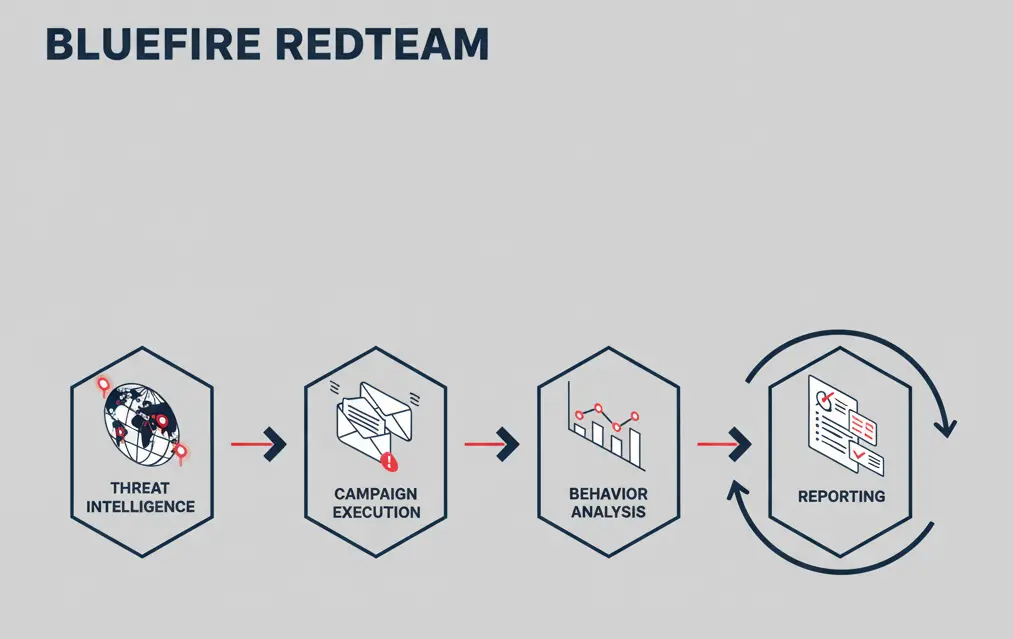
Most managed phishing simulation engagements follow a structured lifecycle:
1. Threat & Environment Analysis
The provider evaluates:
- Industry-specific attack trends
- Organizational risk profile
- Employee roles and workflows
- Existing controls and reporting processes
2. Campaign Design
Simulations are built using:
- Real-world phishing tactics (BEC, credential theft, impersonation)
- Context-aware pretexts
- Role-based targeting
- Timing aligned with realistic attacker behaviour
3. Execution
Campaigns are launched quietly and safely, without tipping off employees or disrupting operations.
4. Risk Analysis & Reporting
Instead of just “who clicked,” results focus on:
- Behavioral patterns
- High-risk roles or workflows
- Reporting effectiveness
- Potential downstream impact
5. Continuous Improvement
Findings are used to:
- Refine future simulations
- Improve security awareness where it matters
- Support compliance and risk reporting
Phishing Simulation as a Service Pricing: What to Expect
Pricing for phishing simulation as a service varies widely based on scope and realism.
Typical Pricing Ranges
| Organization Size | Annual PSaaS Cost (Estimated) |
|---|---|
| Small–Mid Size | $2,000 – $8,000 |
| Mid-Market | $5,000 – $20,000 |
| Enterprise | $10,000 – $50,000+ |
These ranges reflect managed, realistic simulations, not basic software licenses.
Read More: Best Phishing Simulation Vendors (Buyer’s Guide 2026)
What Impacts Phishing Simulation Pricing?
Key cost drivers include:
- Number of employees tested
- Campaign frequency (quarterly vs continuous)
- Level of realism (templates vs bespoke pretexts)
- Targeting depth (generic vs role-based)
- Reporting requirements (basic vs executive/audit-ready)
- Red team involvement
Lower-cost tools reduce price by reducing realism.
Higher-cost services increase value by reducing actual risk.
Phishing Simulation as a Service vs Software Tools
| Factor | Software Platform | Phishing Simulation as a Service |
|---|---|---|
| Setup & Management | Internal | Fully managed |
| Campaign Realism | Template-based | Adversary-led |
| Metrics | Click-focused | Risk-focused |
| Predictability | High | Low (by design) |
| Audit Readiness | Limited | Strong |
| Operational Burden | High | Low |
Organizations choosing PSaaS typically do so because internal teams can’t realistically simulate attackers without bias or predictability.
Real Results Organizations See from PSaaS
High-quality phishing simulation services produce outcomes that go far beyond training metrics.
Common Measurable Results
- Improved phishing reporting speed
- Reduced the success of sophisticated social engineering
- Identification of high-risk roles and workflows
- Stronger alignment between security and leadership
- More defensible audit and compliance narratives
Most importantly, organizations gain clarity about where human risk actually exists.
How to Calculate ROI for Phishing Simulation as a Service
ROI is often misunderstood because phishing risk is probabilistic—not transactional.
Direct ROI Considerations
- Reduced likelihood of credential compromise
- Lower probability of BEC or fraud incidents
- Faster detection and reporting
- Reduced incident response costs
Indirect (But Critical) ROI
- Avoided regulatory findings
- Stronger board and executive confidence
- Reduced insurance exposure
- Better prioritization of security investments
A single prevented phishing-driven incident can justify multiple years of PSaaS spend.
Why Red Team–Led Phishing Simulations Deliver Higher ROI
Template-based simulations answer the question:
“Do employees recognize phishing emails?”
Red team–led simulations answer:
“How would attackers actually succeed here?”
This difference matters.
Providers like Bluefire Redteam design phishing simulations using:
- Real attacker tradecraft
- OSINT-driven targeting
- Role-aware pretexting
- Full kill-chain risk analysis
The result is decision-quality insight, not checkbox metrics.
When Phishing Simulation as a Service Is the Right Choice
PSaaS is especially valuable if your organization:
- Has already done basic awareness training
- Operates in a regulated or high-risk environment
- Needs audit- and board-ready reporting
- Has limited internal security resources
- Wants realism without operational overhead
If phishing represents a material business risk, managed simulation is often the most efficient control.
Common Mistakes to Avoid When Choosing a Provider
- Choosing based on price alone
- Overvaluing click-rate reduction
- Ignoring attacker realism
- Running simulations too predictably
- Treating phishing as a training problem only
The goal is risk reduction, not perfect scores.
Final Takeaway: Is Phishing Simulation as a Service Worth It?
For organizations serious about reducing human cyber risk, phishing simulation as a service offers:
- Better realism
- Better insight
- Better executive communication
- Better long-term outcomes
Software can scale.
Expertise reduces risk.