
Introduction: Why Active Directory Is Still the #1 Target for Attackers
Over 90% of businesses still use Active Directory (AD) as the foundation for authorization and authentication, despite the expansion of cloud identity platforms. Attackers are aware of this.
Whether it’s ransomware groups, insider threats, red teams, or nation-state actors, nearly every modern breach includes at least one of the following:
- Kerberoasting
- NTLM relay attacks
- Lateral movement through shared drives
- Misconfigured GPO exploitation
- Privilege escalation via stale objects
- Credential harvesting in memory
- Pass-the-Hash / Pass-the-Ticket
- Golden Ticket attacks
If an attacker owns AD, they own your entire organization.
Active Directory Penetration Testing exists to simulate real adversaries inside your identity infrastructure — revealing the exact paths attackers could use to move laterally, escalate privileges, and compromise your domain.
This guide will cover everything a CISO, Security Engineer, or IT Director needs to know.
What Is Active Directory Penetration Testing?
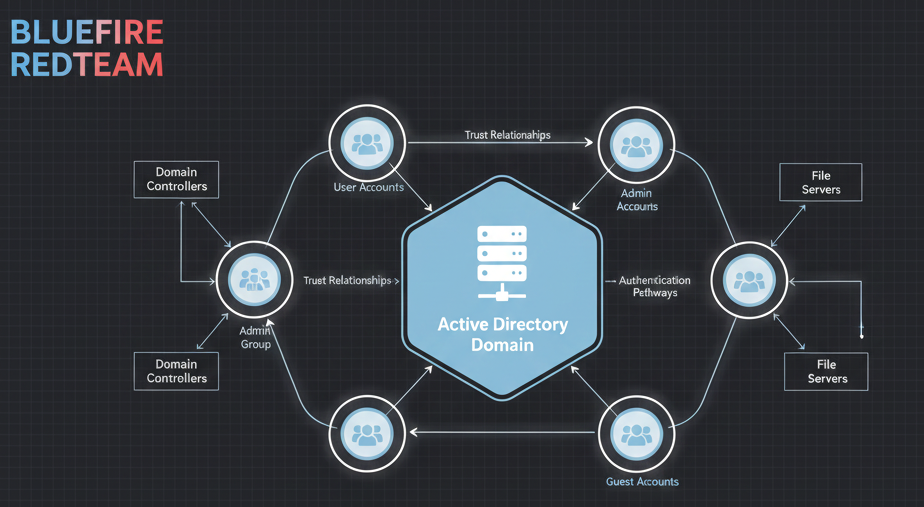
Active Directory Penetration Testing is a human-led offensive security engagement that identifies weaknesses, misconfigurations, and privilege escalation paths in your AD domain.
Unlike compliance audits or vulnerability scans, AD penetration testing involves:
- Real exploitation
- Real attacker techniques
- Real privilege abuse
- Real lateral movement
- Real proof of compromise
It answers one question:
“Can an attacker go from a low-privilege user to Domain Admin — and how fast?”
Active Directory Pen Testing vs. AD Audits
| AD Audit | AD Penetration Test |
|---|---|
| Checklist-driven | Attack-driven |
| Uses automated scanning | Uses human adversary simulation |
| Surface-level misconfigurations | Full exploitation & escalation mapping |
| Good for compliance | Essential for true AD security |
| Focuses on hygiene | Focuses on attacker success paths |
If you want to understand actual business risk, you need offensive testing — not a hygiene report.
Common Active Directory Attack Paths Your Pen Test Will Uncover
AD is a massive system — but attackers only need one weak link.
Below are the high-impact weaknesses Bluefire Redteam typically identifies:
Credential & Authentication Vulnerabilities
- Password reuse across service accounts
- Weak or guessable passwords
- Plaintext credentials stored in SYSVOL
- Cached credentials in memory (LSASS)
- NTLM downgrades
Privilege Escalation Issues
- Excessive privileges assigned to standard users
- Unconstrained delegation on sensitive accounts
- Writable group memberships
- Compromised Tier 0 assets
- Stale objects with high privileges
Lateral Movement Opportunities
- SMB share crawling
- Remote execution via WinRM or PsExec
- Misconfigured firewall and segmentation
- Local admin privilege reuse
Domain Persistence Techniques
- Skeleton Key malware simulation
- Golden Ticket / Silver Ticket
- DCSync privileges
- Malicious GPO creation
A proper AD Pen Test exposes exactly how far an attacker can go — and how fast.
The Real Reason AD Is Vulnerable: Complexity & Neglect
Active Directory environments “age” like infrastructure — not software.
Over years, they accumulate:
- Stale user accounts
- Forgotten admin accounts
- Misconfigured GPOs
- Outdated trust relationships
- Over-permissive delegation settings
- Legacy authentication protocols (NTLMv1)
- Unpatched domain controllers
This complexity becomes attack surface.
An AD Pen Test is the only way to measure it.

Bluefire Redteam’s Active Directory Pen Testing Methodology
Our AD Pen Testing methodology mirrors how real attackers compromise enterprises.
Here’s the exact process we use:
1. Initial Enumeration & Reconnaissance
We map:
- Domain trusts
- Groups & memberships
- Privileged accounts
- Organizational Units (OUs)
- Active Directory site topology
- Authentication protocols in use
- Accessible file shares
- Password policy weaknesses
This gives us a full identity-centric attack surface.
2. Credential Harvesting & Authentication Abuse
We test:
- Kerberoasting
- AS-REP roasting
- Password spraying
- Brute force protection bypasses
- NTLM relay attacks
- Credential dumping simulations (non-destructive)
If credentials can be harvested — attackers will harvest them.
3. Privilege Escalation Path Enumeration
Using manual testing and specialized tools, we identify:
- Misconfigured ACLs
- Abusable privileges
- Delegation vulnerabilities
- Local admin reuse
- Write privileges on high-value objects
- Dangerous GPO rights
Common privilege escalation findings include:
- Unconstrained delegation
- WriteDACL permissions
- Shadow admins
- Privileged service accounts
- Dangerous trust relationships
This is where AD environments crumble.
4. Lateral Movement Simulation
We test real attacker movement strategies:
- Pass-the-Hash
- Pass-the-Ticket
- Overpass-the-Hash
- SMB / RDP pivoting
- WinRM takeover
- Service account impersonation
This shows how an attacker spreads silently.
5. Forced Authentication & Relay Attacks
We validate:
- PrinterBug
- Spooler service abuse
- WebDAV exploitation
- Fake SMB server relay chains
These attacks are still devastatingly effective in most organizations.
6. Domain Compromise Simulation
We test for:
- DCSync attack viability
- Golden Ticket creation
- Privileged group manipulation
- DCShadow simulation
- Persistence opportunities
This determines whether an attacker can gain full domain dominance.
7. Reporting, Remediation & Retesting
Our reports include:
Executive Summary
- Business impact
- Exploited paths
- Mapping of attacker success
- Risk scoring
Technical Report
- Step-by-step exploitation details
- Tools used
- Screenshots & evidence
- Fix priorities
Retesting
Included at no extra cost.
Active Directory Pen Testing Pricing
Pricing depends heavily on:
- Domain size
- Number of users & service accounts
- Number of Domain Controllers
- Domain complexity
- Number of forests / trusts
- Maturity of AD security controls
What You Get From an AD Penetration Test
Bluefire Redteam delivers:
- Complete AD attack surface map
- Identified privilege escalation paths
- Credential & authentication weaknesses
- Lateral movement routes
- Domain compromise viability
- Detailed remediation playbook
- Executive risk summary
- Free retesting to validate fixes
This is far more than a compliance scan — it’s a blueprint of how attackers can break your Active Directory.
Who Needs AD Pen Testing?
AD Pen Testing is essential for:
- Enterprises with hybrid identity
- Organizations targeted by ransomware
- Financial institutions
- Healthcare providers
- Government & critical infrastructure
- Any company undergoing digital transformation
- Any organization that has not audited AD in 12+ months
If you have AD — attackers are already trying to compromise it.
Why Companies Choose Bluefire Redteam for AD Pen Testing

Bluefire is trusted because we provide:
1. Offensive Security Only — No Compliance Guesswork
We simulate real attackers, not auditors.
2. Deep Active Directory Exploitation Expertise
Our operators specialize in AD privilege escalation and persistence TTPs.
3. Real Exploitation, Not Just Scanning
We create real-world attack chains.
4. Insider-threat & ransomware simulation
We test how fast an attacker can become Domain Admin.
5. Executive-ready reports
Clear, visual, and business-impact oriented.
6. Free Retesting Included
Because security is only real when verified.
Strengthen Your Active Directory Security Today
Active Directory compromise is one of the highest-impact events a company can face.
Bluefire Redteam identifies and exploits the exact weaknesses attackers would leverage — before they can.
👉 Book an Active Directory Penetration Test
Bluefire Redteam
We think like attackers — so you can defend with confidence.